Telescope
For other uses, see Telescope (disambiguation).
A telescope is a device used to observe distant objects by their emission, absorption, or reflection of electromagnetic radiation. Originally, it was an optical instrument that used lenses, curved mirrors, or a combination of both to observe distant objects, which made it an optical telescope. Today, the word "telescope" describes a wide range of instruments that can detect different regions of the electromagnetic spectrum, and in some cases other types of detectors.
The first known practical telescopes were refracting telescopes with glass lenses. They were invented in the Netherlands at the beginning of the 17th century, and people used them for both land-based purposes and astronomy.
The reflecting telescope, which uses mirrors to collect and focus light, was invented within a few decades of the first refracting telescope.
In the 20th century, many new types of telescopes were invented. These included radio telescopes in the 1930s and infrared telescopes in the 1960s.
Etymology
The word telescope was coined in 1611 by the Greek mathematician Giovanni Demisiani. He used it for one of Galileo Galilei's instruments, which was presented at a banquet at the Accademia dei Lincei. In the Starry Messenger, Galileo had used the Latin word perspicillum.
The word comes from two Ancient Greek words: τῆλε, tele, meaning 'far', and σκοπεῖν, skopein, meaning 'to look or see'. Together they form τηλεσκόπος, teleskopos, meaning 'far-seeing'.
History
Main article: History of the telescope
The earliest known record of a telescope is a 1608 patent submitted to the government in the Netherlands by spectacle maker Hans Lipperhey for a refracting telescope. No one knows for sure who invented it, but news of it spread across Europe. Galileo heard about it and, in 1609, built his own version and used it to study objects in the sky. Soon after, people began exploring whether the objective, the part that gathers light, could be a mirror instead of a lens. Parabolic mirrors could reduce spherical aberration and avoid chromatic aberration, so many designs were proposed and several reflecting telescopes were tried. In 1668, Isaac Newton built the first practical reflecting telescope, a design now called the Newtonian reflector. John Dobson invented the Dobsonian telescope in 1956.
The achromatic lens, invented in 1733, partly fixed the colour problems of simple lenses and allowed shorter, more useful refracting telescopes. Reflecting telescopes did not have those colour problems, but early mirrors made of speculum metal tarnished quickly. Silver-coated glass mirrors in 1857 and aluminized mirrors in 1932 helped solve this. Refracting telescopes can only be about 1 meter (39 inches) across, so most large research telescopes built since the start of the 20th century have been reflectors. The largest reflecting telescopes now have objectives larger than 10 meters (33 feet), and work is underway on several designs of 30–40 m. During the 20th century, telescopes were also developed to work with a wide range of wavelengths, from radio to gamma-rays. The first purpose-built radio telescope began operating in 1937, and many complex instruments have been developed since then.
Main article: Space telescope
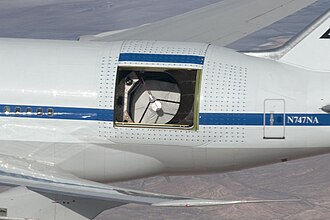
Earth's atmosphere blocks most kinds of light, so only a few bands can be seen from the ground. These are visible light, near-infrared, and part of the radio waves. That is why X-ray and far-infrared telescopes must be placed in orbit. Even when a wavelength can be seen from the ground, a telescope in space may still be better because of problems such as clouds, astronomical seeing, and light pollution. Space telescopes have some disadvantages, including cost, size, maintenance, and upgrades.
Some well-known space telescopes from NASA include the Hubble Space Telescope, which detects visible light, ultraviolet, and near-infrared, and the Spitzer Space Telescope, which detects infrared. The Kepler Space Telescope discovered thousands of exoplanets. The most recent telescope launched is the James Webb Space Telescope, which was launched on 25 December 2021 from Kourou, French Guiana, on an Ariane 5 rocket. Webb detects infrared light and orbits the L2 Lagrange Point of the Earth-Sun system.
By electromagnetic spectrum
Telescopes detect different kinds of electromagnetic radiation, and astronomers collect each kind in a different way. Longer wavelengths are easier to handle with antenna technology. Near-infrared light can be collected much like visible light, while far-infrared and submillimetre telescopes work more like radio telescopes. The James Clerk Maxwell Telescope uses a parabolic aluminum antenna, while the Spitzer Space Telescope uses a mirror. The Hubble Space Telescope and its Wide Field Camera 3 observe from ultraviolet to infrared light. Shorter wavelengths need special mirrors, as with TRACE and SOHO, which reflect extreme ultraviolet. A larger aperture collects more light and allows a finer view. Telescopes can be grouped by location, as space telescope or flying telescope, and by whether professional astronomers or amateur astronomers use them. A place with one or more telescopes is called an observatory.
Radio telescopes are directional radio antennas, often with a large dish that collects radio waves. Multiple dishes can work together as astronomical interferometers to make detailed images. Radio telescopes also collect microwave radiation, which can pass through the atmosphere and gas and dust clouds. Ultraviolet light is mostly absorbed by the Earth's atmosphere, so it must be observed from high up or from space. X-rays are much harder to focus, so X-ray telescopes use special mirrors. Very high energy gamma rays are detected with Imaging Atmospheric Cherenkov Telescopes, and the Fermi Gamma-ray Space Telescope was launched in June 2008.
Main articles: Radio telescope, Radio astronomy, and Submillimetre astronomy
Main articles: Infrared telescope and Infrared astronomy
Main articles: Optical telescope and Visible-light astronomy
Main article: Ultraviolet astronomy
Main articles: X-ray telescope and X-ray astronomy
Main article: Gamma-ray astronomy
Lists of telescopes
- List of optical telescopes
- List of largest optical reflecting telescopes
- List of largest optical refracting telescopes
- List of largest optical telescopes historically
- List of radio telescopes
- List of solar telescopes
- List of space observatories
- List of telescope parts and construction
- List of telescope types

Quiz time!
5 questions about Telescope
What does the word "telescope" mean, based on its Ancient Greek roots?
Pictures
Keep exploring



This article is a child-friendly adaptation of the Wikipedia article on Telescope, available under CC BY-SA 4.0.
Images from Wikimedia Commons. Tap any image to view credits and license.