 Safekipedia
New Amsterdam
Adapted from Wikipedia · Discoverer experience
New Amsterdam was a 17th-century Dutch settlement at the southern tip of Manhattan Island. It started as a small trading place near Fort Amsterdam and grew into an important city. The Dutch West India Company set up the settlement to protect their fur trade along the Hudson River.
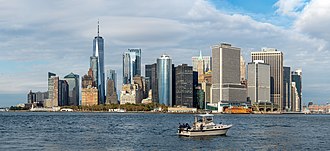
By 1653, New Amsterdam became an official city. Over time, more people moved there, and by 1664, thousands of people lived in and around the area. That year, English forces took control and renamed the city New York after the Duke of York. Today, the place where New Amsterdam once stood is known as Lower Manhattan.
Etymology
The original name used by the local Munsee people for the southern tip of the island was Manhattoe. When the Dutch built Fort Amsterdam, the growing settlement was called many things, including "Amsterdam" and "New Amsterdam." Back then, New Amsterdam's borders stopped at what is now the wall of Wall Street, and did not include the rest of the island of Manhattan or the larger area known as New Netherland.
History
See also: Dutch colonization of the Americas and History of New York City
In 1524, nearly a century before the arrival of the Dutch, the site that would later become New Amsterdam was named Nouvelle Angoulême by the Italian explorer Giovanni da Verrazzano, to honor his patron King Francis I of France, whose family included the Counts of Angoulême. The Dutch first explored the area around what is now New York Bay in 1609 with the ship Halve Maen, commanded by Henry Hudson. Hudson was working for the Dutch Republic and was also secretly trying to find a route to Asia.
Beaver pelts were very valuable in Europe at the time because they could be used to make waterproof hats. The Dutch established trading posts and mapped the region. In 1624, the Dutch West India Company sent settlers to form a permanent settlement. They built Fort Amsterdam on Manhattan Island to protect their trade and settlement.
The settlement grew into a small city with diverse settlers, including people from different countries and backgrounds. It became an important trading center and was later captured by the English in 1664, becoming New York City. The Dutch briefly recaptured it in 1673 but returned it to England in 1674.
Cartography
The early days of New Amsterdam were well recorded through detailed maps. During this time, the Dutch were excellent mapmakers. The Dutch West India Company, which oversaw New Netherland, needed to keep track of the colony's growth, trade, and population. This led to the creation of many accurate maps and plans.
One important map is called the Castello Plan, made in 1660. It shows nearly every building in New Amsterdam and, when compared with a list of citizens from the same year, helps us know who lived where. Another map, the Duke's Plan, also comes from around 1660 and shows areas beyond the main town. These maps have been very helpful for learning about New York City's history, such as finding the exact spot where the Stadthuys (City Hall) once stood.
Layout
These maps allow us to reconstruct the town's layout exactly. Fort Amsterdam was at the very southern tip of Manhattan Island, near today's The Battery. Broadway was the main road leading north. The town had a wall along its northern edge, which today is where Wall Street is located. A canal that ran from the harbor inland was filled in 1676 and is now Broad Street. The streets in the town were winding, like those in European cities. The area's street layout, especially in the Financial District, still reflects this old design.
Legacy
The founding of New Amsterdam in 1625 is remembered today on the official Seal of New York City. Over time, historians have found that New Amsterdam shaped many parts of modern New York and the United States.
Although most of the original buildings from New Amsterdam are gone, some ideas and plans from that time are still seen in the city today. The street layout in parts of Manhattan still follows the old design from when it was New Amsterdam. Some houses and farms, like the Wyckoff Farm in Brooklyn, still show parts from the Dutch period. Today, some buildings in New York are built in a style called Dutch Colonial Revival, reminding people of New Amsterdam’s history.
Images
Related articles



This article is a child-friendly adaptation of the Wikipedia article on New Amsterdam, available under CC BY-SA 4.0.
Images from Wikimedia Commons. Tap any image to view credits and license.