 Safekipedia
Manhattan
Adapted from Wikipedia · Discoverer experience
Manhattan is the most crowded and smallest part of New York City, one of its five boroughs. It is also New York County, the smallest county in the United States by area. Located on Manhattan Island, it is close to the southern tip of New York State and is a key part of the Northeast megalopolis, serving as the heart of the New York metropolitan area.
Before Europeans arrived, the area was home to the Lenape people. Dutch settlers built a trading post there in 1624, naming it New Amsterdam. It became part of England in 1664 and was renamed New York. In the late 1800s, the Statue of Liberty in New York Harbor welcomed many immigrants to the United States. Today, Manhattan is known for its important roles in business, culture, and government. It is home to major financial centers like Wall Street and the New York Stock Exchange, as well as famous places such as Times Square, Central Park, and the headquarters of the United Nations.
The area includes many neighborhoods like Lower Manhattan, Midtown, and Upper Manhattan. It has some of the world's most visited tourist spots, important universities, and famous buildings such as the Empire State Building. Harlem became a center for African American culture in the 1920s, and Greenwich Village played a key role in the history of LGBTQ rights. With its many bridges, tunnels, and skyscrapers, Manhattan remains a busy and influential part of the world.
History
Main article: History of Manhattan
See also: History of New York City
Lenape settlement
Main article: Lenape settlements
Manhattan was once part of the land of the Munsee, Lenape, and Wappinger tribes. They had many small villages in the area, linked by paths. One main path, which later became Broadway, stretched from the north in Inwood to Battery Park in the south. The Lenape used these lands for fishing and growing plants.
Toponymy
Further information: Etymology of Manhattan
The name "Manhattan" likely comes from the Lenape language. It may mean "the place where we get bows" because of trees good for making bows. Another idea is that it means "island."
Colonial era
Main articles: New Netherland, New Amsterdam, and Province of New York
In 1524, an explorer named Giovanni da Verrazzano was the first European to visit the area. He worked for France and named parts of the land after a French king. In 1609, Henry Hudson explored the river that now bears his name. The Dutch built a trading post and a fort called New Amsterdam in 1624. In 1664, the English took over and renamed the place New York.
American Revolution
Further information: American Revolution
During the American Revolutionary War, Manhattan was an important place. The British held the city for most of the war after battles nearby. After the war, New York City was the temporary capital of the United States for a short time.
19th century
New York grew into a busy port and business center. The Erie Canal, finished in 1825, helped connect the city to faraway places. Central Park, one of the first big city parks, opened in 1858. In 1898, Manhattan joined with other areas to become part of New York City.
20th century
Further information: Triangle Shirtwaist Factory fire and Stonewall riots
In the early 1900s, many people moved to Manhattan from other places. Tall buildings like the Empire State Building were built in the 1920s and 1930s. During World War II, a secret science project called the Manhattan Project took place there. In 1969, important events for rights happened in Greenwich Village. By the 1990s, the area began to improve with less crime and more people moving in.
21st century
See also: September 11 attacks
On September 11, 2001, two tall buildings called the Twin Towers were damaged by planes, causing many deaths. The area has been rebuilt since then. In 2012, a big storm named Hurricane Sandy caused flooding and damage in Lower Manhattan. People are now thinking about ways to protect the area from future storms.
Geography
See also: Geography of New York City
New York County, which is the same as the borough of Manhattan, is very small. It covers 33.6 square miles, with 22.8 square miles of land and 10.8 square miles of water. Most of Manhattan is on an island that is 13.4 miles long and, at its widest point, 2.3 miles wide.
The island of Manhattan is split into three main parts: Downtown (Lower Manhattan), Midtown, and Uptown (Upper Manhattan). The Hudson River is on the west side and the East River is on the east side.
Manhattan Island
The island of Manhattan is about 13.4 miles from north to south, and at its widest, 2.3 miles. It is split into three parts: Downtown (Lower Manhattan), Midtown, and Uptown (Upper Manhattan). Fifth Avenue runs down the middle, separating the East Side from the West Side.
Early in the 1800s, people added land to expand Lower Manhattan. When building the World Trade Center in 1968, dirt from the construction was used to add more land along the shoreline. In May 2021, a new park called Little Island opened along the Hudson River.
Marble Hill
Main article: Marble Hill, Manhattan
Marble Hill used to be part of Manhattan Island, but a canal dug in 1895 separated it. Later, the canal was filled in, and Marble Hill became part of the mainland. In 1984, it was decided that Marble Hill is part of both the borough of Manhattan and Bronx County.
Smaller islands
See also: List of smaller islands in New York City
In New York Harbor, there are three smaller islands:
- Ellis Island, shared with New Jersey
- Governors Island
- Liberty Island (managed by the National Park Service)
Other smaller islands in the East River include:
Geology
Main article: Geology of Manhattan
The bedrock under Manhattan is made of three types of rock: Inwood marble, Fordham gneiss, and Manhattan schist. This strong rock helps support the city's tall buildings.
Climate
See also: Climate of New York City
New York City has both humid subtropical and humid continental climates. It is the northernmost major city in North America with a humid subtropical climate. The city gets about 234 days of sunshine each year.
Winters are cold and damp, with average January temperatures around 33°F (1°C). Summers are warm and humid, with average July temperatures around 77°F (25°C). The city gets about 50 inches of rain each year and about 26 inches of snow.
Neighborhoods
Main articles: Neighborhoods in New York City and List of Manhattan neighborhoods
Manhattan has many neighborhoods with different names and histories. Some names describe their location, like the Upper East Side. Others are short for longer names, like SoHo (South of Houston) or TriBeCa (Triangle Below Canal Street). Some neighborhoods are known for special things, like Chinatown for its Chinese community or Chelsea for its art galleries.
Manhattan has two main business areas: the Financial District in the south and Midtown Manhattan in the middle. The island is split into uptown (north) and downtown (south), with Midtown in between.
Boroughscape
Ten-mile Manhattan skyline panorama from 120th Street to the Battery, taken February 21, 2018, from across the Hudson River in Weehawken, New Jersey.
- Riverside Church
- Time Warner Center
- 220 Central Park South
- Central Park Tower
- One57
- 432 Park Avenue
- 53W53
- Chrysler Building
- Bank of America Tower
- Conde Nast Building
- The New York Times Building
- Empire State Building
- Manhattan West
- a: 55 Hudson Yards, b: 35 Hudson Yards, c: 10 Hudson Yards, d: 15 Hudson Yards
- 56 Leonard Street
- 8 Spruce Street
- Woolworth Building
- 70 Pine Street
- 30 Park Place
- 40 Wall Street
- Three World Trade Center
- Four World Trade Center
- One World Trade Center
Demographics
Main article: Demographics of Manhattan
According to the 2020 census, Manhattan's population grew by 6.8% over the past ten years to 1,694,251 people. This makes up 19.2% of New York City's total population and 8.4% of New York State's population. In 2022, Manhattan had the highest population density of any county in the United States, with 70,450.8 people living in each square mile.
Religion
In 2010, the largest religious groups in Manhattan included Catholics with 323,325 members, followed by Orthodox Jews with 64,000 members, Muslims with about 42,545 members, and many others. Altogether, about 44.0% of the population belonged to religious groups. Manhattan had 703 religious organizations in 2014, ranking seventeenth among all U.S. counties. There is a large Buddhist temple near the Manhattan Bridge in Chinatown.
Languages
As of 2015, 60.0% of people aged five and older in Manhattan spoke only English at home. Spanish was spoken by 22.63%, Chinese by 5.37%, French by 2.21%, and smaller percentages spoke Korean, Russian, and Japanese. Overall, 40.0% of Manhattan's population spoke a language other than English at home.
| Racial composition | 2020 | 2010 | 2000 | 1990 | 1950 | 1900 |
|---|---|---|---|---|---|---|
| White | 50.0% | 57.4% | 54.3% | 58.3% | 79.4% | 97.8% |
| —Non-Hispanic | 46.8% | 48% | 45.7% | 48.9% | n/a | n/a |
| Black or African American | 13.5% | 15.6% | 17.3% | 22.0% | 19.6% | 2.0% |
| Hispanic or Latino (of any race) | 23.8% | 25.4% | 27.1% | 26.0% | n/a | n/a |
| Asian | 13.1% | 11.3% | 9.4% | 7.4% | 0.8% | 0.3% |
Landmarks and architecture
Main article: Architecture of New York City
See also: List of skyscrapers in New York City
Manhattan has many famous places and buildings. You can visit the American Museum of Natural History, Broadway with its theaters, Central Park, Times Square, and the tall Empire State Building. There are also beautiful parks like Bryant Park and important buildings such as Grand Central Terminal and Columbia University.
Manhattan is known for its tall buildings, which make its skyline special. Some of these buildings are very important to New York City, like the Chrysler Building. There are also many parks and green spaces where people can walk, play, and relax.
National protected areas
- African Burial Ground National Monument
- Castle Clinton National Monument
- Federal Hall National Memorial
- General Grant National Memorial
- Governors Island National Monument
- Hamilton Grange National Memorial
- Lower East Side Tenement National Historic Site
- Statue of Liberty National Monument (part)
- Theodore Roosevelt Birthplace National Historic Site
Parkland
Central Park is the largest park in Manhattan. It has walking paths, playgrounds, and even places to ice-skate. Other parks in Manhattan include Hudson River Park, Washington Square Park, and Bryant Park. These parks give people places to enjoy the outdoors and play.
Economy
Main article: Economy of New York City
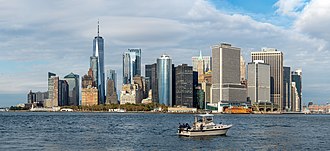
The Financial District of Lower Manhattan, seen from Brooklyn
Manhattan is a big part of New York City's economy. With 2.45 million workers, it helps create about half of all jobs in the city. In 2024, Manhattan had the highest total and per-person earnings of any area in the United States. Most people in Manhattan work in offices rather than factories.
Financial sector
Main article: Wall Street
Manhattan is very important for money and banking. It is home to the New York Stock Exchange and the Nasdaq, two of the biggest places where people buy and sell pieces of companies called stocks.
Corporate sector
New York City has more big company offices than any other city in the United States, with most of them in Manhattan. There is a lot of office space here, making it a major place for businesses.
Tech and biotech
Further information: Tech companies in Manhattan, Biotech companies in Manhattan, Silicon Alley, and Tech:NYC
Manhattan helps make New York City a top place for technology. Many tech jobs are here, working with computers, the internet, and new ideas. There are also companies that work with medicines and science.
Tourism
Main article: Tourism in New York City
Tourism is very important to Manhattan's economy. Many people visit places like famous buildings and shows. In 2019, over 66 million visitors came to the city, but fewer came in 2020 because of health concerns. By 2023, the number of visitors was getting better again.
Real estate
Real estate is very valuable in Manhattan. Some buildings and homes here are worth a lot of money. For example, one home sold for a record high price in 2019.
Media
Main articles: Media in New York City and New Yorkers in journalism
See also: List of films set in New York City and List of television shows set in New York City
Manhattan is a big place for news and entertainment. Many important newspapers, television stations, and radio stations are based here. These include well-known names like The New York Times and networks such as ABC, CBS, and NBC. There are also many other media outlets that share news and stories with people around the world.
Education
See also: Education in New York City, List of high schools in New York City, and List of colleges and universities in New York City
Manhattan has many schools, both public and private. Public schools are run by the New York City Department of Education, the largest school system in the United States. There are also special charter schools, such as Success Academy Harlem 1 through 5, Success Academy Upper West, and Public Prep.
The area is home to famous public high schools like Stuyvesant High School and Fiorello H. LaGuardia High School. There are also many private schools, including Brearley School and Dalton School.
Many college students live in Manhattan. Well-known colleges include Columbia University, New York University (NYU), and The New School. The City University of New York (CUNY) has several colleges in Manhattan, such as Baruch College and Hunter College.
Manhattan is an important place for medical research, with many top hospitals and universities studying health and science.
The New York Public Library is one of the biggest libraries in the country, with many branches found in Manhattan.
Culture
See also: Culture of New York City
Further information: Broadway theatre, LGBTQ culture in New York City, Transgender culture of New York City, List of museums and cultural institutions in New York City, Music of New York City, List of nightclubs in New York City, Met Gala, New York Fashion Week, NYC Pride March, and Stonewall Riots
Manhattan is the part of New York City that most people think of when they hear the city's name. Residents in the rest of New York City often call a trip to Manhattan "going to the City."
Manhattan has been very important for culture around the world. In the 1920s, it helped start African-American writing with writers like Langston Hughes. In the 1950s and 1960s, it was a center for pop art with artists like Jasper Johns and Roy Lichtenstein. Broadway theater, with its big plays and musicals, is very famous and happens mostly around Times Square.
The city has many famous museums, such as the Metropolitan Museum of Art and the Museum of Modern Art. It also has many music groups and places to see art. Manhattan is also known for celebrating different cultures and ways of life, especially with its big pride events every June.
The city has many famous parades, like the Macy's Thanksgiving Day Parade and the St. Patrick's Day Parade. These parades celebrate holidays, cultures, and big achievements.
Sports
Manhattan is home to two major sports teams: the New York Knicks in basketball and the New York Rangers in hockey. Both teams play their home games at Madison Square Garden, the main sports arena in the area.
In the past, Manhattan had many other teams. The original New York Giants and New York Yankees played baseball at the Polo Grounds. The New York Mets also started there before moving to Shea Stadium. Today, New York City's football teams, the New York Giants and New York Jets, play in East Rutherford, New Jersey at MetLife Stadium.
The New York Cosmos, a soccer team, once played at Downing Stadium before moving to other venues. The first national college basketball championship, the National Invitation Tournament, has been held in New York since 1938. Rucker Park in Harlem is famous for its streetball games, where many future NBA players have practiced in the summer.
Government
Main article: Government of New York City
Since New York City joined together in 1898, Manhattan has been led by the city's rules. These rules were updated in 1989 to create a strong system where the mayor and council work together. The city government takes care of important things like schools, safety, libraries, and clean water for everyone in Manhattan.
In 1898, each area of New York City got a leader called a Borough President. These leaders had a big say in how money was spent and how land was used. But in 1989, a court decided this wasn't fair because some areas had more people but the same say. Since then, the Borough President helps speak for their area to city leaders and others. Brad Hoylman-Sigal is the current Borough President of Manhattan, chosen in 2025. Alvin Bragg is the District Attorney of New York County. Manhattan has ten members in the City Council and twelve areas, each with a group called a Community Board that helps solve local problems.
As home to the United Nations, Manhattan has many international offices. It is also where New York City Hall is located, which is where the mayor and city council work. The mayor's team and many city offices are in the Manhattan Municipal Building, finished in 1914.
Politics
See also: Community boards of Manhattan
Most people in Manhattan support the Democratic Party. As of 2016, only about 10% of voters were registered as Republicans, mostly in the Upper East Side and Financial District. Democrats make up over 68% of registered voters.
Manhattan strongly supports Democratic candidates in elections. Since 1988, more than three-quarters of votes here have gone to Democratic presidents. In recent years, Democrats like Barack Obama and Hillary Clinton have won over 86% of the vote. In 2024, Donald Trump got more votes than any Republican since 1988, but Democrat Kamala Harris still won with 80% of the vote.
As of 2023, three Democrats represent Manhattan in the United States House of Representatives:
- Dan Goldman represents New York's 10th congressional district, which includes Lower Manhattan and part of Brooklyn.
- Jerry Nadler represents New York's 12th congressional district, covering the Upper West Side, Upper East Side, and Midtown Manhattan.
- Adriano Espaillat represents New York's 13th congressional district, which includes Upper Manhattan and part of the northwest Bronx.
Federal offices
The United States Postal Service runs post offices in Manhattan. The James Farley Post Office in Midtown is the main post office for New York City. The United States District Court for the Southern District of New York and the United States Court of Appeals for the Second Circuit are in Lower Manhattan's Foley Square. The U.S. Attorney and other federal offices are also in that area.
Crime and public safety
Main article: Crime in New York City
In the mid-1800s, many people came to the United States looking for a better life. Some ended up in very poor living conditions in an area called the Five Points. By the 1820s, this area was known for unsafe places.
In the early 1900s, many Italian immigrants joined gangs. From 1920 to 1933, there was a ban on selling alcohol, which some criminal groups used to their advantage.
Crime rates in New York City, including Manhattan, rose sharply after World War II. The number of murders in Manhattan was very high in 1979. By the 1990s and 2000s, crime dropped a lot. In 2022, the number of murders in Manhattan was much lower than in 1990.
Today, most areas of Manhattan have crime rates similar to other big cities. Some neighborhoods in Upper Manhattan still have higher crime rates, even though they have improved. After the start of the COVID-19 pandemic in 2020, there was an increase in some types of crime, but rates have since gone down again.
Housing
Many people moved to Manhattan around the year 1900, especially to an area called the Lower East Side. They lived in crowded and unhealthy buildings called tenements. These buildings were usually five stories tall and were built very close together. A new set of rules in 1929 stopped the building of new tenements, but some still exist today.
Manhattan has many kinds of homes, including private houses and public housing managed by the New York City Housing Authority. There are also special programs that help people find affordable places to live. In 2023, there were over 900,000 housing units in Manhattan. Most people in Manhattan rent their homes instead of owning them.
Manhattan is also known for its very expensive homes. The cost to buy a home in Manhattan is one of the highest in the United States. For example, the price per square foot in Manhattan is much higher than in cities like San Francisco, Boston, and Los Angeles.
Infrastructure
Transportation
See also: Transportation in New York City
Public transportation
Manhattan is special in the U.S. because many people use public transportation and don’t own cars. While most Americans drive to work, most people in Manhattan take buses or the subway. Very few families in Manhattan have cars.
The New York City Subway is the main way to travel around the city. It connects every part of the city except one. There are many subway stations in Manhattan. Other ways to travel include trains that go to nearby areas, and buses that go all over the city.
The East Side Access project finished in 2023, bringing more trains to a big station. Many important transportation projects were finished in the past ten years to make travel better.
MTA New York City Transit runs buses in Manhattan. There are also special buses that go faster for people going into the city.
The Roosevelt Island Tramway is a fun cable car that goes between two parts of the city. The Staten Island Ferry is a free boat ride that many people use.
The Port Authority Bus Terminal is a very busy place where many buses come from all over.
Major highways
Taxis
Main article: Taxis of New York City
New York’s famous yellow taxicabs are everywhere in the city. There are also other companies that provide cars for hire.
Bicycles
Main article: Cycling in New York City
More people in Manhattan are riding bicycles to work now than before.
Streets and roads
Manhattan’s streets are arranged in a grid, making it easy to find your way around. Most streets run north-south or east-west. Some important streets are very wide, and others cross the whole island.
There are also special roads along the rivers and parks. Some plans to build big highways through the city were never built.
Bridges, tunnels, and ferries
Manhattan is an island, so it has many bridges and tunnels connecting it to other parts of New York City and New Jersey. The George Washington Bridge is one of the busiest bridges in the world. There are also many tunnels under the rivers.
Ferry services also run between Manhattan and other places.
Heliports
Manhattan has three places where helicopters can land.
Utilities
Gas and electricity in Manhattan are provided by a big company. They also have a big system that uses steam to heat buildings.
A big company takes care of the city’s garbage. Most of the trash is taken to places far away to be disposed of.
Health care
Main article: List of hospitals in New York City § Manhattan
Manhattan has many hospitals, including some of the biggest ones in the United States.
Water purity and availability
Main articles: Food and water in New York City and New York City water supply system
New York City’s drinking water comes from protected areas in the mountains. Because of this, the water is very clean and doesn’t need to be treated much. Work is being done to make sure there is even more clean water for the city in the future.
Images
Related articles


This article is a child-friendly adaptation of the Wikipedia article on Manhattan, available under CC BY-SA 4.0.
Images from Wikimedia Commons. Tap any image to view credits and license.