
September 11 attacks
The September 11 attacks, often called 9/11, were a coordinated series of attacks carried out by the Islamic terrorist organization al-Qaeda against the United States in 2001. A total of 19 hijackers took control of four commercial passenger airliners. Two planes were flown into the Twin Towers of the World Trade Center in New York City. A third plane crashed into the Pentagon, the headquarters of the United States Department of Defense, in Arlington County, Virginia. The fourth plane crashed in a rural field in Pennsylvania during a passenger revolt.
The ringleader, Mohamed Atta, flew American Airlines Flight 11 into the North Tower at 8:46 a.m. At 9:03 a.m., Marwan al-Shehhi flew United Airlines Flight 175 into the South Tower. Both collapsed within an hour and forty-two minutes, destroying the remaining five structures in the complex. Hani Hanjour flew American Airlines Flight 77 into the Pentagon at 9:37 a.m. United Airlines Flight 93, hijacked by Ziad Jarrah, was believed to target either the United States Capitol or the White House. Alerted to the earlier attacks, the passengers revolted, and the hijackers crashed the aircraft into a field near Shanksville, Pennsylvania at 10:03 a.m. The Federal Aviation Administration ordered a ground stop for all traffic in U.S. airspace, so aircraft in the air had to return to their starting point or land in Canada. The efforts in Canada to support arriving aircraft and their passengers were called Operation Yellow Ribbon.
That evening, the Central Intelligence Agency told President George W. Bush that its Counterterrorism Center had found that al-Qaeda, led by Osama bin Laden, was responsible. The United States responded by invading Afghanistan and starting its Global War on Terror, with the goal of eliminating groups it considered terrorist organizations and the governments it said supported them. NATO invoked Article 5 of the North Atlantic Treaty, its only use so far, which called on allies to fight al-Qaeda too. Bin Laden escaped capture as U.S. and allied forces moved through Afghanistan. He denied any involvement until 2004, when excerpts of a taped statement, in which he accepted responsibility for the attacks, were released. Al-Qaeda's cited motivations included U.S. support of Israel, the presence of U.S. military bases in Saudi Arabia, and sanctions against Iraq. The nearly ten-year manhunt for bin Laden ended in May 2011, when he was killed during a U.S. military raid in Abbottabad, Pakistan. The war in Afghanistan continued for another decade.
The attacks killed 2,977 people, injured thousands more, and led to long-term health consequences. They caused at least US$10 billion in damage to buildings, infrastructure, and property. It remains the deadliest terrorist attack in history, as well as the deadliest incident for firefighters and law enforcement personnel in American history, killing 343 firefighters and 72 officers. The crashes of Flight 11 and Flight 175 were the deadliest aviation disasters of all time. The destruction of the World Trade Center and its environs seriously harmed the U.S. economy and induced global market shocks. Many other countries tightened airport security, strengthened anti-terrorism legislation, and expanded the powers of their law enforcement and intelligence agencies. The Costs of War Project has estimated that the total deaths caused by the attacks, together with the deaths from the conflicts they directly triggered, exceed 4.5 million.
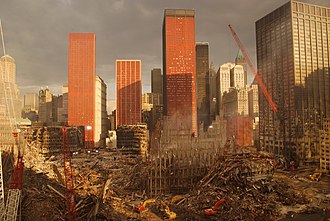
Cleanup of the World Trade Center site, known as "Ground Zero," was completed in May 2002, and the Pentagon was repaired within a year. After delays in designing a replacement complex, six new buildings were planned for the World Trade Center site, along with a museum and a memorial honoring those killed or injured in the attacks. The tallest of these, One World Trade Center, began construction in 2006 and opened in 2014. Memorials to the attacks include the National September 11 Memorial & Museum in New York City, the Pentagon Memorial in Arlington County, Virginia, and the Flight 93 National Memorial at the Pennsylvania crash site.
Background
Main article: Osama bin Laden
Main article: Motives for the September 11 attacks
Further information: Fatwas of Osama bin Laden and Political views of Osama bin Laden
Main article: Khalid Sheikh Mohammed
Main article: Planning of the September 11 attacks
Main article: September 11 intelligence before the attacks
In 1996, Osama bin Laden, the leader of al-Qaeda, issued a statement that declared war against the United States and demanded that American troops leave Arabia. He said the American troops were a problem for all Muslims. Later, he pointed to American support for Israel and to sanctions against Iraq as reasons for his anger. After he was forced to leave Sudan, bin Laden went to Afghanistan, where the Taliban allowed al-Qaeda to use the country as its base. Bin Laden directed the 9/11 attacks and told the hijackers to target the World Trade Center and the Pentagon with hijacked planes. At first he denied his role, but in a 2004 video he confirmed that he had organized 9/11.
The attacks were planned by Khalid Sheikh Mohammed, who had earlier helped plan a bombing of the World Trade Center in 1993. Mohammed first shared the idea with bin Laden in 1996. Several hijackers, including Mohamed Atta, came to the United States in 2000 and took flying lessons. Government agencies had some information about the plot, but they did not share it well with one another. Later, officials said that rules separating criminal investigators from intelligence agents were a major reason for this failure.
Attacks
For a chronological guide, see Timeline for the day of the September 11 attacks.
Early on the morning of September 11, 2001, nineteen hijackers took control of four commercial airliners, two Boeing 757s and two Boeing 767s. Large planes on long flights were chosen because they would have more fuel. Nobody on the planes survived. American Airlines Flight 11 was flown into the North Tower of the World Trade Center, and United Airlines Flight 175 was flown into the South Tower. American Airlines Flight 77 crashed into the Pentagon, and United Airlines Flight 93 crashed into a field near Stonycreek Township after passengers and crew tried to take back control of the plane.
See also: Media documentation of the September 11 attacks and Air traffic control during the September 11 attacks
At first, many people thought the first crash was an accident. The second crash showed that the attacks were deliberate. The World Trade Center towers collapsed because of fires caused by the crashes. The Federal Aviation Administration then grounded all civilian aircraft within the United States, and planes already in the air were told to land immediately.
Main articles: Casualties of the September 11 attacks and Lists of victims of the September 11 attacks
Further information: Collapse of the World Trade Center and List of buildings damaged or destroyed in the September 11 attacks
Main article: Rescue and recovery effort after the September 11 attacks on the World Trade Center
See also: List of emergency and first responder agencies that responded to the September 11 attacks
Reactions
Main article: Reactions to the September 11 attacks
See also: Timeline for September following the September 11 attacks
Right after the attacks, many people and groups responded. Congress created the September 11th Victim Compensation Fund through an Act of Congress to help victims and their families, who agreed not to file lawsuits against the airlines involved. Air travel was stopped across the country, and about 500 international flights were turned back or sent to other countries. Canada received 226 of them and launched Operation Yellow Ribbon. Congress passed the USA PATRIOT Act, and the government created the U.S. Department of Homeland Security through the Homeland Security Act of 2002. Some people were treated unfairly because of how they looked or where their families came from, and Muslims and South Asians were targeted with harassment and hate crimes. Muslim groups, including the Council on American-Islamic Relations, condemned the attacks and helped the victims.
Countries around the world denounced the attacks and showed support for the United States. United Nations Security Council Resolution 1368 condemned the attacks, and British Prime Minister Tony Blair said Britain stood "shoulder to shoulder" with the United States. On September 14, 2001, the U.S. Congress passed the Authorization for the use of Military Force Against Terrorists, which is still in effect. On October 7, 2001, the war in Afghanistan began against the Taliban and al-Qaeda. Al-Qaeda leader Osama bin Laden escaped during the Battle of Tora Bora and stayed out of sight for almost ten years. The Bush administration also announced a war on terror to bring bin Laden and al-Qaeda to justice.
Aftermath
Main article: Aftermath of the September 11 attacks
Health issues
Main article: Health effects arising from the September 11 attacks
When the towers collapsed, toxic dust spread across Lower Manhattan. Exposure to the dust is believed by some to have contributed to fatal or debilitating illnesses among people who were at Ground Zero, and an estimated 18,000 people have developed illnesses from it. The Environmental Protection Agency (EPA) was ordered to make reassuring statements about air quality, and it did not say the air had returned to normal until June 2002. Later, the James L. Zadroga 9/11 Health and Compensation Act (2010) provided $4.2 billion for the World Trade Center Health Program, which offers testing and treatment for people with long-term health problems related to the attacks.
Economic
Main article: Economic effects of the September 11 attacks
The attacks had a major effect on markets in the U.S. and around the world. The stock exchanges stayed closed from September 11 until September 17. When they reopened, the Dow Jones Industrial Average fell by a record amount in one day. The attacks also led to the U.S. wars in Afghanistan and Iraq, along with extra homeland security spending. In the years after the attacks, U.S. troops were withdrawn from Afghanistan, ending the 2001–2021 war there. Further information: War in Afghanistan (2001–2021), Aftermath of the War in Afghanistan (2001–2021), and Killing of Ayman al-Zawahiri
Cultural influence
Main article: Cultural influence of the September 11 attacks
Further information: List of cultural references to the September 11 attacks, Entertainment affected by the September 11 attacks, and Osama bin Laden in popular culture
See also: Osama bin Laden (elephant)
Many people spent more time with family and flew more American flags after the attacks. The attacks have also been used as background or themes in film, music, and literature. Governments around the world passed new laws to fight terrorism. In the United States, the Department of Homeland Security was created to coordinate efforts against terrorism, and the Transportation Security Administration was created to inspect passengers and luggage at airports. Osama bin Laden was killed by U.S. forces on May 2, 2011, after a 10-year search. The main trial of the attacks has not yet been resolved, and only a few people have been convicted in connection with them.
Investigations
Further information: Hijackers in the September 11 attacks
Further information: September 11 intelligence before the attacks
Main article: Joint Inquiry into Intelligence Community Activities before and after the Terrorist Attacks of September 11, 2001
See also: Criticism of the 9/11 Commission
Main article: NIST World Trade Center Disaster Investigation
See also: 7 World Trade Center (1987–2001) § 9/11 and collapse
Main article: Alleged Saudi government role in the September 11 attacks
See also: Saudi Arabia–United States relations, Saudi Arabia and state-sponsored terrorism, and The 28 pages
Right after the attacks, the Federal Bureau of Investigation (FBI) started PENTTBOM, the largest criminal inquiry in U.S. history. At its height, more than half of the FBI's agents worked on it and followed about half a million leads. The FBI concluded there was "clear and irrefutable" evidence linking al-Qaeda and bin Laden to the attacks. Investigators quickly identified the hijackers, starting with the luggage of leader Atta, which was found at Boston's Logan Airport. Its Arab-language sic papers were called "the Rosetta stone of the investigation." Within hours, the FBI released names and personal details of suspected hijackers. On September 27, photos of all 19 were released: fifteen were from Saudi Arabia, two from the United Arab Emirates, one from Egypt, and one from Lebanon. The FBI also recorded the deaths in its 2001 annual violent crime index in separate tables, warning that adding them to crime statistics would create an outlier effect. In 2004, John L. Helgerson, the Inspector General of the Central Intelligence Agency (CIA), was harshly critical of senior CIA officials for not doing everything possible to confront terrorism. In 2007, senators from the Republican and Democratic parties drafted legislation to make the review public, and Ron Wyden said, "The American people have a right to know what the Central Intelligence Agency was doing in those critical months before 9/11." The report was released in 2009 by President Barack Obama.
In 2002, the Senate Select Committee on Intelligence and the House Permanent Select Committee on Intelligence began a joint inquiry into the U.S. Intelligence Community. Its report found that the FBI and CIA had not used available information to disrupt the plots. In 2002, Bob Graham, the inquiry's chair, said there was "evidence that there were foreign governments involved in facilitating the activities of at least some of the terrorists." In 2016, John Brennan said he believed 28 redacted pages would soon be made public. In September 2016, Congress passed the Justice Against Sponsors of Terrorism Act, which allowed relatives of victims to sue Saudi Arabia over its government's alleged role in the attacks. The 9/11 Commission, chaired by Thomas Kean, issued the 9/11 Commission Report in July 2004. It concluded that al-Qaeda carried out the attacks. The National Institute of Standards and Technology found that the planes' impact stripped away fireproofing and that fires weakened the steel, causing the towers to collapse. A document called "File 17" named suspected Saudi intelligence officers, and a Saudi national, Omar al-Bayoumi, was a paid cooptee of the General Intelligence Presidency. Saudi Arabia has denied any involvement in 9/11.
Rebuilding and memorials
Main articles: Rescue and recovery effort after the September 11 attacks on the World Trade Center and Construction of One World Trade Center
Further information: World Trade Center (2001–present) and World Trade Center site
Within hours of the attacks, a search and rescue operation began. The World Trade Center site was cleared by the end of May 2002, and the damaged part of the Pentagon was rebuilt within a year. The temporary World Trade Center PATH station opened in late 2003. Work on the main site was delayed until late 2006, when leaseholder Larry Silverstein and the Port Authority of New York and New Jersey agreed on financing. Construction of One World Trade Center began in April 2006. Its spire was added in May 2013, making it the tallest building in the Western Hemisphere, and it opened on November 3, 2014. 4 WTC opened in November 2013, and the Ronald O. Perelman Performing Arts Center opened in September 2023. Construction of 2 World Trade Center began in 2008, and as of 2026 it is still unfinished. Silverstein Properties was still trying to secure funding for it.
Main article: Memorials and services for the September 11 attacks
In the days after the attacks, memorials and vigils were held around the world, and photographs of the dead and missing were posted around Ground Zero. One of the first memorials was the Tribute in Light, 88 searchlights at the footprints of the towers. The winning design for the World Trade Center Site Memorial Competition, Reflecting Absence, was chosen in August 2006 and completed in 2011. The Sphere by German sculptor Fritz Koenig stood between the Twin Towers on Austin J. Tobin Plaza until the attacks. It was later stored near John F. Kennedy International Airport, was the subject of a 2001 documentary, The Sphere, by Percy Adlon, and was installed at Liberty Park, close to the 9/11 Memorial, in August 2017. In Arlington County, the Pentagon Memorial opened in 2008 with 184 benches facing the Pentagon. In Shanksville, a visitor center opened in 2015 overlooking the crash site. Every anniversary, the names of the victims are read out in New York City, and the President attends a memorial service at the Pentagon and asks Americans to observe Patriot Day with a moment of silence. In 2023, Joe Biden marked the day in Anchorage, Alaska, instead of attending services in the affected areas.
Pictures
Keep exploring



This article is a child-friendly adaptation of the Wikipedia article on September 11 attacks, available under CC BY-SA 4.0.
Images from Wikimedia Commons. Tap any image to view credits and license.