
Osama bin Laden
Osama bin Laden (1957/1958 – 2 May 2011) was the founder and first general emir of al-Qaeda, a Salafi jihadist militant organization, from 1988 until his killing in 2011. During that time, he was one of the most important supporters of Islamic terrorism and jihadist militant movements around the world. He wanted to found a pan-Islamic caliphate and to end the interventionism of the United States and the Soviet Union in the Middle East. He first became well known in the 1980s, when he organized money and military help for resistance against the Soviet invasion of Afghanistan.
Born into the billionaire bin Laden family in Riyadh, Saudi Arabia, bin Laden moved to Afghanistan during the Soviet–Afghan War (1979–1989). He used his own fortune to fund several jihadist groups, including the Afghan mujahideen and Egyptian Islamic Jihad. He also built a large Islamist network to train militants in Chechnya, Bosnia and Herzegovina, Somalia, Yemen, Tajikistan, and Kosovo. In 1984, he co-founded Maktab al-Khidamat to recruit fighters for the mujahideen. In 1988, he founded al-Qaeda to fight alongside the Afghan militants. Later, he commanded a mujahideen force during the First Afghan Civil War, which followed the Soviet withdrawal.
When bin Laden returned to Saudi Arabia, he publicly supported anti-Western causes and opposed the Saudi royal family. This led to his exile and the loss of his citizenship in 1991. He went back to Afghanistan and then moved to Sudan later that year. In 1993, al-Qaeda bombed the World Trade Center in New York City. In 1996, he returned to Afghanistan after being expelled from Sudan, and the Taliban took control of Afghanistan later that year. Al-Qaeda allied with the Taliban, and they worked together in the 1996–2001 Afghan war. In 1996 and 1998, bin Laden declared a holy war on all Americans. In 1998, al-Qaeda bombed U.S. embassies in East Africa, and the U.S. and the United Nations officially declared bin Laden a terrorist. That same year, al-Qaeda also began an ongoing insurgency in Yemen.
The September 11 attacks were planned mainly by bin Laden and Khalid Sheikh Mohammed. Some intelligence sources claim that they were aided by Saudi Arabia, even though bin Laden had been expelled from the country. Nineteen al-Qaeda members hijacked four American passenger planes, planning to crash them into U.S. landmarks. American Airlines Flight 77 hit the Pentagon in Virginia. United Airlines Flight 93 crashed in a field in Pennsylvania before it could reach the hijackers' unknown target in Washington, D.C.. The World Trade Center towers collapsed after being struck by American Airlines Flight 11 and United Airlines Flight 175. More than 5,000 deaths from inhalation exposure have been linked to the attacks, and an estimated 25,000 people were injured. Many nations passed strict anti-terrorism legislation, and an international manhunt for bin Laden began. The U.S. invaded Afghanistan and deposed the Taliban. Bin Laden was forced to move to Pakistan before February 2002. He bought land in Abbottabad to build a new compound, and he moved into it in 2005.
Al-Qaeda fought the U.S. and its allies in the war in Afghanistan (2001–2021) and the Iraq War (2003–2011), and it continued to carry out major terrorist attacks around the world. By 2009, U.S. intelligence saw bin Laden as al-Qaeda's "ideological figurehead," while Ayman al-Zawahiri acted as its "strategic commander." In 2010, U.S. intelligence found bin Laden's compound. In 2011, a team of U.S. Navy SEALs raided it and killed bin Laden. Al-Zawahiri succeeded him as al-Qaeda's emir.
Polls show that Muslims in general have a negative view of bin Laden, while many Islamists consider him a hero. Elsewhere, he is widely seen as a symbol of terrorism and mass murder.
Name and terms
Further information: Romanization of Arabic and Arabic name
His name is most often romanized from Arabic as Osama bin Laden, but it can also be spelled Usama and bin Ladin. During his life, U.S. intelligence usually called him Usama bin Laden and used the initialism "UBL." He was named after Usama ibn Zayd, one of the companions of Muhammad. Usama means "lion." Bin, also spelled ibn, means "son of." His full name means Osama, son of Muhammad, son of Awad, son of Laden. His father is spelled Muhammad bin Ladin here.
Under Arabic linguistic convention, people would call him Osama or Osama bin Laden, not bin Laden alone, because bin Laden is a patronymic surname and not a surname in the Western style. In the West, he is still often called bin Laden. He also went by titles such as Sheikh and emir, which are Islamic titles for a government or military leader. A mujahid is someone who takes part in jihad, which means struggle in the name of Islam. The Hajj is the traditional pilgrimage of Muslims to the holy city of Mecca. He was also called Abu Abdallah, a kunya that names a parent after their child, with Abdallah being his son.
Early life
Osama bin Laden's exact date of birth is unknown. In a 1998 interview with Al Jazeera, broadcast a year later, he reportedly gave March 10, 1957, but this date did not appear in the interview transcript. Saudi men of his generation often did not know their exact birthdays, because birthdays were not celebrated, and officials gave many men the same date on official papers. In a 1991 interview, he gave the month of Rajab in the Islamic year 1377, which could be 1957 or 1958. His first wife, Najwa, gave February 15, 1957. Researchers generally agree he was born in Riyadh, though FBI and Interpol documents once listed Jeddah. His father, Muhammad, was born in what is now Yemen, and his mother, Hamida al-Attas (born A'alia Ghanem), was born in Syria. Muhammad was married 22 times, and al-Attas was his tenth wife. Osama was the 17th of Muhammad's approximately 52 children, and the only one with al-Attas.
The bin Laden family came from Yemen, and Muhammad moved to Saudi Arabia in the early 1900s. He founded the Saudi Binladin Group in 1931 and became very wealthy by the 1950s through his connection to the House of Saud, the Saudi royal family. Six months after Osama was born, he and his parents moved to Hejaz, where he lived until adulthood. His parents divorced in 1960, and Muhammad died in 1967. Osama's inheritance was estimated at about $300 million in 2000 and $50–60 million in 2001, not adjusting for inflation. As of 2026, the family still owns the Saudi Binladin Group and still has ties to the House of Saud. From 1968 to 1976, Osama attended Al-Thager Model School in Jeddah. In 1971 he took an English-language course in Oxford, England, and later said he was impressed by a visit to Shakespeare's house in Stratford-upon-Avon. In September 1971, his older brother Salem organized a family trip to Falun, Sweden, where a local reporter interviewed the family for the newspaper Falu Kuriren. A photograph from the trip showing 21 family members in front of a pink Cadillac drew wide international attention after the September 11 attacks, though family members said Osama did not travel with the group. In the late 1970s, he studied economics and business administration at King Abdulaziz University in Jeddah. Sources disagree on whether he earned a degree in civil engineering in 1979 or in public administration in 1981, or left without one. At university, his main interest was Islam. He studied the Quran and jihad, and did charity work.
Religious and political views
Further information: Political views of Osama bin Laden and Interviews of Osama bin Laden
Bin Laden was reportedly an avid reader who often quoted Bernard Montgomery and Charles de Gaulle. He was raised in Sunni Islam and followed the Athari school of Islamic theology, which interprets the Quran literally rather than figuratively. For religious reasons, he was against gambling, homosexuality, intoxicants, masturbation, music, premarital sex, and usury. He once wrote a letter to the American public, released after his death, urging them to work with Barack Obama's administration to prevent further climate change and to "save humanity" from greenhouse gas emissions "that threaten its destiny." Western sources consider him an Islamic extremist. The German intelligence agency BfV describes this kind of extremism as believing Islam should rule social life and the political order, which goes against the sovereignty of the people, the separation of state and religion, freedom of expression, and equal rights.
The Islamic world and systems of government
See also: Islam and violence and Islam and modernity
Bin Laden promoted Islamism through his militant organization al-Qaeda, which has carried out many terrorist attacks around the world. He believed the Islamic world was in crisis and that only the full restoration of Sharia could correct it. He rejected pan-Arabist, socialist, communist, and democratic systems as solutions. He once called democracy a "religion of ignorance," and he praised Spain's democratic system for letting rulers be held accountable by the law.
Attacking the United States
Main article: Motives for the September 11 attacks
See also: War on Islam controversy, Anti-Zionism, and Eco-terrorism
Bin Laden did not clearly take responsibility for 9/11 until a 2004 video, but he had hinted at his reasons before then. He was angered by American troops stationed in Saudi Arabia, and he believed violent jihad was needed to respond to U.S. policies in the Middle East that he considered unjust. He also criticized U.S. support for Israel. Bin Laden said the 1948 formation of the State of Israel was "a crime which must be erased." He hoped that al-Qaeda's attacks would make the U.S. military stop targeting Muslims.
Judaism
See also: International Jewish conspiracy and Islamic–Jewish relations
Bin Laden was strongly anti-Semitic. He claimed that Jews were behind many negative events in the world and that Jews and Muslims could never live together peacefully. He also said that Jews controlled American media, politics, and economic institutions. Bin Laden's views on these and other matters were shaped by his strong beliefs, and he later urged his followers to focus on persuading Muslims rather than fighting them.
Militant and political career, 1979–2001
Main article: Militant career of Osama bin Laden
In 1979, the mostly non-Muslim Soviet Union occupied Muslim-majority Afghanistan, where many Afghan Muslims opposed the socialist government the Soviets backed. Bin Laden went to Pakistan with Abdullah Yusuf Azzam to help the Afghan mujahideen resist the Soviets. In 1984, the two founded Maktab al-Khidamat, which recruited fighters from across the Arab world. Bin Laden helped build cave complexes in the Afghan mountains and set up militant camps in Pakistan's Khyber Pakhtunkhwa province. Between 1979 and 1992, the U.S., through the CIA's Operation Cyclone program, along with Saudi Arabia and China, gave money and weapons to the mujahideen through Pakistan's Inter-Services Intelligence. In 1987, bin Laden led his own soldiers to a victory against the Soviets at the Battle of Jaji. Bin Laden split from MaK in 1988, and al-Qaeda formed that year, around the time the Soviets began withdrawing from Afghanistan. The Soviets finished withdrawing in 1989.
After the Soviet withdrawal, bin Laden returned to Saudi Arabia, where many people praised him as a hero. When Iraq invaded Kuwait in 1990, starting the Gulf War, bin Laden criticized the Saudi royal family for accepting U.S. troops. The royals put him under house arrest, and he was exiled in 1991. He moved to Sudan, where he set up a new base in Khartoum. In 1994, Saudi Arabia took away his Saudi citizenship. In the 1990s, al-Qaeda carried out attacks around the world. In 1993, a group of al-Qaeda members bombed the underground portion of the World Trade Center in New York City. In 1996, bin Laden was allowed to return to Afghanistan, where the Taliban were in control. On 7 August 1998, hundreds of people were killed in truck bomb explosions at U.S. embassies in Dar es Salaam, Tanzania, and Nairobi, Kenya. This brought bin Laden to the attention of the American public for the first time. In October 2000, al-Qaeda bombed USS Cole, killing 17 U.S. Navy sailors. In 1998, the U.S. indicted bin Laden for the embassy bombings, and the Taliban refused to hand him over.
Main article: September 11 attacks
On 11 September 2001, 19 al-Qaeda members took control of four airliners that had left the U.S. East Coast. They tried to crash the planes into important national landmarks. American Airlines Flight 11 and United Airlines Flight 175 crashed into the Twin Towers of the World Trade Center. American Airlines Flight 77 crashed into the Pentagon. United Airlines Flight 93 crashed in a field in Pennsylvania after other passengers tried to take back the cockpit, so it did not reach its target. The Twin Towers eventually collapsed. All of the hijackers and at least 2,977 victims died, and an estimated 25,000 people were injured. The planning had begun years earlier, when bin Laden and others made the general plan in 1999 and chose the hijackers in 2000, including Mohamed Atta. Bin Laden later confirmed in a 2004 video that he had organized the attacks.
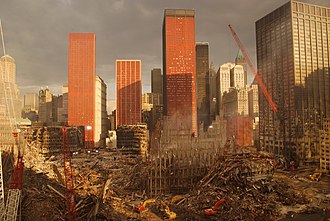
The destroyed World Trade Center site was called "Ground Zero," and many people who were there later developed health issues. After the attacks, the U.S. Congress passed the Patriot Act, and new agencies were created, including the Department of Homeland Security and the Transportation Security Administration. Countries also strengthened their anti-terrorism laws. The FBI considers its investigation into 9/11 to be its largest criminal investigation ever.
Militant and political career, 2001–2011
Further information: U.S. government response to the September 11 attacks and Prelude to the War in Afghanistan (2001–2021)
See also: Osama bin Laden § Controversy over alleged Pakistani support, and Al-Qaeda safe house
See also: List of unsuccessful terrorist plots in the United States post-9/11, Detentions following the September 11 attacks, and Devil Eyes
After the attacks of 9/11, the U.S. began a global war on terror, which included a manhunt for bin Laden. The Taliban refused to hand him over to the U.S. In October 2001, a U.S.-led group invaded Afghanistan to remove the Taliban and catch al-Qaeda members, which started the War in Afghanistan. In late 2001, the U.S. attacked al-Qaeda's complex at Tora Bora, but bin Laden escaped. He was later believed to have moved into Pakistan, and by 2003 he had settled in Haripur, Pakistan. In 2004, his bodyguards began buying land in Abbottabad, and bin Laden moved into a new compound there in August 2005. U.S. intelligence later believed that he may have lived there for at least five years.
After 9/11, al-Zawahiri became al-Qaeda's spokesperson and set up al-Qaeda groups in many countries. Al-Qaeda was blamed for bombings in Bali, Istanbul, and London that killed many people. In March 2003, a coalition led by the U.S. invaded Iraq, starting the Iraq War. The Iraqi group al-Qaeda in Iraq became one of the main insurgent forces. The U.S. also held prisoners in secret black sites and at Guantanamo Bay detention camp, where harsh methods called 'enhanced interrogation techniques' were used. In 2011, the CIA ran a fake hepatitis B vaccinations campaign in Pakistan to confirm bin Laden's location, and when it was revealed, it helped increase vaccine hesitancy and polio cases there. Barack Obama's campaign had promised, "We will kill bin Laden."
Death
Main article: Killing of Osama bin Laden
Further information: Reactions to the killing of Osama bin Laden
See also: Osama bin Laden death conspiracy theories
On 2 May 2011, bin Laden was shot and killed at his compound in Abbottabad, shortly after 1:00 a.m. PKT, in a raid by a U.S. military special operations unit. The raid, Operation Neptune Spear, was ordered by Barack Obama that April. Members of the Obama administration followed it from the White House Situation Room. A team of U.S. Navy SEALs from SEAL Team Six, part of the Joint Special Operations Command, carried out the raid as a CIA operation, with CIA operatives on the ground to help. It was launched from Afghanistan. At first, the press widely reported that SEAL Robert J. O'Neill had fatally wounded bin Laden, but witnesses later disputed this. SEAL Matt Bissonnette claims that bin Laden died after he and another SEAL shot him. The SEALs took the body out of Abbottabad. U.S. officials said it was flown to Afghanistan for identification, then to the USS Carl Vinson in the Arabian Sea, where it was buried at sea in accordance with Islamic customs. Later reporting has questioned this account.
News of bin Laden's death led to large celebrations outside the White House and in New York City. ''The Washington Post'' described the Arab world's reaction as "muted," while views in Latin America varied. Peru's then-leftist president Alan García called the killing "the first miracle performed by [the late Pope] John Paul II" after being beatified the week prior, while others criticized the U.S. for violating Pakistani sovereignty. In India, reports of possible ties between bin Laden and Pakistan's government caused "jubilation," as many residents felt it showed a moral superiority over Pakistan. The U.S. said on 18 May that it would not pay bin Laden's $25 million bounty, and on 15 June, federal prosecutors dropped all criminal charges against him. Ayman al-Zawahiri succeeded him as emir of al-Qaeda and served until he was killed in 2022. After bin Laden's death, Pakistan's ambassador to the U.S., Husain Haqqani (listed as Pakistani ambassador to the U.S.), promised a "full inquiry." Journalists such as Carlotta Gall, Seymour Hersh, and Steve Coll offered differing views on how much Pakistani officials, including Ahmad Shuja Pasha while head of the ISI, knew about bin Laden's location, and in 2019 Imran Khan said the ISI had given the initial location to the CIA.
Personal life
Main article: Personal life of Osama bin Laden
Adult bin Laden was described as thin and tall, weighing about 73 kilograms (160 lb). He usually walked with a cane and may have had some type of kidney disease. Nasser al-Bahri, who was bin Laden's bodyguard from 1997 to 2001, described him as a frugal man and a strict father. He took his family to picnics in the desert and went recreational shooting with them. Al-Bahri said that bin Laden once played association football and volleyball. He was also obsessed with black horses and the English football club Arsenal. Bin Laden also wrote jihadist poetry.
In 1974, bin Laden married Najwa Ghanem, his first cousin. They had eleven children and separated days before 9/11. In 1983, he married Khadijah Sharif, and they had three children before divorcing in 1993. He married Khairiah Sabir in 1985, and they had a son, Hamza, who may be an al-Qaeda leader. He married Siham Sabir in 1987, and they had four children. His fifth marriage, in 1996, was to an unnamed woman, and it was annulled within days of the ceremony. In 2000, he married Amal al-Sadah, and they had five children.
See also: Osama bin Laden in popular culture
In the West, bin Laden is widely seen as a terrorist and mass murderer. News organizations have called him the "most famous terrorist" both before and after his death. His obituary in The New York Times said that Americans generally saw him as the main symbol of global terrorism, on the same level as Adolf Hitler or Joseph Stalin.
His popularity among Muslims was highest during the Iraq War. opinion polls showed that about 50 to 60% of people in some Muslim countries viewed him favorably. A 2004 poll of Saudis was summed up by The New York Times as "yes to bin Laden rhetoric, no to al-Qaeda violence." When he died, the Pew Research Center found that he had generally become "discredited" to his Arab supporters over the previous years. In 2020, Imran Khan called bin Laden's killing "an embarrassing moment" in Pakistan's history, and he praised bin Laden as a "martyr."
Pictures
Keep exploring


This article is a child-friendly adaptation of the Wikipedia article on Osama bin Laden, available under CC BY-SA 4.0.
Images from Wikimedia Commons. Tap any image to view credits and license.