
Mohamed Atta
Mohamed Atta (September 1, 1968 – September 11, 2001) was an Egyptian engineer, architect, and terrorist hijacker for al-Qaeda. Ideologically a pan-Islamist, he was the ringleader of the September 11 attacks and served as the hijacker-pilot of American Airlines Flight 11, which he flew into the North Tower of the original World Trade Center as part of coordinated attacks. Aged thirty-three, he was the oldest of the 19 hijackers who took part in the mission. Before the attacks, he worked as a civil engineer.
Born and raised in Egypt, Atta studied architecture at Cairo University, graduating in 1990, and pursued postgraduate studies in Germany at the Hamburg University of Technology. In Hamburg, he attended prayers at the al-Quds Mosque, where he met Marwan al-Shehhi, Ramzi bin al-Shibh, and Ziad Jarrah. Together they formed the Hamburg cell.
Atta disappeared from Germany for periods of time. He went on the hajj in 1995, but he also met Osama bin Laden and other top al-Qaeda leaders in Afghanistan from late 1999 to early 2000. Bin Laden and Khalid Sheikh Mohammed recruited Atta and the other Hamburg cell members for a "planes operation" in the United States. Atta returned to Hamburg in February 2000 and began asking about flying training in the United States. He, Jarrah, and al-Shehhi arrived there in June to learn how to pilot planes. Atta obtained his instrument rating in November and his commercial pilot's license in December.
Beginning in May 2001, Atta helped with the arrival of the "muscle" hijackers, whose role was to subdue passengers and crew so the hijacker-pilots could take over. In July, he traveled to Spain to meet with bin al-Shibh and finalize the plot. In August, he traveled as a passenger on "surveillance" flights to work out in detail how the attacks could be carried out.
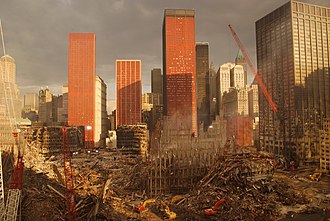
On the morning of September 11, 2001, Atta and his team boarded and hijacked American Airlines Flight 11, which Atta flew into 1 World Trade Center (the North Tower). More than 1,600 people died as a result of the impact, the fire that followed, and the later collapse of the tower. This made him responsible for the single deadliest air crash of all time, as well as the single deadliest terrorist attack of all time.
Not to be confused with Mohammad Hatta, Mohammed Atef, or Mahmoud Mahmoud Atta.
Aliases
Main article: Arabic name
Mohamed Atta used many different names on his documents, including "Mehan Atta", "Mohammad El Amir", "Muhammad Atta", "Mohamed El Sayed", "Mohamed Elsayed", "Muhammad al-Amir", "Awag Al Sayyid Atta", and "Awad Al Sayad". In Germany, he registered his name as "Mohamed el-Amir Awad el-Sayed Atta" and went by Mohamed el-Amir at the Hamburg University of Technology. In his will, written in 1996, he gave his name as "Mohamed the son of Mohamed Elamir awad Elsayed". Al-Qaeda knew him as Abd al-Rahman al-Misri.
Atta also claimed to have different nationalities. Sometimes he said he was Egyptian, and at other times he told people he was from the United Arab Emirates. During his flight training in Florida, he claimed to be a member of the Saudi royal family.
Early life
Mohamed Atta was born on September 1, 1968, in Kafr el-Sheikh, a town in the Nile Delta region of Egypt, which was then part of the United Arab Republic. His father was a lawyer who studied both civil law and sharia. His mother came from a wealthy farming and trading family and was also well educated. They married when she was 14, in an arranged marriage. Atta was the only son and had two older sisters, who both became successful in their careers as a medical doctor and a professor. The family had few relatives on his father's side and kept their distance from his mother's family.
When Atta was ten, his family moved to the Cairo neighborhood of Abdeen. His father kept the family very private and did not allow Atta to play with the other children nearby, so Atta mostly studied at home and did very well in school. In 1985, he enrolled at Cairo University to study engineering, and he was one of the top-scoring students. He graduated in 1990 with an architecture degree and then worked for several months at the Urban Development Center in Cairo. That same year, his family moved to an apartment building in the city of Giza. In late 1999, after returning from Germany, Atta became engaged to a woman chosen by his father and her family, but the marriage never took place.
Germany
Further information: Hamburg cell
Atta went to Germany in 1992 to continue his studies after graduating from Cairo University with marks that were not high enough for graduate school. He enrolled in the urban planning graduate program at the Hamburg University of Technology. For his thesis, he studied the ancient Syrian city of Aleppo and criticized how modern buildings disrupted the life of communities. He lived with roommates who found him hard to live with, because he kept to himself and rarely bathed. Over time, he became more religiously devoted and joined a group of friends who shared his anger toward the United States and the governments of the Middle East.
In late 1999, Atta and some of these friends traveled to Afghanistan, where they were chosen for what was called the "planes operation" plot. German investigators said that Atta trained at al-Qaeda camps in Afghanistan from late 1999 to early 2000. After returning to Germany, Atta and two of his friends reported their passports stolen, possibly to hide their travel to Afghanistan.
United States
In 2000, Atta was still living in Germany when he wrote to flight schools in the United States asking for pilot training. He received a visa from the United States embassy in Berlin and arrived in the United States in June 2000 at Newark International Airport. He trained at Huffman Aviation in Venice, Florida, where he earned a commercial pilot's license from the Federal Aviation Administration in December 2000.
In July 2001, Atta traveled to Spain to meet with Ramzi bin al-Shibh, and the two men discussed plans for the attacks. Atta then returned to the United States and spent the following weeks renting cars, staying in hotels in Wayne, New Jersey, and making trips that were later understood to be practice runs for the attacks. On August 23, his driver's license was revoked after he did not appear in traffic court to answer an earlier citation for driving without a license.
9/11 attacks and death
Main article: American Airlines Flight 11
On September 10, 2001, Atta picked up Abdulaziz al-Omari from a hotel in Boston, Massachusetts. The two men drove a rented car to a Comfort Inn in South Portland, Maine. There they used ATMs and stopped at Wal-Mart. The FBI reported seeing two Middle-Eastern men in the parking lot of a Pizza Hut, where Atta is known to have eaten that day. The next morning, they arrived at the Portland International Jetport and took a Colgan Air (US Airways Express) flight to Logan International Airport in Boston. In Portland, Atta was selected by the Computer-Assisted Passenger Prescreening System, so his checked bags received extra screening for explosives. At Boston, Atta took a call from Marwan al-Shehhi, which was apparently to confirm that the attacks were ready to begin. He then boarded American Airlines Flight 11, which left Boston for Los Angeles International Airport with 81 passengers.
About fifteen minutes into the flight, the hijacking began. The pilots stopped responding to air traffic control, and the plane's transponder was switched off several minutes later. Pilots of United Airlines Flight 175 reportedly heard a suspicious message, "Everyone, stay in your seats," which investigators later traced to Flight 11's cockpit. Flight attendant Betty Ong reported that the cockpit was unresponsive. Air traffic controllers heard a voice believed to be Atta's, and the plane turned south toward New York City. The last message from Flight 11 was heard at 8:33 a.m. At 8:46 a.m., the plane struck the North Tower of the World Trade Center in New York City. The impact cut off escape routes from floors 92 and higher, and the tower collapsed 102 minutes later. Atta's luggage, which had been delayed, was later found at Logan Airport. It contained airline uniforms, flight manuals, a copy of his will, and a list of instructions titled The Last Night.
Family reaction and denial
Atta's father strongly rejected claims that his son was involved in the 9/11 attacks. He blamed the Mossad and the United States government instead, saying they had a hand in framing his son. He also rejected news reports that said his son drank heavily. He described his son as a quiet boy who was not involved in politics, who was shy, and who was dedicated to studying architecture. He said he had spoken with Mohamed by phone the day after the attacks, on September 12, 2001. In late 2002, he gave interviews to the German news magazine Bild am Sonntag, saying his son was alive and hiding in fear, and that American Christians were responsible for the attacks. In a September 24, 2001 interview, he said, "My son is gone. He is now with God. The Mossad killed him."
In 2021, on the 20th anniversary of the attacks, Atta's mother spoke to the Spanish online newspaper El Independiente. She was 79 at the time. She denied that her son had taken part in the attacks and said she believes he is in Afghanistan.
Mistaken identity
After the 9/11 attacks, the names of the hijackers were released, and some people were confused about who Mohamed Atta was. At first, his identity was mixed up with that of a Jordanian man named Mahmoud Mahmoud Atta, who bombed an Israeli bus in the West Bank in 1986, killing one person and injuring three. Mahmoud Atta was 14 years older. He was later sent from Venezuela to the United States, then to Israel, where he was tried, found guilty, and sentenced to life in prison. The Israeli Supreme Court later overturned his extradition and set him free. Reports also said Mohamed Atta had attended the International Officers School at Maxwell Air Force Base in Montgomery, Alabama. A United States Air Force official told The Washington Post that differences in their birth dates showed they were probably not the same people.
After the September 11 attacks, Czech officials said Atta had traveled to Prague on April 8, 2001, to meet an Iraqi intelligence agent. This claim was passed to the FBI as "unevaluated raw intelligence," but intelligence officials have since concluded that the meeting did not happen. A Pakistani businessman named Mohammed Atta had come to Prague from Saudi Arabia, which may have added to the confusion. The Egyptian Mohamed Atta had arrived at the Florenc bus terminal in Prague from Germany in June 2000, then left the next day on Czech Airlines for Newark, New Jersey. In the Czech Republic, some officials said the source of the claim was an Arab informant who came forward only after Atta's photo appeared in newspapers around the world. Investigators have since agreed that the person seen with the Iraqi agent was mistakenly identified as Atta. In 2005, Army Lt. Col. Anthony Shaffer and Congressman Curt Weldon said a Defense Department data project called Able Danger had made a chart linking Atta with Nawaf al-Hazmi, Khalid al-Mihdhar, and Marwan al-Shehhi as members of a Brooklyn-based al-Qaeda cell in early 2000. Navy Captain Scott Phillpott, whose memory Shaffer largely relied on, later took back his recollection, saying he was "convinced that Atta was not on the chart that we had." An inspector general's report said Phillpott "may have exaggerated" about knowing Atta's identity because he supported using Able Danger's techniques to fight terrorism. Five witnesses later told reporters that their statements had been changed in the final report, or that important information had been left out. The alleged distortions of the IG report centered on leaving out evidence that Able Danger had identified and tracked Atta years before 9/11.
Assessment and motivation
Experts have different ideas about why Atta acted as he did. Political psychologist Jerrold Post has suggested that Atta and the other hijackers followed orders from al-Qaeda leaders and did whatever their leader, Osama bin Laden, said was right for the cause. American political scientist Robert Pape argues that Atta was driven by his commitment to the political cause and was psychologically normal. Criminal justice professor Adam Lankford, however, found evidence that Atta faced social isolation, depression, guilt, shame, hopelessness, and rage. In this view, Atta's political and religious beliefs shaped his choice of target but were not the underlying causes of his behavior.
On October 1, 2006, The Sunday Times released a video it had obtained "through a previously tested channel." It appears to show Atta and Ziad Jarrah recording a message at a training camp in Afghanistan. The video is dated January 18, 2000. It has good picture quality but no sound, and lip readers have not been able to make out what is said. Atta and Jarrah appear cheerful, laughing and smiling in front of the camera, and they had never been pictured together before. Sources from both al-Qaeda and the United States confirmed that the video is authentic. Another part shows Osama bin Laden speaking to his followers at a complex near Kandahar, and Ramzi bin al-Shibh is also identified in the video. The Sunday Times reported that investigators had struggled to find Atta's whereabouts in January 2000, after he disappeared from Hamburg, and that the tape places him in Afghanistan when he was given operational command. Months later, both he and Jarrah enrolled at flying schools in America.
In popular culture
Canadian actor Elie Gemael played Atta in the second episode of the BBC/Discovery documentary-style drama Zero Hour, titled "The Last Hour of Flight 11".
Atta was the main villain in the 2004 British-Canadian film The Hamburg Cell, where he was played by Egyptian-French actor Maral Kamel. Martin Brodie played him in The Path to 9/11, a 2006 ABC miniseries.
Pictures
Keep exploring


This article is a child-friendly adaptation of the Wikipedia article on Mohamed Atta, available under CC BY-SA 4.0.
Images from Wikimedia Commons. Tap any image to view credits and license.