 Safekipedia
North Macedonia
Adapted from Wikipedia · Discoverer experience
North Macedonia, officially the Republic of North Macedonia, is a landlocked country in Southeast Europe. It shares borders with Greece to the south, Albania to the west, Bulgaria to the east, Kosovo to the northwest, and Serbia to the north. The country has a population of over 1.83 million, with Skopje, the capital, being the largest city.
The area has a rich history, beginning with the kingdom of Paeonia. Over the centuries, it was ruled by many empires, including the Persian Achaemenid Empire, the Kingdom of Macedonia, the Roman Republic, the Byzantine Empire, and the Ottoman Empire. In the early 20th century, it became part of Serbia and later joined Yugoslavia before gaining independence in 1991.
Today, North Macedonia is a member of many international groups, such as NATO and the United Nations. It works toward joining the European Union. The country has made progress in its economy and provides important services like universal health care and free primary and secondary education for all its citizens.
Names and etymology
See also: Macedonia (terminology) and Macedonia naming dispute
The name of North Macedonia comes from an ancient Greek word, Makedonía, which described a kingdom and later a region. This name comes from an ancient Greek word meaning 'tall' or 'high', possibly describing the people who lived there.
For many years, the name "Macedonia" was not widely used. It was brought back in the 1800s by people from Bulgaria and Greece who were proud of their history. Later, during a time of big changes after World War II, the area became known as the Socialist Republic of Macedonia, part of a larger country called Yugoslavia.
When Yugoslavia broke apart in 1991, the area became independent and was called the Republic of Macedonia. In 2018, after an agreement with Greece, the country changed its name to the Republic of North Macedonia. This change was approved by the country's parliament and officially started in early 2019. Even so, many people still use the name "Macedonia" when talking about their country.
History
Main article: History of North Macedonia
See also: Historiography in North Macedonia
Early history
Main articles: Paeonia (kingdom), Macedonia (ancient kingdom), Kingdom of Dardania, and Roman Empire
North Macedonia roughly matches the area of the ancient kingdom of Paeonia, located north of the kingdom of Macedonia. In early times, Bylazora was the main town of the Paeonian kings, later moving to Stobi. The region was home to the Paeonians, with other groups like the Illyrian Dardani and Enchelae also living there.
In the late 6th century BC, the Achaemenid Persians conquered Paeonia. After their defeat in 479 BC, the Persians left the area.
Philip II of Macedon took over parts of Paeonia in 356 BC. Alexander the Great later included the rest in his empire. After Alexander’s death, Celtic armies attacked but were defeated in 310 BC.
The Romans established the province of Macedonia in 146 BC. By the time of Diocletian, it was split into Macedonia Prima in the south and Macedonia Salutaris in the north, with Stobi as its capital. This included most of today’s North Macedonia. Roman rule brought Scupi under their control during Domitian’s time, placing it in the province of Moesia. Greek remained dominant in the east, but Latin also spread in Macedonia.
Medieval period
Further information: Sclaveni, Byzantine Empire, First Bulgarian Empire, Bulgaria (theme), Serbian Empire, and Ottoman Vardar Macedonia
Slavic tribes settled in the Balkan region, including North Macedonia, by the late 6th century AD, led by the Pannonian Avars. They settled in places with earlier communities and mixed with local populations. Around 680, a Bulgar ruler named Kuber led a group called the Sermesianoi to the region of Pelagonia. They may have included Bulgars, Byzantines, Slavs, and Germanic tribes.
The Slavic tribes in Macedonia converted to Christianity around the 9th century during the reign of Tsar Boris I of Bulgaria. The Ohrid Literary School, founded in 886 by Saint Clement of Ohrid, became a major cultural center of the First Bulgarian Empire, spreading the Cyrillic script.
, the first synod church of the Archbishopric of Ohrid (top). The Church of Saints Clement and Panteleimon (bottom). Both churches are located in Ohrid.
After Sviatoslav’s invasion of Bulgaria, the Byzantines took control of East Bulgaria. Samuil became Tsar of Bulgaria, moving the capital to Skopje and then Ohrid. He re-established Bulgarian power, but after defeats by the Byzantine Emperor Basil II in 1014, the Byzantines restored control over the Balkans, including North Macedonia. The Bulgarian Patriarchate was lowered in rank and became the Archbishopric of Ohrid. By the late 12th century, Byzantine decline led to the region being contested by various powers, including a brief Norman occupation in the 1080s.
In the early 13th century, a revived Bulgarian Empire gained control of the region. Plagued by political issues, the empire didn’t last, and the region came under Byzantine control again in the early 14th century. In the 14th century, it became part of the Serbian Empire. Skopje became the capital of Tsar Stefan Dušan’s empire. After Dušan’s death, internal struggles divided the Balkans. This period saw the entry of the Ottoman Turks into Europe.
Ottoman period
Further information: Ottoman Vardar Macedonia
The Kingdom of Prilep was one of the short-lived states that emerged from the collapse of the Serbian Empire in the 14th century and was seized by the Ottomans at the end of the same century. Gradually, all of the central Balkans were conquered by the Ottoman Empire and remained under its rule for five centuries as part of the province or Eyalet of Rumelia. The name Rumelia means "Land of the Romans" in Turkish, referring to the lands taken from the Byzantine Empire. Over time, Rumelia Eyalet was reduced in size until the 19th century, when it included parts of central Albania and western North Macedonia with its capital at Bitola. Rumelia Eyalet was abolished in 1867, and the territory of Macedonia became part of vilayets of Manastir, Kosova, and Selanik until the end of Ottoman rule in 1912. With the Bulgarian National Revival in the 19th century, many reformers came from this region.
Modern period
Macedonian autonomism
See also: Bulgarian Millet, Autonomy for Macedonia and Adrianople regions, and Macedonia for the Macedonians
Several movements aiming to create an autonomous Macedonia, covering the entire region, began in the late 19th century. The earliest was the Bulgarian Macedonian-Adrianople Revolutionary Committees, later becoming the Secret Macedonian-Adrianople Revolutionary Organization (SMARO). In 1905, it was renamed the Internal Macedonian-Adrianople Revolutionary Organization (IMARO), and after World War I, it split into the Internal Macedonian Revolutionary Organization (IMRO) and the Internal Thracian Revolutionary Organisation (ITRO).
In its early years, only Bulgarians could join, but later it opened to all people in European Turkey. Most members were Macedonian Bulgarians. In 1903, IMRO organized the Ilinden-Preobrazhenie Uprising against the Ottomans. After some successes, including the Kruševo Republic, the uprising was crushed with many losses. The uprising and the Kruševo Republic are seen as important steps toward the eventual creation of the Macedonian state. Leaders of the Ilinden uprising are celebrated as national heroes in North Macedonia. IMRO revolutionaries like Gotse Delchev, Pitu Guli, Dame Gruev, and Yane Sandanski are mentioned in the national anthem “Today over Macedonia.” The major national holiday, Republic Day, is celebrated on 2 August, the day of the Ilinden uprising.
Kingdom of Serbia
See also: Second Balkan War and Serbianisation
Following the Balkan Wars of 1912 and 1913 and the dissolution of the Ottoman Empire, most of the territory that would become North Macedonia was annexed by Serbia, as agreed in the peace treaty at Bucharest. However, the Strumica region went to Bulgaria. After this, an anti-Bulgarian campaign began in areas under Serbian and Greek control. Many Bulgarian schools and churches were closed, and Exarchist clergy and teachers were expelled. The use of Macedonian dialects and standard Bulgarian was banned. IMRO, with local Albanians, organized the Ohrid-Debar uprising against Serbian rule. The rebels captured Gostivar, Struga, and Ohrid, driving out Serbian troops. A Carnegie Endowment report said a Serbian army of 100,000 suppressed the uprising. Many were killed, and tens of thousands fled to Bulgaria and Albania.
World War I
See also: Bulgarian occupation of Serbia (World War I)
During World War I, most of today’s North Macedonia was part of the Bulgarian-occupied zone of Serbia after the country was invaded by the Central Powers in fall 1915. The region was called the “Military Inspection Area of Macedonia” and was run by a Bulgarian military commander. Policies aimed at making the region Bulgarian were started, including using only Bulgarian language, banning Serbian Cyrillic, arresting and deporting Serbian priests, changing Serbian-sounding names to Bulgarian ones, bringing teachers from Bulgaria, and removing Serbian books from schools and libraries. Adult males were sent to labor camps or forced to join the Bulgarian Army. The goal was to create purely Bulgarian territories by changing the non-Bulgarian Slavic population.
Kingdom of Yugoslavia
See also: South Serbia (1919–1922) and Vardar Banovina
After Bulgaria’s surrender and the end of World War I, the area returned to Belgrade’s control as part of the newly formed Kingdom of Serbs, Croats, and Slovenes, later renamed the Kingdom of Yugoslavia in 1929. Serbian teachers and clergy were brought in, Serbian language signs and books were put up, and all Bulgarian organizations were dissolved. After the Treaty of Neuilly-sur-Seine, the Strumica region was added to Serbian Macedonia in 1919.
The Serbian government enforced Serbian language and culture, suppressing Bulgarian activists, changing family names, settling Serbian families in the area, and using intense propaganda. About 50,000 Serbian soldiers and gendarmerie were stationed in North Macedonia. By 1940, about 280 Serbian colonies with 4,200 families were set up.
In 1929, the Kingdom became the Kingdom of Yugoslavia, and South Serbia, including North Macedonia, became the Vardar Banovina.
The Internal Macedonian Revolutionary Organization (IMRO) promoted the idea of an Independent Macedonia in the interwar period. Its leaders wanted independence for the area split between Serbia and Greece for all people, regardless of religion or ethnicity. Bulgaria offered Pirin Macedonia for this purpose after World War I, but Serbia and Greece opposed it. In 1924, the Communist International suggested all Balkan communist parties support a “United Macedonia,” but this was rejected by Bulgarian and Greek communists.
IMRO started an insurgent war in Vardar Macedonia, with the Macedonian Youth Secret Revolutionary Organization conducting guerrilla attacks against Serbian officials. In 1923, a group called the Association against Bulgarian Bandits was formed by Serbian chetniks, IMRO renegades, and members of the Macedonian Federative Organization to fight IMRO and MMTRO. In 1934, IMRO member Vlado Chernozemski killed Alexander I of Yugoslavia.
Macedonist ideas grew in Yugoslav Vardar Macedonia and among left diaspora in Bulgaria during the interwar period, supported by the Comintern. In 1934, the Comintern issued a special resolution recognizing a separate Macedonian nation and language for the first time.
World War II
Main article: World War II in Yugoslav Macedonia
During World War II, Yugoslavia was occupied by Axis powers from 1941 to 1945. The Vardar Banovina was split between Bulgaria and Italian-occupied Albania. Bulgarian Action Committees were set up to prepare the region for Bulgarian administration and army. The committees were mostly former IMRO and Macedonian Youth Secret Revolutionary Organization members, with some IMRO (United) members also joining.
As leader of the Vardar Macedonian communists, Metodi Shatorov (“Sharlo”) switched from the Yugoslav Communist Party to the Bulgarian Communist Party and refused to fight against the Bulgarian Army. The Bulgarian authorities, under German pressure, were responsible for the round-up and deportation of over 7,000 Jews in Skopje and Bitola. Harsh rule by occupying forces led many Vardar Macedonians to support Josip Broz Tito’s Communist Partisan resistance movement after 1943, starting the National Liberation War.
In Vardar Macedonia, after the Bulgarian coup d’état of 1944, Bulgarian troops, surrounded by German forces, fought their way back to Bulgaria. Under the new Bulgarian pro-Soviet government, four armies were mobilized and reorganized. Most re-entered occupied Yugoslavia in early October 1944, moving from Sofia to Niš, Skopje, and Priština to block German forces withdrawing from Greece. The Bulgarian army reached the Alps in Austria, helping expel Germans to the west through Yugoslavia and Hungary.
Pushed by the Soviet Union to create a large South Slav Federation, in 1946 the new Communist government, led by Georgi Dimitrov, agreed to give Bulgarian Macedonia to a United Macedonia. With the Bled agreement in 1947, Bulgaria formally agreed to this unification but postponed it until after the formation of the future Federation. This was the first time it accepted a separate Macedonian ethnicity and language. After the Tito-Stalin split, Pirin Macedonia stayed part of Bulgaria, and the Bulgarian Communist Party changed its view on a separate Macedonian nation and language.
Socialist Yugoslavia
Main article: Socialist Republic of Macedonia
In December 1944, the Anti-fascist Assembly for the National Liberation of Macedonia (ASNOM) proclaimed the People’s Republic of Macedonia as part of the People’s Federal Republic of Yugoslavia. ASNOM acted as a government until the end of the war. The Macedonian alphabet was created by ASNOM linguists based on Vuk Stefanović Karadžić’s phonetic alphabet and Krste Petkov Misirkov’s principles. During the Greek civil war (1946–1949), Macedonian communist insurgents supported the Greek communists. Many refugees fled to the Socialist Republic of Macedonia from there. The state removed “Socialist” from its name in 1991 when it peacefully left Yugoslavia.
The new republic became one of the six republics of the Yugoslav federation. After the federation was renamed the Socialist Federal Republic of Yugoslavia in 1963, the People’s Republic of Macedonia was also renamed the Socialist Republic of Macedonia.
Declaration of independence
North Macedonia celebrates 8 September 1991 as Independence Day, marking the referendum that approved independence from Yugoslavia. The anniversary of the Ilinden Uprising on 2 August is also celebrated as the Day of the Republic.
Robert Badinter, head of the Arbitration Commission of the Peace Conference on Yugoslavia, recommended EC recognition in January 1992. On 15 January 1992, Bulgaria was the first country to recognize the independence of the republic.
Macedonia stayed peaceful during the Yugoslav Wars of the early 1990s. Minor border changes with Yugoslavia were made to fix demarcation issues. The country was seriously affected by the Kosovo War in 1999, as around 360,000 ethnic Albanian refugees from Kosovo sought shelter there. They left after the war, and Albanian nationalists on both sides of the border began fighting for autonomy or independence for Albanian-populated areas in Macedonia.
21st century
2001 insurgency
Main article: 2001 insurgency in Macedonia
A conflict happened between the government and ethnic Albanian insurgents, mostly in the north and west, from February to August 2001. The war ended with NATO’s help. The Ohrid Agreement gave the Albanian minority more political power and cultural recognition. The Albanian side agreed to stop separatist demands and recognize Macedonian institutions. The NLA agreed to give up their weapons to NATO. However, Macedonian forces had two more armed clashes with Albanian militant groups in Operation Mountain Storm and the 2015 Kumanovo clashes.
Ethnic tensions rose in Macedonia in 2012, with violent incidents between ethnic Albanians and Macedonians. In April 2017, about 200 protesters, mostly from the conservative VMRO-DPMNE party, stormed the Macedonian Parliament after an ethnic Albanian was elected Speaker of the Assembly.
Antiquisation
Main articles: Antiquisation and Macedonism
When it came to power in 2006, especially after not being invited to join NATO in 2008, the VMRO-DPMNE government followed a policy of “Antiquisation” to pressure Greece and build national identity. Statues of Alexander the Great and Philip of Macedon were put up in cities. Public places like airports, highways, and stadiums were named after them. These actions were seen as provocations by Greece, making it harder for the country to join the EU and NATO. This policy was criticized at home and by EU diplomats, and after the Prespa agreement in 2016, it was partly reversed by the new SDSM government. Both countries now recognize that their uses of “Macedonia” and “Macedonian” refer to different historical and cultural contexts.
EU and NATO path
In August 2017, the then Republic of Macedonia signed a friendship agreement with Bulgaria to end “anti-Bulgarian ideology” and solve historical issues.
Under the Prespa agreement signed with Greece on 17 June 2018, the country changed its name to the Republic of North Macedonia and stopped public use of the Vergina Sun. It kept the name “Macedonian” but said it was different from the Hellenistic Macedonian identity in northern Greece. The agreement removed irredentist material from textbooks and maps in both countries and got official UN recognition of the Slavic Macedonian language. This replaced the 1995 Interim Accord.
The Greek veto was lifted, and with the friendship agreement with Bulgaria, the European Union approved starting accession talks on 27 June, expected in 2019, if the Prespa deal was carried out. On 5 July, the Macedonian parliament ratified the Prespa agreement with 69 MPs voting for it. On 12 July, NATO invited Macedonia to start accession talks to become the alliance’s 30th member. On 30 July, the parliament approved a non-binding referendum on changing the country’s name, held on 30 September. Ninety-one percent voted in favor with 37% turnout, but the referendum failed because it needed 50% turnout.
On 6 February 2019, NATO members and Macedonian Foreign Affairs Minister Nikola Dimitrov signed the accession protocol for North Macedonia to join NATO in Brussels. The protocol was ratified by the Greek parliament on 8 February, completing the Prespa agreement conditions. On 12 February, the Macedonian government started constitutional changes to rename the country to North Macedonia and informed the United Nations.
In March 2020, after all NATO members ratified, North Macedonia joined NATO as the 30th member. That same month, the EU leaders approved North Macedonia to start EU accession talks. On 17 November 2020, Bulgaria blocked the EU’s negotiation framework for North Macedonia, citing issues like implementing the 2017 friendship treaty, state-supported harmful speech, minority claims, and “nation-building” based on denying Bulgarian identity, culture, and history in Macedonia. This veto was condemned by intellectuals from both countries and criticized by international observers.
Protests happened in July 2022 over the French proposal for North Macedonia to join the EU. Accession talks officially began that month after the proposal passed the Assembly.
The 2023 European Commission Progress Report said unfulfilled constitutional changes were the main reason for blocking further accession. The EU’s intention for the country’s accession seems unclear, besides wanting to keep its influence in the Western Balkans against China and Russia. On 25 September 2024, the EU decided to separate Albania from North Macedonia on the EU accession path due to disputes between North Macedonia and Bulgaria. After this, the EU opened negotiations on the first chapters with Albania separately on 15 October 2024.
Geography
Main article: Geography of North Macedonia
See also: Geology of North Macedonia
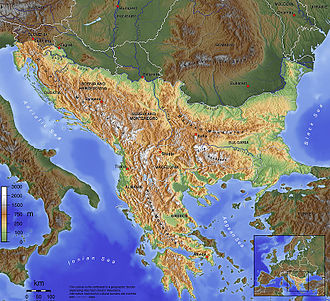
North Macedonia is a small country in Southeast Europe with an area of 25,436 km2. It shares borders with Serbia to the north, Kosovo to the northwest, Bulgaria to the east, Greece to the south, and Albania to the west. It is a landlocked country with a central valley formed by the Vardar river, surrounded by mountain ranges. The country has three large lakes—Lake Ohrid, Lake Prespa, and Dojran Lake—located on its southern borders.
North Macedonia has diverse terrain with rugged mountains and scenic landscapes. The tallest mountain is Mount Korab, reaching 2,764 meters. The country's rivers flow into three basins: the Aegean, the Adriatic, and the Black Sea. The Vardar river is the largest and most important for the country's economy and transportation.
Climate
See also: Climate of North Macedonia
North Macedonia experiences four seasons, with warm, dry summers and cold, snowy winters. Temperatures can range from −20 °C in winter to 40 °C in summer. The climate varies across the country, with continental conditions in the north, Mediterranean climate in the south, and mountainous areas at higher elevations. The valleys of the Vardar and Strumica rivers have a temperate Mediterranean climate. The country receives varying amounts of rainfall, from 1,700 mm in the west to 500 mm in the east, allowing for the growth of many crops such as wheat, maize, and rice.
Biodiversity
Main article: Wildlife of North Macedonia
North Macedonia is home to a rich variety of plant and animal life. The country has around 3,700 plant species, including many flowering plants, mosses, and ferns. Its forests are filled with animals like bears, wild boars, wolves, foxes, and deer. Rare animals such as the lynx can be found in the western mountains. The country also has many bird species, including the imperial eagle and forest owl. North Macedonia has four national parks that help protect its natural environment.
Politics
Main article: Politics of North Macedonia
North Macedonia is a parliamentary democracy with an executive government led by a group of parties from the unicameral legislature (Собрание, Sobranie; Assembly in English). There is also an independent judicial branch with a constitutional court. The Assembly has 120 seats, and its members are elected every four years. The president has a mostly ceremonial role, while the real power lies with the prime minister. The president is also the commander-in-chief of the armed forces and leads the State Security Council. The president is elected every five years and can serve up to two terms.
Since 2019, local government roles have been split among 80 municipalities (општини, opštini). The capital, Skopje, is managed by ten municipalities together called the "City of Skopje". These municipalities work together for local self-government. Neighboring municipalities can also make cooperative agreements.
North Macedonia’s main political difference is between parties representing the majority ethnic Macedonians and the Albanian minority. This balance of power caused a short conflict in 2001, leading to an agreement on sharing power. In August 2004, new laws were passed to change local boundaries and give more control to areas where Albanians are the majority.
After some difficulties during elections, North Macedonia had a calm change of government in the elections of 5 July 2006. The centre-right party VMRO-DPMNE led by Nikola Gruevski won decisively. Gruevski included the Democratic Party of Albanians in the government, which caused protests in areas with many Albanians. Talks later began between the Democratic Union for Integration and VMRO-DPMNE to discuss disagreements and support the country’s goals of joining Europe and NATO.
After early elections in 2008, VMRO-DPMNE and the Democratic Union for Integration formed a government together. In April 2009, peaceful presidential and local elections were held, important for North Macedonia’s hopes to join the EU. The ruling VMRO-DPMNE party won the local elections, and its candidate, Gjorgi Ivanov, became president.
In June 2017, Zoran Zaev of the Social Democratic Party became prime minister six months after early elections. This new government ended 11 years of rule by the conservative VMRO-DPMNE party led by Nikola Gruevski.
As of 4 January 2020[update], the acting prime minister was Oliver Spasovski and the president of the Parliament was Talat Xhaferi. Protests happened right after Xhaferi’s election, led by VMRO-DPMNE, but police handled them quickly.
Early parliamentary elections were held on 15 July 2020. Zoran Zaev became prime minister again in August 2020. Stevo Pendarovski became president in May 2019. Prime minister Zoran Zaev stepped down after his party lost local elections in October 2021. In January 2022, Dimitar Kovačevski was elected prime minister. A new government was formed with Kovačevski’s Social Democrats and two parties representing ethnic Albanians. Gordana Siljanovska-Davkova became the country’s first female president on 12 May 2024.
Parliament, or Assembly (Macedonian: Собрание, Sobranie), is the country’s law-making body. It creates, suggests, and passes laws. The Constitution of North Macedonia has been in place since shortly after the country’s independence in 1991. It limits the powers of both local and national governments. The military is also limited by the constitution. The constitution says North Macedonia is a free state, with Skopje as its capital. The 120 members of Parliament are elected for four years by all citizens aged 18 or older. The current president of Parliament is Jovan Mitreski since 2024.
The Government, led by the prime minister, holds executive power. The prime minister chooses the government members, who are ministers for different areas like the economy, finance, and foreign affairs. The government members serve for four years. The court system, led by the Supreme court, handles judiciary power. The Assembly chooses the judges.
Administrative divisions
Main articles: Statistical regions of North Macedonia and Municipalities of North Macedonia
North Macedonia’s statistical regions are used only for legal and statistical reasons. The regions are:
In August 2004, the country was reorganised into 84 municipalities (opštini), later reduced to 80 in 2013. Ten of these municipalities make up the City of Skopje, the capital and a special unit of local self-government.
Most current municipalities are the same as or combined from the 123 municipalities created in 1996. Before that, local government was made up of 34 districts or counties (also opštini).
Naming dispute
Main article: Macedonia naming dispute
See also: Macedonia (terminology)
The name “Macedonia” was disputed between Greece and North Macedonia. The disagreement began after the breakup of Yugoslavia in 1991, when the country became independent. Greece did not want the name to be used without a geographic description, to avoid confusion with its own region of Greek Macedonia. Some ethnic Greeks also call themselves Macedonians, unrelated to the Slavic people of North Macedonia. Greece also felt that North Macedonia was claiming Greek cultural symbols like the Vergina Sun and Alexander the Great, and promoting a idea that included Greek lands in a larger United Macedonia.
The United Nations used the temporary name “the former Yugoslav Republic of Macedonia” when the country joined in 1993. Most countries later recognized it as the Republic of Macedonia. The UN tried to help solve the dispute. After the Prespa agreement, most international groups accepted the new name.
Foreign relations
Main article: Foreign relations of North Macedonia
See also: List of diplomatic missions of North Macedonia
North Macedonia became a UN member on 8 April 1993, 18 months after becoming independent from Yugoslavia, using the name “the former Yugoslav Republic of Macedonia.” The country wants to fully join European and Trans-Atlantic groups.
North Macedonia is part of many international groups: IMF (since 1992), WHO (since 1993), EBRD (since 1993), Council of Europe (since 1995), OSCE (since 1995), WTO (since 2003), CEFTA (since 2006), and NATO (since 2020).
In 2005, the country was recognized as a possible member of the European Union. In 2008, North Macedonia wanted to join NATO but could not because of the naming dispute with Greece. The U.S. supported joining, but the decision was delayed until the dispute was solved. After the Prespa agreement, North Macedonia joined NATO in March 2020. The EU also wanted the naming dispute solved before starting membership talks.
In 2012, the EU suggested starting talks with North Macedonia for the fourth time, but Greece blocked it again. The EU also wanted to speed up removing travel restrictions for Macedonian citizens. Bulgaria also had concerns about the country’s position towards them.
Military
Main article: Army of North Macedonia
The Army of North Macedonia is led by the General Staff. It includes the Operations Command with the Mechanized Infantry Brigade, the Air Brigade, the Special Operations Regiment, and several independent battalions. There is also a Training and Doctrine Command, a Logistics Base, and an Honor Guard Battalion. As of 2024, the army had 8,000 active soldiers and 4,850 reservists, with a military budget of US$275 million in 2023. North Macedonia became a volunteer army in 2007 and has sent troops to support NATO, EU, or UN missions in Afghanistan, Bosnia and Herzegovina, Iraq, Kosovo, and Lebanon.
The Ministry of Defence creates the country’s defence plans and evaluates possible threats. It is also in charge of the defence system, including training, equipment, and preparing the defence budget.
Human rights
Main article: Human rights in North Macedonia
North Macedonia follows the European Convention on Human Rights and UN agreements on refugees and against torture. The country’s constitution guarantees basic human rights for all citizens.
Some human rights groups have reported concerns about threats and pressure on human rights activists and journalists, as well as claims of police mistreatment.
Economy
Main article: Economy of North Macedonia
North Macedonia has worked hard to improve its economy since it became independent. The country has an open economy, with trade making up more than 90% of its total money made in recent years. The government has worked to keep prices stable and to bring in money from other countries. They have also focused on helping small and medium-sized businesses grow.
The government started a system with a lower tax rate to attract more businesses. Many big companies from around the world have set up factories in North Macedonia, especially in making cars. The country’s main ways of making money include making things, trading, moving goods, and farming.
Trade
The wars in nearby countries and restrictions on trade hurt North Macedonia’s economy in the past. After these ended, Greece became an important partner for trade. Many Greek companies bought old state-owned businesses in North Macedonia and created jobs for people there.
Other important trading partners include Germany, Italy, the United States, Slovenia, Austria, and Turkey.
Tourism
Main article: Tourism in North Macedonia
Tourism is important to North Macedonia’s economy, making up about 6.7% of its total money in 2016. The number of visitors has been growing since conflicts in 2001. In 2019, over one million tourists visited, with many coming from Turkey, Serbia, Greece, Bulgaria, and Poland. Popular places to visit include lakes such as Ohrid, Prespa, and Dojran, as well as mountains, rural areas, cities, and cultural sites.
Transport
Main article: Transport in North Macedonia
North Macedonia is landlocked and had a hard time after independence when old trade routes broke down. The country’s roads and railways connect it to other parts of the Balkans. As of 2019, there were about 10,591 km of roads, with around 6,000 km paved. The railway network is 922 km long, with the main line connecting the border with Serbia to the border with Greece through Skopje.
Water transport is mostly on lakes like Ohrid and Prespa, mainly for tourists. There are 17 airports, with two international ones: Skopje International Airport and Ohrid St. Paul the Apostle Airport.
Post and telecommunications
North Macedonia Post is the state-owned company for postal services. It started in 1992 and joined the World Postal Union in 1993. Later, it split into Macedonian Telekom and North Macedonia Post.
Internet
The United States helped North Macedonia become the first country with widespread wireless internet. Many schools are now connected to the internet, and a company provides WiFi in the largest cities.
Demographics
Main articles: Demographics of North Macedonia, List of cities in North Macedonia, and Macedonians (ethnic group)
North Macedonia has a population of about 1.8 million people. The country has a mix of different ethnic groups. The largest group are the Macedonians. Other groups include Albanians, Turks, and Roma people.
The country’s main language is Macedonian, but Albanian is also an official language. People also speak Turkish, Romani, Serbian, Bosnian, and Aromanian. Most people in North Macedonia follow Eastern Orthodox Christianity, but many also follow Islam. There are smaller groups of Catholics, Protestants, and others.
North Macedonia has several universities where people can study, such as the Ss. Cyril and Methodius University of Skopje and St. Clement of Ohrid University of Bitola.
Main articles: Macedonian language and Languages of North Macedonia
See also: Political views on the Macedonian language
Main article: Religion in North Macedonia
Religion in North Macedonia (2021)
- Eastern Orthodoxy (46.1%)
- Catholicism (0.40%)
- Non-specified Christian (presumably Orthodox) (13.9%)
- Islam (32.2%)
- None (0.10%)
- Others (7.30%)
Eastern Orthodox Christianity is the most practiced religion in North Macedonia, making up 46.1% of the population, the vast majority of whom belong to the Macedonian Orthodox Church. Various other Christian denominations account for 13.9% of the population. Muslims constitute 32.2% of the population. North Macedonia has the fifth-highest proportion of Muslims in Europe, after those of Kosovo (96%), Turkey (90%), Albania (59%), and Bosnia and Herzegovina (51%). Most Muslims are Albanians, Turks, Romani or Bosniaks; few are Macedonian Muslims. The remaining 1.4% was determined to be "unaffiliated" by a 2010 Pew Research estimation.
There were 1,842 churches and 580 mosques in the country at the end of 2011. The Orthodox and Islamic religious communities have secondary religion schools in Skopje. There is an Orthodox theological college in the capital. The Macedonian Orthodox Church has jurisdiction over 10 provinces (seven in the country and three abroad), has 10 bishops and about 350 priests. A total of 30,000 people are baptised in all the provinces every year.
The Macedonian Orthodox Church, which declared autocephaly in 1967, remained unrecognised by the other Orthodox Churches until 2022 when it restored relations with the Serbian Orthodox Church and the Ecumenical Patriarchate, which has been followed by recognition from other churches.
The Macedonian Byzantine Catholic Church has approximately 11,000 adherents in North Macedonia. The Church was established in 1918, and is made up mostly of converts to Catholicism and their descendants. The Church is of the Byzantine Rite and is in communion with the Roman and Eastern Catholic Churches. Its liturgical worship is performed in Macedonian.
There is a small Protestant community.
The country's Jewish community, which numbered some 7,200 people on the eve of World War II, was almost entirely destroyed during the war: only 2% survived the Holocaust.
After their liberation and the end of the War, most opted to emigrate to Israel. Today, the country's Jewish community numbers approximately 200 persons, almost all of whom live in Skopje. Most Macedonian Jews are Sephardic—the descendants of 15th-century refugees who had been expelled from Castile, Aragon and Portugal.
Main article: Education in North Macedonia
The higher levels of education can be obtained at one of the five state universities: Ss. Cyril and Methodius University of Skopje, St. Clement of Ohrid University of Bitola, Goce Delčev University of Štip, State University of Tetova and University of Information Science and Technology "St. Paul The Apostle" in Ohrid. There are a number of private university institutions, such as the European University, Slavic University in Sveti Nikole, the South East European University and others. North Macedonia was ranked 63rd in the Global Innovation Index in 2025. The national library of North Macedonia, National and University Library "St. Kliment of Ohrid" is in Skopje.
Largest cities or towns in North Macedonia | |||||||||
|---|---|---|---|---|---|---|---|---|---|
| Rank | Name | Region | Pop. | Rank | Name | Region | Pop. | ||
| 1 | Skopje | Skopje Statistical | 526,502 | 11 | Kavadarci | Vardar Statistical | 32,038 | ||
| 2 | Kumanovo | Northeastern Statistical | 75,051 | 12 | Kočani | Eastern Statistical | 24,632 | ||
| 3 | Bitola | Pelagonia Statistical | 69,287 | 13 | Kičevo | Southwestern Statistical | 23,428 | ||
| 4 | Prilep | Pelagonia Statistical | 63,308 | 14 | Gevgelija | Southeastern Statistical | 15,156 | ||
| 5 | Tetovo | Polog Statistical | 63,176 | 15 | Struga | Southwestern Statistical | 15,009 | ||
| 6 | Štip | Eastern Statistical | 42,000 | 16 | Radoviš | Southeastern Statistical | 14,460 | ||
| 7 | Veles | Vardar Statistical | 40,664 | 17 | Kriva Palanka | Northeastern Statistical | 13,481 | ||
| 8 | Ohrid | Southwestern Statistical | 38 818 | 18 | Negotino | Vardar Statistical | 12,488 | ||
| 9 | Strumica | Southeastern Statistical | 33,825 | 19 | Debar | Southwestern Statistical | 11,735 | ||
| 10 | Gostivar | Polog Statistical | 32,814 | 20 | Sveti Nikole | Eastern Statistical | 11,728 | ||
Culture
Main articles: Culture of North Macedonia, List of Macedonians (ethnic group), and Music of North Macedonia
North Macedonia has a rich cultural history in art, architecture, poetry, and music. The country has many ancient religious sites that are protected. Every year, it holds festivals for poetry, cinema, and music. Macedonian music styles grew from the strong influence of Byzantine church music. The country has many preserved Byzantine fresco paintings, mostly from between the 11th and 16th centuries. These paintings are in very good condition and show the skill of Macedonian artists.
Important cultural events include the Ohrid Summer Festival of classical music and drama, the Struga Poetry Evenings, which brings together poets from over 50 countries, and film festivals in Bitola and Skopje. The National Opera opened in 1947 and holds May Opera Evenings in Skopje each year.
Media
Main article: Mass media in North Macedonia
The oldest newspaper in the country is Nova Makedonija, starting in 1944. Other well-known newspapers and magazines include Utrinski vesnik, Dnevnik, Vest, Fokus, Večer, Tea Moderna, Makedonsko Sonce, and Koha. The public channel is Macedonian Radio Television, founded in 1993. TEKO TV from Štip was the first private television channel, starting in 1989. Other popular private channels are Sitel, Kanal 5, Telma, Alfa TV, and Alsat-M.
Cinema
Main article: Cinema of North Macedonia
Making films in North Macedonia goes back over 110 years. The first film made in the country was created in 1895 by Janaki and Milton Manaki in Bitola. Over the years, films have shown the history, culture, and everyday life of the Macedonian people. Many Macedonian films have been shown at festivals around the world and have won important awards. The first Macedonian feature film was Frosina, released in 1952. The first colour feature film was Miss Stone, released in 1958. The highest-grossing film was Bal-Can-Can, watched by over 500,000 people in its first year. In 1994, the film Before the Rain was nominated for an Academy Award. In 2020, the documentary Honeyland was also nominated for Academy Awards.
Cuisine
Main article: Macedonian cuisine
Macedonian food comes from the Balkans and includes influences from Mediterranean, Middle Eastern (Ottoman), Italian, German, and Hungarian cuisines. The warm climate helps grow many vegetables, herbs, and fruits.
Macedonian food includes many dairy products, wines, and local drinks like rakija. Tavče gravče is the national dish, and mastika is the national drink. Other popular foods are Šopska salad, ajvar, stuffed peppers, and pastrmajlija.
Sport
Football, handball, and basketball are the most popular sports in North Macedonia. The national football team plays at Toše Proeski Arena. In 2020, the team qualified for UEFA Euro 2020, their first major tournament.
Handball is also important. Macedonian clubs have won European competitions. The women’s national team hosted the European Women’s Handball Championship in 2008.
The national basketball team has played in several EuroBaskets. North Macedonia also has winter sports and takes part in the Olympic Games.
Public holidays
Main article: Public holidays in North Macedonia
The main public holidays in North Macedonia are:
There are also several important religious and minority holidays.
Symbols
See also: List of flags of North Macedonia and National symbols of North Macedonia
- Sun: The flag of North Macedonia, adopted in 1995, shows a yellow sun with eight rays on a red background.
- Coat of arms: After independence in 1991, North Macedonia kept the coat of arms from 1946. It includes wheat, tobacco, poppy, mountains, rivers, lakes, and the sun, showing the country’s richness and freedom.
| Date | English name | Macedonian name | Remarks |
|---|---|---|---|
| 1–2 January | New Year | Нова Година, Nova Godina | |
| 7 January | Christmas Day (Orthodox) | Прв ден Божиќ, Prv den Božiḱ | |
| April/May | Good Friday (Orthodox) | Велики Петок, Veliki Petok | Orthodox Easter and other Easter dates do not match; see: List of dates for Easter |
| April/May | Easter Sunday (Orthodox) | Прв ден Велигден, Prv den Veligden | |
| April/May | Easter Monday (Orthodox) | Втор ден Велигден, Vtor den Veligden | |
| 1 May | Labour Day | Ден на трудот, Den na trudot | |
| 24 May | Saints Cyril and Methodius Day | Св. Кирил и Методиј, Ден на сèсловенските просветители, Sv. Kiril i Metodij, Den na sèslovenskite prosvetiteli | |
| 2 August | Republic Day | Ден на Републиката, Den na Republikata | Day when the Republic was established in 1944, also Ilinden Uprising in 1903. |
| 8 September | Independence Day | Ден на независноста, Den na nezavisnosta | Day of independence from Yugoslavia |
| 11 October | Day of the Macedonian Uprising | Ден на востанието, Den na vostanieto | Beginning of anti-fascist resistance during WWII in 1941 |
| 23 October | Day of the Macedonian Revolutionary Struggle (Holiday) | Ден на македонската револуционерна борба, Den na makedonskata revolucionarna borba | Day when the Internal Macedonian Revolutionary Organization (IMRO) was established in 1893. |
| 1 Shawwal | Eid ul-Fitr | Рамазан Бајрам, Ramazan Bajram | moveable, see: Islamic Calendar |
| 8 December | Saint Clement of Ohrid Day | Св. Климент Охридски, Sv. Kliment Ohridski |
International rankings
| Organisation | Survey | Ranking |
|---|---|---|
| Institute for Economics and Peace | Global Peace Index 2019 | 65 out of 163 |
| Reporters Without Borders | Worldwide Press Freedom Index 2019 | 95 out of 180 |
| Transparency International | Corruption Perceptions Index 2019 | 106 out of 180 |
| United Nations Development Programme | Human Development Index 2019 | 82 out of 189 |
| World Bank | Ease of doing business index 2019 | 10 out of 190 |
Images
Related articles


This article is a child-friendly adaptation of the Wikipedia article on North Macedonia, available under CC BY-SA 4.0.
Images from Wikimedia Commons. Tap any image to view credits and license.