 Safekipedia
Orchid
Adapted from Wikipedia · Discoverer experience
Orchids are beautiful plants that belong to the family Orchidaceae. They are known for their colorful and fragrant flowers and can be found almost everywhere in the world, except Antarctica. Many orchids grow on trees and have special flowers that attract insects for pollination.
The Orchidaceae family is one of the largest families of flowering plants, with about 28,000 species in around 700 genera. This means orchids make up about 6–11% of all seed plants. People who love growing plants, called horticulturists, have created many new types of orchids through hybrids and cultivars.
Etymology
The word "orchid" comes from an old Greek word that described the shape of some orchid parts. It was first used in English in 1845 by a botanist named John Lindley. In older English, some orchids were called "bollockwort" because of how they looked.
Description
Orchids are special plants because they look different from most others. Their flowers often have bilateral symmetry, meaning one side mirrors the other. Many orchids have flowers that twist in a certain way and a special middle petal called a labellum. Their stems and roots grow in different patterns — some grow from one point and get longer each year, while others grow from the front with older parts behind.
Orchid leaves are usually simple with parallel veins. Most orchids add new leaves at the top while older leaves fall off, but some lose all their leaves each year and grow new ones. Some orchids don’t have leaves at all and use their green roots to make food for the plant. Orchid flowers come in many shapes and sizes, with three sepals, three petals, and a special lip or labellum that helps attract insects.
Reproduction
Main article: Pollination of orchids
Charles Darwin studied how orchids have special ways to help plants of the same kind share their pollen. He wrote about this in his 1862 book Fertilisation of Orchids.
Orchid flowers have unique parts where the pollen maker and the pollen receiver are joined into one structure called the column. Most orchids have a single lump of pollen called a pollinium that can help many flowers grow seeds. When an insect visits the flower, it often picks up the pollinium on its body. Later, when the insect visits another flower, the pollinium can place pollen where it belongs, helping the new flower grow seeds.
Some orchids use special tricks to get insects to help. For example, some flowers smell and look like female insects, which tricks male insects into visiting. Other orchids make special smells that attract bees, who pick up these smells for their own work.
Orchids can also grow new plants without needing another flower. Some plants grow small baby plants along their stems, which can be cared for and grown into new flowers.
After flowering, orchids grow small seed pods that open to release tiny seeds. These seeds are very small and need help from special fungi to grow, which gives them the food they need to start growing.
Evolution
Fossil and reconstructed history
There are not many fossils of orchids. In 2007, scientists found an extinct bee trapped in old tree resin from about 15 to 20 million years ago. This bee had pollen from an unknown orchid on its wings. This discovery was the first fossil proof that orchids existed and that bees helped them reproduce long ago. An even older orchid was found in 2017, dating back 40 to 55 million years.
Studies of orchid DNA suggest these plants might have first appeared 76 to 84 million years ago. Some experts think orchids could be even older, maybe around 100 million years old.
Phylogeny
A special diagram made in 2015 shows how orchids are related to each other. This was proven by studying the DNA of seven orchid genes.
Taxonomy
Main article: Taxonomy of the Orchidaceae
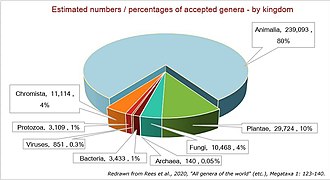
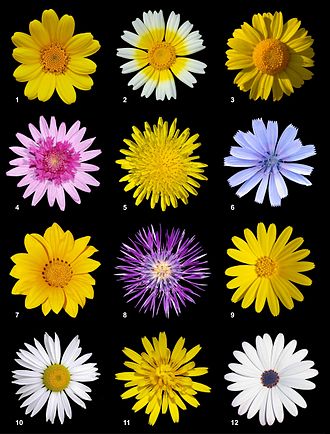
Orchids are one of the largest groups of flowering plants, with at least 700 different types and 28,000 species. They are only rivalled by another plant group called Asteraceae, which has more types but fewer species. New orchid species are still being found and named today.
Hybrids
Orchids can easily mix with each other when grown by people, creating many new hybrids. These hybrids have special names. For example, hybrids from two specific orchid types are named using a special word that combines both names. When three or more types mix, the name often ends with “-ara”. These hybrid orchids also have unique naming rules that are different from normal species names.
For example, hybrids between Brassavola nodosa and Brassavola acaulis are placed in the grex Brassavola Guiseppi. The name of the grex ("Guiseppi" in this example) is written in a non-italic font without quotes.
Distribution and ecology
Orchids can be found everywhere in the world except Antarctica. Many grow high up in trees in warm and warmish parts of the world. Some grow on rocks, and others grow on the ground.
Some orchids do not have the green color called chlorophyll, so they cannot make their own food from sunlight. Instead, they get their food from fungi in the soil. These special relationships help the orchids grow.
Orchids also use clever tricks to get insects to help them make new flowers. Some smell like sweet nectar but do not actually give any food. Others smell like decaying fungi to attract certain insects, and some even smell like female insects to attract males. In each case, the insect helps the orchid while looking for something else.
Uses
Horticulture
Many orchids are grown for their beautiful flowers. Most orchids need warm places to grow, so they are usually kept inside in colder areas. But some orchids, like Cypripedium and Dactylorhiza, can grow outside in cooler climates. Every year, thousands of new orchid mixtures are created and registered.
There are many clubs and societies for orchid lovers all around the world. Some well-known groups include the Orchid Society of Great Britain and the American Orchid Society. New orchids are added to a special list kept by the Royal Horticultural Society. Each February, there is a big orchid festival at the Royal Botanic Gardens, Kew.
A cultivated _[Phalaenopsis](/wiki/Phalaenopsis)_
Orchid [cornucopia](/wiki/Cornucopia) in the annual festival of orchids at the [Royal Botanic Gardens, Kew](/wiki/Royal_Botanic_Gardens,_Kew)
A [× _Brassolaeliocattleya_](/wiki/×_Brassolaeliocattleya) ("BLC") Paradise Jewel 'Flame' hybrid orchid
Flavours and aromas
Further information: Vanilla
The dried seed pods of a type of orchid called Vanilla (especially Vanilla planifolia), are used to add flavor to foods like baked goods, perfumes, and special treatments for relaxation.
People who make perfumes often study the smells of orchids to find new fragrance ideas.
-
.jpg)
Vanilla planifolia with green seedpods
Vanilla seedpods drying
Vanilla "beans" used as a spice
Food
The parts of some orchids, like the early purple orchid Orchis mascula, are ground into a powder and used in cooking, such as in a warm drink called salep and in ice cream. Some orchids from Australia, like Gastrodia sesamoides, produce parts that look like potatoes and were eaten by local people. These plants can still be found near old settlements, such as Ku-ring-gai Chase National Park. Aboriginal peoples found these plants by noticing where animals like bandicoots dug for them.
Cultural symbolism
Orchids hold special meaning in some cultures, with several countries choosing them as their national flowers. In ancient Rome, orchids from the Mediterranean appear on the Ara Pacis, marking the earliest known example of orchids in European art.
Conservation
Most orchids are protected under international rules to make sure people don't take too many from nature. Some orchids need extra care because they are in danger because of things like climate change. For example, when a big dam was built, people moved some orchids to safer, higher places where they could grow well.
Images
Related articles




This article is a child-friendly adaptation of the Wikipedia article on Orchid, available under CC BY-SA 4.0.
Images from Wikimedia Commons. Tap any image to view credits and license.