 Safekipedia
Zambia
Adapted from Wikipedia · Discoverer experience
Zambia (/ˈzæmbiə, ˈzɑːm-/), officially the Republic of Zambia, is a landlocked country in Southern Africa. It is bordered to the north by the Democratic Republic of the Congo, Tanzania to the northeast, Malawi to the east, Mozambique to the southeast, Zimbabwe and Botswana to the south, Namibia to the southwest, and Angola to the west. The capital city is Lusaka, which is located in the south-central part of the country.
The land was originally home to Khoisan peoples and later affected by the Bantu expansion. In the late 1800s, the British Empire took control of the area, forming the protectorates of Barotziland–North-Western Rhodesia and North-Eastern Rhodesia, which later merged into Northern Rhodesia. Zambia gained independence from the United Kingdom on 24 October 1964, with Kenneth Kaunda becoming its first president.
Today, Zambia is known for its rich natural resources, including minerals and wildlife. However, many people in the country still face challenges, with almost half of the population living in conditions affected by multidimensional poverty. The city of Lusaka also hosts the headquarters of the Common Market for Eastern and Southern Africa (COMESA).
Etymology
Further information: Rhodesia (name)
Before it became Zambia, this area was called "Northern Rhodesia" from 1911 until 1964. When Zambia became independent from British rule in October 1964, it chose the name Zambia. The name comes from the Zambezi river, which might mean "the grand river."
Geography
Main articles: Geography of Zambia and Geology of Zambia
Zambia is a landlocked country in southern Africa. It is the 39th-largest country in the world, covering 752,614 square kilometres. The land is mostly made up of high plateaus with some hills and mountains, split by river valleys.
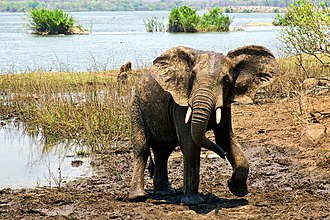
Zambia has two main river systems. The Zambezi River and its tributaries flow through much of the country, while the Congo River basin covers the northern part. The country has a tropical climate but stays moderate because of its higher elevation. It has two main seasons: a rainy season from November to April and a dry season from May to October. Zambia is home to many different plants and animals, including special types of giraffes and many fish species.
History
Main article: History of Zambia
The land we now call Zambia was home to early humans, as shown by fossil skull remains found in Kabwe District. These remains, called the Broken Hill Man, are very old, dating between 300,000 and 125,000 years BC.
Long ago, the Khoisan and Batwa peoples lived in Zambia until around AD 300, when Bantu people began to settle there. The Bantu originated in West and Central Africa, around what is today Cameroon and Nigeria. About 5000 years ago, they started moving into much of Africa. This big movement is called the Bantu expansion. They were the first to bring iron working to many parts of Africa.
The first Bantu people in Zambia lived in villages and worked together. They moved their villages when the soil became too tired from farming. They kept herds of cattle and were very self-sufficient. Early European visitors noted how independent these communities were.
Later, more Bantu groups arrived from the Congo Basin. These groups became part of big kingdoms like the Luba and Lunda. The Luba Kingdom started in the 14th century and had a strong central government. It traded with many places, from the Atlantic to the Indian Ocean.
Another group, the Maravi, formed around Lake Malawi and later became known as the Chewa people. They built a big empire that stretched from the Indian Ocean through Mozambique to Zambia and parts of Malawi. They traded ivory and made iron tools.
The Mutapa Empire also grew powerful, trading gold and ivory with places far away, like Asia. Later, the Portuguese came and caused trouble, leading to conflicts.
In the 1800s, Europeans began to explore Zambia. One famous explorer was David Livingstone, who named the big waterfalls on the Zambezi River Victoria Falls after the queen of the United Kingdom.
In 1964, Zambia became independent, with Kenneth Kaunda as its first president. The country faced many challenges but has grown since then, especially with its mineral resources.
Politics
Main article: Politics of Zambia
Zambia is a country where people choose their leaders through voting. The leader, called the president, is both the head of the government and the most important person in the country. Zambia became its own country in 1964.
In 2015, after the previous president passed away, a new election was held, and Edgar Lungu became president. Later, in 2021, Hakainde Hichilema won the election and became the new president. People in Zambia vote to decide who leads the country.
In 2019, Zambia joined an international agreement to ban a certain type of very powerful weapons.
See also: Human rights in Zambia, LGBT rights in Zambia, and Zambian nationality law
Demographics
Main article: Demographics of Zambia
As of the 2022 Zambian census, Zambia's population was 19,610,769.
The main ethnic groups in Zambia are Bemba 3.3 million (33.6%), Nyanja 1.8 million (18.2%), Tonga 1.7 million (16.8%), North-Western peoples 1 million (10.3%), Lozi (Barotse) 770,000 (7.8%), Mambwe 580,000 (5.9%), Tumbuka 500,000 (5.1%), Lamba 165,000 (2%), Asians 11,900 and Europeans 6,200.
Zambia is one of the most highly urbanised countries in sub-Saharan Africa, with 44% of the population concentrated along the major transport corridors, while rural areas are sparsely populated. The fertility rate was 6.2 as of 2007[update] (6.1 in 1996, 5.9 in 2001–02).
Economy
Further information: Economy of Zambia
Zambia's economy has changed over time. In recent years, the country has earned money by selling goods like copper to other countries. However, many people in Zambia still struggle with poverty, especially in rural areas. The government is working to grow the economy in new ways, such as farming, tourism, and other types of mining.
Mining is a big part of Zambia's economy. Copper mining is especially important, and Zambia is one of the top copper producers in the world. The country also mines other valuable materials like gold, manganese, and nickel. Agriculture and tourism also help support the economy. Zambia has many beautiful national parks and famous places like Victoria Falls, which attract visitors from around the world.
Culture
Before Zambia became a modern country, people lived in groups called tribes, each with its own traditions. During the time when European powers were influencing the area, different tribes began to live together in towns and cities. This brought new traditions and ideas from around the world, especially in how people dressed and acted. Even today, many original traditions stay alive in the countryside.
Zambia has many special ceremonies and events. These celebrate important moments like birthdays, weddings, and new leaders. Some ceremonies are known all over the country, while others are only for certain groups. Traditional arts include making pots, baskets, and carvings. Music and dance are very important, with drums being a common part of performances. In cities, people also enjoy music from other parts of the world.
Media
Main articles: Media in Zambia and Telecommunications in Zambia
Zambia values free speech, but the government sometimes limits what media can report. While some news outlets are owned by the government, many journalists choose to be careful with what they write. There are also private radio and television stations that many people watch.
Sports and games
Sports and games are important in Zambia, bringing people together for fun and learning. Popular sports include football, athletics, and netball. Traditional games such as nsolo and chiyenga are also played. Zambia first joined the Olympic Games in 1964 and has won medals in boxing and track events. Football is especially loved, with the national team achieving great successes, including winning the African Cup of Nations in 2012.
Music and dance
Music and dance are key parts of Zambian culture. Traditional music often uses drums and singing, with dances that bring communities together. A special music style called Zamrock started in the 1970s, mixing local sounds with influences from famous international bands.
Zamrock
Zamrock is a music style from the 1970s that mixes Zambian traditions with sounds inspired by artists like Jimi Hendrix and Black Sabbath. Popular bands include Rikki Ililonga and WITCH.
Images
Related articles




This article is a child-friendly adaptation of the Wikipedia article on Zambia, available under CC BY-SA 4.0.
Images from Wikimedia Commons. Tap any image to view credits and license.