 Safekipedia
Education in ancient Greece
Adapted from Wikipedia · Explorer experience
Education in ancient Greece
In Ancient Greece, learning was very important. Boys went to school to learn many things. They studied reading, writing, music, and sports. This helped them grow up strong and smart.
Schools were different in places like Classical Athens and Sparta. In Athens, boys learned to play instruments, sing, and read poems. They also ran and wrestled to stay healthy. Rich families could start school earlier than poorer families.
In Sparta, boys lived together and trained to be strong. They did lots of running and exercises. Girls in Sparta also learned sports so they could help raise healthy children.
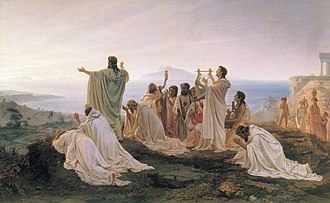
One famous teacher was Pythagoras. He loved numbers and taught how they help us understand the world. He lived on the island of Samos and later in Kroton. His students, called Pythagoreans, followed special rules and studied shapes and numbers.
Education in ancient Greece helped boys become good leaders and strong athletes. It showed how much the Greeks valued learning and staying healthy.
Images
Related articles


This article is a child-friendly adaptation of the Wikipedia article on Education in ancient Greece, available under CC BY-SA 4.0.
Images from Wikimedia Commons. Tap any image to view credits and license.