 Safekipedia
Dominica
Adapted from Wikipedia · Adventurer experience
Overview
Dominica, officially the Commonwealth of Dominica, is an island country in the Caribbean Sea. It is part of the Windward Islands in the Lesser Antilles. The capital city is Roseau, on the west side of the island. Dominica covers 750 km2 (290 sq mi). Its highest point is Morne Diablotins, which is 1,448 m (4,751 ft) tall.
History
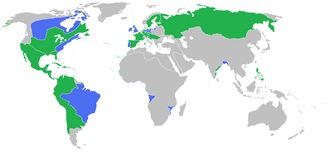
The island has a rich history. The Arawak people from South America were the first to live there. Later, the Kalinago came. Christopher Columbus saw the island in 1493. Europeans, mostly the French, took control from the late 1600s until 1763. After the Seven Years' War, Great Britain took over and made English the official language. Dominica became independent in 1978.
Nature and Wildlife
Dominica is called the “Nature Island of the Caribbean” because of its beautiful natural surroundings. It is one of the youngest islands, still shaped by geothermal-volcanic activity. It has the world’s second-largest hot spring, Boiling Lake, and many lush rainforests with rare plants and animals. The sisserou parrot, Dominica’s national bird, lives only here. It appears on the national flag, which includes the color purple. Dominica is part of the Commonwealth of Nations, the United Nations, and the Organization of American States.
Etymology
The Kalinago people called the island Wai‘tu kubuli, meaning "Tall is her body". They thought of the island like a goddess.
Christopher Columbus, sailing for Spain, named the island Dominica. He saw it on a Sunday in November 1493, and named it after that day. Some people in Dominica think the island should be called Waitukubuli instead. Others think changing the name would be too expensive.
History
Main article: History of Dominica
Geologic history
Dominica rose out of the sea about 26 million years ago. It was the last Caribbean island formed by volcanic activity along the Lesser Antilles Volcanic Arc.
Pre-colonial period and early European contact
Before Europeans arrived, the Kalinago people lived on Dominica. In 1493, Christopher Columbus saw the island and named it Dominica.
French colony
Spain didn’t colonize Dominica. In 1632, France claimed the island. By 1690, French woodcutters began cutting timber and brought enslaved Africans to work. In 1727, France made Dominica an official colony. The island was taken by Britain in 1761 and became a British colony in 1763.
British colony
Britain established a small colony in 1805. Enslaved people were brought from Africa to work on plantations. After slavery ended in 1833, many people gained freedom and political rights. By 1838, Dominica became the first British West Indies colony with an elected legislature.
Early 20th century
During World War II, many Dominicans volunteered to fight for Britain. After the West Indies Federation ended in 1962, Dominica became an associated state of the United Kingdom in 1967. It gained full independence as a republic in 1978, with Patrick John as its first prime minister.
Post-independence
In 1979, political unrest led to the collapse of the government. Eugenia Charles became prime minister and was the Caribbean’s first female leader. The economy struggled due to falling banana prices.
In 2015, Tropical Storm Erika caused severe damage, and in 2017, Hurricane Maria destroyed many buildings on the island. Dominica won its first Olympic gold medal in 2024 when Thea LaFond took first place in the women’s triple jump at the Paris Summer Olympics.
Geography and climate
Main article: Geography of Dominica
Dominica is an island nation in the Caribbean Sea, the northernmost of the Windward Islands. It is about 750 square kilometres in size. The island has lush rainforests and many special plants and animals. Dominica has tall, volcanic mountains and a tropical forest area that became a World Heritage Site in 1995.
The capital city is Roseau, and most people live along the coast. Dominica sometimes faces strong storms. These storms have sometimes damaged homes and farms.
Fauna
Dominica has many different kinds of birds, including two types that live only on the island. The sisserou parrot is Dominica's national bird and lives in the island's mountain forests. Another related parrot, called the red-necked parrot, is also only found on Dominica. Both birds are rare and protected.
The island has four kinds of snakes, two of which are only found on Dominica. Dominica also has eleven types of lizards, including two special ones that are only found there. The island is an important place for the Lesser Antillean iguana, which is in danger of disappearing.
The waters around Dominica are home to many whales and dolphins. Some sperm whales live in the area all year. Other animals often seen include spinner dolphins, pantropical spotted dolphins, and bottlenose dolphins. This makes Dominica a popular spot for people who enjoy watching whales and dolphins.
Government
Main article: Politics of Dominica
See also: Foreign relations of Dominica
Dominica is a country where people choose their leaders by voting. The leader is called the president, and the main person who runs things is the prime minister. They all work together in a group called the cabinet. There is also a group called the House of Assembly. Twenty-one members are chosen by voters, and nine others help make decisions.
Dominica is special because it is one of the few countries in the Caribbean that is a republic. This means it does not have a king or queen. Instead, it has a president. Dominica works closely with other nearby countries in groups like the Caribbean Community and the Organisation of Eastern Caribbean States.
Military
Dominica does not have a big army. The main group that helps keep safety is the police. The police also has a special unit and a coast guard. If there is ever a big problem, the police can help protect the country.
Human rights
In the past, laws in Dominica made it hard for people who loved someone of the same sex to be together. But in 2024, these laws were changed so everyone is treated fairly.
Territorial disputes
Dominica and Venezuela have talked about a small island called Isla de Aves. In 2006, Dominica’s leader said this island belongs to Venezuela, so they no longer argued about it.
Administrative divisions
Dominica is divided into 10 parishes.
| Parish | Population |
|---|---|
| Saint Andrew Parish | 9,471 |
| Saint David Parish | 6,043 |
| Saint George Parish | 21,241 |
| Saint John Parish | 6,561 |
| Saint Joseph Parish | 5,637 |
| Saint Luke Parish | 1,668 |
| Saint Mark Parish | 1,834 |
| Saint Patrick Parish | 7,622 |
| Saint Paul Parish | 9,786 |
| Saint Peter Parish | 1,430 |
Economy
Main article: Economy of Dominica
Dominica uses the East Caribbean Dollar as its money. For many years, Dominica had a smaller economy compared to other islands in the Caribbean. Things got tough around 2003 and 2004, but the economy started to grow again in 2005 and 2006. This growth came from more people visiting the island, building new things, and selling things like bananas.
Farming, especially bananas, used to be very important for Dominica. Bad weather and changes in world prices made this hard. In 2007, Hurricane Dean damaged farms and roads. To cope, the island began growing other crops like coffee, patchouli, aloe vera, and fruits such as mango and papaya. Tourism has also become more important.
Dominica is part of groups that help its economy, like the Caribbean Basin Initiative, which lets many of its products enter the United States without extra taxes. The island is also working to become a place where banks and companies from other countries can do business.
Dominica offers a way for people to become citizens by investing in the island. This has helped bring money for important projects, like building homes that can survive hurricanes and improving healthcare.
Main article: Tourism in Dominica
Dominica is a volcanic island with beautiful mountains, rainforests, lakes, hot springs, waterfalls, and places to dive. Even though it doesn’t have many sandy beaches, these natural features attract visitors who love nature. The island has been getting more visitors as new facilities have been built in the capital, Roseau. In 2008, Dominica had fewer tourists than any other Caribbean island tracked, but its unique landscape continues to draw people, especially scuba divers.
Infrastructure
Air
Dominica has two airports that you can use. The biggest airport is Douglas-Charles Airport (DOM). You can fly there from Miami and Newark. It is on the northeast side of the island, about a 45-minute drive from Portsmouth and an hour from the capital, Roseau. The second airport is Canefield Airport (DCF). It is about 15 minutes from Roseau on the southwest coast. A new airport, Dominica International Airport, is being built in Wesley. It will open in 2026.
Roads
The roads on Dominica follow the coastline and river valleys. The main roads are two-lane highways. They connect Roseau to Portsmouth and Douglas Charles Airport. It takes about 45 minutes to drive between Portsmouth and Roseau. These roads were rebuilt between the early 2010s and 2015. China and the European Union helped with this. Private minibuses are the main way people travel around the island.
Green energy
Dominica uses clean energy. This includes hydroelectricity, solar energy, and geothermal energy. After a big storm in 2017, the government decided to use more geothermal energy. In March 2018, Dominica joined an agreement to use more solar power.
Demographics
Main article: Demographics of Dominica
Dominica has a small population of around 22,649 people, as counted in 1844. Most people have African roots, but there are also people from European, Lebanese, Syrian, and East Asian backgrounds. Dominica is special because it is the only eastern Caribbean island where the native Kalinago people still live. There are over 3,000 Kalinago people living in eight villages on the east coast. This area is called the Kalinago Territory and was given to them by the British in 1903.
The population of Dominica grows slowly because many people move to other countries. The island has more people who live over 100 years old than many other places. This was studied at the Ross University School of Medicine.
Dominica joined the Leeward Islands in 1832 and fully became part of it in 1871. After a big eruption of the Mount Pelée volcano on nearby Martinique in 1902, some people came to live in Dominica.
Languages
English is the official language of Dominica, and everyone speaks it. Many people also speak Dominican Creole, a French-based language. This started because French settlers came to the island in 1690. Dominican Creole is more common among older people. There is also a dialect called Kokoy, spoken in the villages of Marigot and Wesley. Kokoy is a mix of English and Creole and comes from people who moved from Montserrat and Antigua.
Religion
Main article: Religion in Dominica
Most people on Dominica, about 61.4%, are Catholic. There are also many Protestant churches, including Seventh-day Adventist groups. Other religions practiced on the island include spiritualism, Baháʼí, Buddhism, Hinduism, Islam, and Chinese folk religion.
Education in Dominica
Schooling in Dominica is required until secondary school. After primary school, students take an exam to enter secondary school. After five years, they can take an exam called the Caribbean Secondary Education Certificate. Some students take an advanced exam after two more years of study. Dominica has its own Dominica State College, and some students go to universities in Cuba, the University of the West Indies, or other countries.
The Dominica Library and Information Service helps people with reading and learning. It started in 1843 and has grown to include public libraries, research services, and archives. The old library was damaged in Hurricane Maria in 2018 and is being rebuilt.
| Year | Pop. | ±% p.a. |
|---|---|---|
| 1871 | 27,178 | — |
| 1881 | 28,211 | +0.37% |
| 1891 | 26,841 | −0.50% |
| 1901 | 28,894 | +0.74% |
| 1911 | 33,863 | +1.60% |
| 1921 | 37,059 | +0.91% |
| 1946 | 47,624 | +1.01% |
| 1960 | 59,916 | +1.65% |
| 1970 | 69,549 | +1.50% |
| 1981 | 73,795 | +0.54% |
| 1991 | 71,183 | −0.36% |
| 2001 | 71,242 | +0.01% |
| 2011 | 70,739 | −0.07% |
| Source: | ||
Culture
Main articles: Culture of Dominica and Music of Dominica
Dominica has a rich history shaped by the Arawaks and Carib (Kalinago) tribes who lived there before European settlers arrived. Today, the Kalinago community lives on the east coast and keeps its own traditions. The island's culture mixes African, European, and Caribbean influences.
Music and dance are very important in Dominica. The island celebrates with traditional songs and dances. Festivals like "Creole in the Park" and the "World Creole Music Festival" show local music. Dominica created a musical style called "Cadence-lypso", which mixes different traditions. Other popular music styles include "Jing ping" and "Cadence".
Cuisine
Dominica's food is similar to other Caribbean islands but has its own special touches. Breakfast often includes saltfish and "bakes" (a type of fried dough). Other popular foods are cornmeal porridge, fried fish, and plantains. Meals often have stews with vegetables and meat, making rich and tasty dishes.
Sports
Cricket is a favorite sport on the island. Dominica's athletes have also done well in other sports. Jérôme Romain won a bronze medal in triple jump, and Thea LaFond earned a gold medal at the 2024 Summer Olympics. Other popular sports include netball, basketball, rugby, tennis, and association football.
Media
Dominica has two big newspapers called The Sun and The Chronicle. There are also two national television stations. You can listen to radio stations, such as the Dominica Broadcasting Corporation, and other independent ones. Mobile phone services are provided by Digicel and FLOW. Older newspapers like The Dominican, The Dominica Guardian, and the Dominica Colonist are available for free in the Digital Library of the Caribbean.
Notable people
Dominica has been home to many interesting people who have achieved success in different fields. Phyllis Shand Allfrey was a well-known writer, newspaper editor, activist, and politician. Chelsea Connor is a biologist, activist, and birdwatcher. Exile One is a famous music group. Jerelle Joseph is a scientist and academic. Thea LaFond and Chris Lloyd are both athletes, as is Jérôme Romain. Jean Rhys was a celebrated writer. A. C. Shillingford was a successful businessman. Julian Wade played football professionally. Asquith Xavier, born in Dominica but living in Britain, helped end unfair treatment based on skin colour on British Railways in London during the 1960s.
Images
Related articles


This article is a child-friendly adaptation of the Wikipedia article on Dominica, available under CC BY-SA 4.0.
Images from Wikimedia Commons. Tap any image to view credits and license.