 Safekipedia
Flag of the United States
Adapted from Wikipedia · Adventurer experience
The national flag of the United States, often called the American flag or the U.S. flag, has thirteen horizontal stripes, alternating red and white. In the top-left corner, or canton, there is a blue rectangle with fifty small, white, five-pointed stars. The fifty stars stand for the 50 states of the United States, and the thirteen stripes remind us of the thirteen colonies that fought for independence from Great Britain.
The flag began as a way to mark U.S. ships and forts. Over time, its meaning grew. It became very important when it was used to show support during a difficult time. After a long struggle, the flag became a true national symbol. As the United States grew, the flag became one of the most recognized symbols everywhere.
People call the flag many names, such as "the Stars and Stripes", "Old Glory", "the Star-Spangled Banner", and "the Red, White and Blue". The Pledge of Allegiance and the holiday Flag Day honor the flag. Whenever a new state joins the United States, a star is added to the flag. The last change happened in 1960 when Hawaii became a state.
History
For a chronological guide, see Timeline of the flag of the United States.
See also: List of flags of the United States
The current design of the U.S. flag is its 27th; the design of the flag has been changed 26 times since 1777. The 48-star flag was used for 47 years until the 49-star version became official on July 4, 1959. The 50-star flag was ordered by then president Eisenhower on August 21, 1959, and was adopted in July 1960. It is the longest-used version of the U.S. flag and has been in use for over 65 years.
First flag
Further information: Continental Union Flag and Prospect Hill Flag Debate
The first official flag resembling the "Stars and Stripes" was the Continental Navy ensign (often called the Continental Union Flag, Continental Colours, the first American flag, Cambridge Flag, and Grand Union Flag) used from 1775 to 1777. It had 13 red-and-white stripes, with the British Union Flag in the canton. It first appeared on December 3, 1775, when Continental Navy Lieutenant John Paul Jones flew it aboard Captain Esek Hopkins' flagship Alfred on the Delaware River.
Prospect Hill was the location of George Washington's command post during the Siege of Boston in the American Revolution. On New Year's Day in 1776, Washington held a flag-raising ceremony to boost the morale of the men of the Continental Army. The usual story says the Continental Union Flag flew, although some think it might have been a British Union Flag instead. The Continental Union Flag remained the national flag until June 14, 1777. At the time of the Declaration of Independence in July 1776, there were no flags with stars; the Continental Congress did not adopt flags with "stars, white in a blue field" for another year. It has historically been called the first flag of the United States.
It was also called the Cambridge Flag and Grand Union Flag, though these names became common in the 19th century. It looks very much like the East India Company flag of the time. Some think the company flag inspired the design of the U.S. flag. Both flags could have been made by adding white stripes to a Red Ensign, one of the three maritime flags used in the British Empire at the time. However, the East India Company flag could have from nine to 13 stripes and was not allowed to be flown outside the Indian Ocean.
Benjamin Franklin once spoke in support of using the East India Company flag for the United Colonies. He told George Washington, "While the field of your flag must be new in the details of its design, it need not be entirely new in its elements. There is already in use a flag, I refer to the flag of the East India Company." This was a way of showing American loyalty to the Crown as well as the colonies' wishes to be self-governing, like the East India Company.
The idea that the Continental Union Flag came directly from the East India Company flag has been questioned for lack of written proof; however, the similarity to the company flag is clear, and some of the Founding Fathers of the United States knew about the East India Company's activities and their free control of India under Company rule.
Flag Resolution of 1777
On June 14, 1777, the Continental Congress passed the Flag Resolution which said: "Resolved, That the flag of the thirteen United States be thirteen stripes, alternate red and white; that the union be thirteen stars, white in a blue field, representing a new constellation." Flag Day is now celebrated on June 14 each year. While scholars debate this, tradition says the new flag was first raised in June 1777 by the Continental Army at the Middlebrook encampment.
Both the stripes (barry) and the stars (mullets) have roots in classical heraldry. Mullets were uncommon in early modern heraldry. However, an example of mullets representing areas is the Valais 1618 coat of arms, where seven mullets stood for seven districts.
Another popular idea is that the design was inspired by the coat of arms of George Washington's family, which has three red stars over two horizontal red bars on a white field. Despite the similar look, there is "little evidence" or "no evidence at all" to support this link to the flag design. The Digital Encyclopedia of George Washington, published by the Fred W. Smith National Library for the Study of George Washington at Mount Vernon, calls it an "enduring myth" with "no clear evidence". The story seems to have started with the 1876 play Washington: A Drama in Five Acts, by the English poet Martin Farquhar Tupper, and was spread through the children's magazine St. Nicholas.
The first official U.S. flag flown in battle was on August 3, 1777, at Fort Schuyler (Fort Stanwix) during the Siege of Fort Stanwix. Massachusetts troops brought news of the flag's adoption by Congress to Fort Schuyler. Soldiers used their shirts for the white stripes; red material came from officers' wives' petticoats, and blue material from Capt. Abraham Swartwout's coat. Congress paid Capt. Swartwout for his coat for the flag.
The 1777 resolution was likely meant to define a naval ensign. In the late 18th century, the idea of a national flag did not yet exist or was just beginning. The flag resolution appears among other resolutions from the Marine Committee. On May 10, 1779, Secretary of the Board of War Richard Peters said that "it is not yet clear what is the Standard of the United States." However, the term "Standard" meant a national standard for the Army of the United States. Each regiment was to carry the national standard along with its regimental standard. The national standard was not a reference to the national or naval flag.
Two examples of flags with unusual stars and stripes made after the 1777 resolution. Top: The Bennington flag. Bottom: The Serapis flag.
The Flag Resolution did not specify any particular arrangement, number of points, or direction for the stars and the arrangement or whether the flag had to have seven red stripes and six white ones or the other way around. The look was up to the flag maker. Some flag makers arranged the stars into one big star, in a circle or in rows and some replaced a state's star with its initial. One arrangement has 13 five-pointed stars in a circle, with the stars pointing outward from the circle (instead of up), the Betsy Ross flag. Experts date the earliest known example of this flag to 1792 in a painting by John Trumbull.
Despite the 1777 resolution, the early years of American independence had many different, hand-made flags. As late as 1779, Captain John Manley felt that the United States "had no national colors" so each ship flew whatever flag the captain liked.
Some of the early flags had blue stripes as well as red and white. Benjamin Franklin and John Adams, in an October 3, 1778, letter to Ferdinand I of the Two Sicilies, described the American flag as having "13 stripes, alternately red, white, and blue, a small square in the upper angle, next to the flagstaff, is a blue field, with 13 white stars, denoting a new Constellation." John Paul Jones used many 13-star flags on his U.S. Navy ships including the well-known 1779 flags of the Serapis and the Alliance. The Serapis flag had three rows of eight-pointed stars with red, white, and blue stripes. However, the flag for the Alliance had five rows of eight-pointed stars with 13 red and white stripes, and the white stripes were on the outer edges. Both flags were recorded by the Dutch government in October 1779, making them two of the earliest known flags of 13 stars.
Designer of the first stars and stripes
Francis Hopkinson of New Jersey, a naval flag designer and a signer of the Declaration of Independence, designed a flag in 1777 while he was chairman of the Continental Navy Board's Middle Department, between his appointment to that position in November 1776 and the time the flag resolution was passed in June 1777. The Navy Board was part of the Continental Marine Committee. Hopkinson claimed he designed the U.S. flag, and he also claimed he designed a flag for the U.S. Navy. Hopkinson was the only person to make such a claim during his own life when he sent a letter and several bills to Congress for his work. These claims are recorded in the Journals of the Continental Congress and George Hasting's biography of Hopkinson. Hopkinson first wrote a letter to Congress, through the Continental Board of Admiralty, on May 25, 1780. In this letter, he asked for a "Quarter Cask of the Public Wine" as payment for designing the U.S. flag, the seal for the Admiralty Board, the seal for the Treasury Board, Continental currency, the Great Seal of the United States, and other symbols. However, in three later bills to Congress, Hopkinson asked to be paid in cash, but he did not list his U.S. flag design. Instead, he asked to be paid for designing the "great Naval Flag of the United States" in the first bill; the "Naval Flag of the United States" in the second bill; and "the Naval Flag of the States" in the third, along with the other items. The flag references were general terms for the naval ensign that Hopkinson had designed: a flag of seven red stripes and six white ones. The many red stripes made the naval flag more visible against the sky on a ship at sea. In contrast, Hopkinson's flag for the United States had seven white stripes and six red ones – actually, six red stripes on a white background. Hopkinson's sketches have not been found, but we can draw these conclusions because Hopkinson used different stripe arrangements in the Admiralty (naval) Seal that he designed in the Spring of 1780 and the Great Seal of the United States that he suggested at the same time. His Admiralty Seal had seven red stripes; whereas his second U.S. Seal suggestion had seven white ones. Remnants of Hopkinson's U.S. flag of seven white stripes can be seen in the Great Seal of the United States and the President's seal. The stripe arrangement would have matched other flags of the time that had seven stripes below the canton, or blue area with stars. For example, two of the earliest known examples of Stars and Stripes flags were painted by a Dutch artist who saw Navy Lieutenant John Paul Jones' squadron arrive in Texel, The Netherlands, in 1779. The two flags have seven stripes below the canton.
When Hopkinson was chairman of the Navy Board, his role was like that of today's Secretary of the Navy. The payment was not made, most likely because other people had helped design the Great Seal of the United States, and because it was thought he already received a salary as a member of Congress. This goes against the legend of the Betsy Ross flag, which says that she made the first Stars and Stripes flag at the government's request in the Spring of 1776.
On May 10, 1779, a letter from the War Board to George Washington said that there was still no design set for a national standard, on which to base regimental standards, but it also mentioned flag requirements given to the board by General von Steuben. On September 3, Richard Peters sent to Washington "Drafts of a Standard" and asked for his "Ideas of the Plan of the Standard", adding that the War Board preferred a design they saw as "a version of the Marine Flag". Washington agreed that he liked "the standard, with the Union and Emblems in the center." The drafts have been lost to history but are likely to be similar to the first Jack of the United States.
The origin of the stars and stripes design has been confused by a story spread by Betsy Ross' family. The story says Betsy Ross made one of the first flags from a pencil sketch given to her by George Washington. There is no proof of this in George Washington's diaries or the Continental Congress's records. In fact, almost a century passed before Ross's grandson, William Canby, first publicly suggested the story in 1870. By her family's own saying, Ross ran an upholstery business, and she had never made a flag as of the supposed visit in June 1776. Moreover, her grandson said that his own search through the Journals of Congress and other official records found no proof for his grandmother's story.
George Henry Preble says in his 1882 book that no combined stars and stripes flag was commonly used before June 1777, and that no one knows who designed the 1777 flag. Historian Laurel Thatcher Ulrich argues that there was no "first flag" worth arguing about. Researchers believe that the United States flag developed over time, and did not have one design. Marla Miller writes, "The flag, like the Revolution it represents, was the work of many people."
The family of Rebecca Young said that she made the first flag. Young's daughter was Mary Pickersgill, who made the Star-Spangled Banner Flag. She was helped by Grace Wisher, a 13-year-old African American girl.
Later flag acts
See also: Flag Acts
15-star, 15-stripe Star-Spangled Banner Flag
This 48-star flag was used from 1912 to 1959, the second longest-used U.S. flag. The current U.S. flag is the longest-used flag, having passed the 1912 version in 2007.
In 1795, the number of stars and stripes was increased from 13 to 15 (to show the entry of Vermont and Kentucky as states of the Union). For a time, the flag was not changed when later states joined, likely because it was thought that doing so would cause too much clutter. It was the 15-star, 15-stripe flag that inspired Francis Scott Key to write "Defence of Fort M'Henry", later called "The Star-Spangled Banner", which is now the American national anthem. The flag is now on display in the show "The Star-Spangled Banner: The Flag That Inspired the National Anthem" at the Smithsonian Institution National Museum of American History in a two-story display room that keeps the flag safe while it is shown.
On April 4, 1818, a plan was passed by Congress at the suggestion of U.S. Naval Captain Samuel C. Reid in which the flag was changed to have 20 stars, with a new star to be added when each new state was admitted, but the number of stripes would be reduced to 13 to honor the original colonies. The law said that new flag designs should become official on the first July 4 (Independence Day) after the admission of one or more new states.
In 1912, the 48-star flag was adopted. This was the first time that a flag law set an official arrangement of the stars in the canton, namely six rows of eight stars each, where each star would point upward. The U.S. Army and U.S. Navy, however, had already been using standard designs. Throughout the 19th century, different star patterns, both square and round, had been common in everyday use.[citation needed]
In 1960, the current 50-star flag was adopted, adding the most recent change, from 49 stars to 50, when the present design was chosen, after Hawaii became a state in August 1959. Before that, the addition of Alaska in January 1959 led to the short-lived 49-star flag.
49- and 50-star unions
When Alaska and Hawaii were being thought about for statehood in the 1950s, more than 3,000 designs from the public were sent to President Dwight D. Eisenhower's office for thought. Although some were 49-star ideas, most were 50-star plans. The earliest idea of a 50-star flag design was sent in 1953, with most ideas arriving after Alaska became a state in 1958 (the ideas were different in style, from simple pencil sketches to professionally made flags). For the case of states joining in 1912, a joint Army-Navy group gave suggestions to the President on designs of a new flag, who finally made the choice; at that time the War Department said it had received some 150 ideas in 1912 from the public for thought.
For the 49- and 50-state flags, on July 14, 1953 President Eisenhower said his favorite way to choose a flag design: by a joint group with six members, three from the Armed forces and one each from the Interior Department, State Department and Commission on Fine Arts. (In late 1958, the White House said that the Secretaries of State, Defense, and Treasury, along with the Chairman of the Commission on Fine Arts were chosen to informally suggest the new flag designs to the President; this group was responsible for formally sending designs for the 50-star flag to the President on August 17, 1959.) On January 3, 1959, President Eisenhower issued Executive Order 10798 setting the design of the 49-star flag, and on August 21, 1959, President Eisenhower issued Executive Order 10834 setting the design of the (current) 50-star flag. At the time, credit was given by the executive office to the United States Army Institute of Heraldry for the design. The 49- and 50-star flags were each first raised at Fort McHenry on Independence Day, in 1959 and 1960 respectively.
There is a well-known story of Ohio teenager and later mayor of Napoleon, Ohio, Robert G. Heft, as the original designer of the 50-star flag, but no official proof of this is known; like other informal ideas sent to the government, his idea looked close to the design of the final 50-star American flag, and by the time Heft sent his idea, the final design likely had already been chosen. Biographer Alec Nevala-Lee looked into Heft's story, finding that the main facts behind the story seem made up.
On July 4, 2007, the 50-star flag became the longest-used version of the flag, passing the 48-star flag that was used from 1912 to 1959.
"Flower Flag" arrives in Asia
The U.S. flag was brought to the city of Canton (Guǎngzhōu) in China in 1784 by the merchant ship Empress of China, which carried a load of ginseng. There it got the name "Flower Flag" (Chinese: 花旗; pinyin: huāqí; Cantonese Yale: fākeì). According to a made-up story first printed in the Boston Courier and later told by author and U.S. naval officer George H. Preble:
When the thirteen stripes and stars first appeared at Canton, much interest was caused among the people. Stories said that a strange ship had arrived from the far end of the world, carrying a flag "as beautiful as a flower". Every one went to see the kwa kee chuen [花旗船; Fākeìsyùhn], or "flower flagship". This name quickly became part of the language, and America is now called the kwa kee kwoh [花旗國; Fākeìgwok], the "flower flag country"—and an American, kwa kee kwoh yin [花旗國人; Fākeìgwokyàhn]—"flower flag person"—a more friendly name than that of "red headed barbarian"—the name first given to the Dutch.
In the above saying, the Chinese words are given based on spoken Cantonese. The names given were common in the nineteenth and early twentieth centuries.
Chinese now calls the United States Měiguó from Mandarin (simplified Chinese: 美国; traditional Chinese: 美國). Měi is short for Měilìjiān (simplified Chinese: 美利坚; traditional Chinese: 美利堅, phono-semantic matching of "American") and "guó" means "country", so this name has nothing to do with the flag. However, the "flower flag" name is still used in some places today: for example, American ginseng is called flower flag ginseng (simplified Chinese: 花旗参; traditional Chinese: 花旗參) in Chinese, and Citibank, which opened a branch in China in 1902, is known as Flower Flag Bank (花旗银行).
Similarly, Vietnamese also uses the borrowed term from Chinese with Sino-Vietnamese reading for the United States, as Hoa Kỳ from 花旗 ("Flower Flag"). Even though the United States is also called nước Mỹ (or simpler Mỹ) in everyday speech in Vietnamese before the name Měiguó became popular among Chinese, Hoa Kỳ is always taken as the proper name for the United States with the Vietnamese state officially naming it as Hợp chúng quốc Hoa Kỳ (chữ Hán: 合眾國花旗, lit. 'United states of the Flower Flag'). Because of that, in Vietnam, the U.S. is also called xứ Cờ Hoa ("land of Flower Flag") based on the Hoa Kỳ name.
Also, the seal of Shanghai Municipal Council in Shanghai International Settlement from 1869 had the U.S. flag as part of the top left-hand shield near the flag of the UK, as the U.S. helped create this area in the Chinese city of Shanghai. It is also in the badge of the Gulangyu Municipal Police in the International Settlement of Gulangyu, Amoy.
President Richard Nixon gave a U.S. flag and Moon rocks to Mao Zedong during his visit to China in 1972. They are now shown at the National Museum of China.[citation needed]
The U.S. flag went around the world for the first time in 1787–1790 on the Columbia. William Driver, who named the U.S. flag "Old Glory", took the U.S. flag around the world in 1831–32. The flag caught the eye of the Japanese when a big version was taken to Yokohama by the steamer Great Republic as part of a trip around the world in 1871.
Civil War and the flag
Before the Civil War, the American flag was rarely seen outside of military forts, government buildings and ships. This changed after the Battle of Fort Sumter in 1861. The flag flying over the fort was allowed to leave with the Union troops as they gave up. It was taken across Northern cities, which started a wave of "Flagmania". The Stars and Stripes, which had no real place in public mind, suddenly became part of the national identity. The flag became a sign of the Union, and the sale of flags grew at this time. Historian Adam Goodheart wrote:
For the first time American flags were made in large numbers instead of one at a time by hand, and even so, makers could not keep up with demand. As the long winter of 1861 turned to spring, that old flag meant something new. The idea of the Union cause changed into a real thing: pieces of cloth that millions of people would fight for, and many thousands would die for.
In the Civil War, the flag was allowed to be taken into battle, changing the 1847 rule which stopped this. (During the American Revolutionary War and War of 1812 the army was not officially allowed to take the United States flag into battle. It was not until 1834 that the artillery was allowed to take the American flag; the army would be allowed to do the same in 1841. However, in 1847, in the middle of the war with Mexico, the flag was limited to camp use and not allowed to be brought into battle.) Some wanted to take away the stars of the states which had left, but Abraham Lincoln said no, believing it would make the Confederate states seem real.
Historical progression of designs
Main article: History of the flags of the United States
See also: List of U.S. states by date of admission to the Union
In the following table showing the 28 various designs of the United States flag, the star patterns for the flags are only the usual patterns, often linked to the United States Navy. Canton designs, before the 48-star flag was announced, had no official way of arranging the stars.
| Number of stars ( | Number of stripes | Design(s) | Arrangement of stars | States represented by new stars | Dates in use | Duration |
|---|---|---|---|---|---|---|
| 0 | 13 |  | —N/a | Continental Union Flag: Connecticut, Delaware, Georgia, Maryland, Massachusetts Bay, New Hampshire, New Jersey, New York, North Carolina, Pennsylvania, Rhode Island and Providence Plantations, South Carolina, Virginia represented by stripes, no stars | December 3, 1775 – June 14, 1777 | 1+1⁄2 years |
| 13 | 13 |  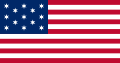     | Various: 3–2–3–2–3 or Square or Circle or 4–5–4 | Connecticut, Delaware, Georgia, Maryland, Massachusetts, New Hampshire, New Jersey, New York, North Carolina, Pennsylvania, Rhode Island, South Carolina, Virginia | June 14, 1777 – May 1, 1795 | 18 years |
| 15 | 15 | 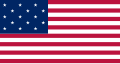 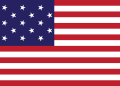 | 5 rows of 3 | Vermont, Kentucky | May 1, 1795 – July 3, 1818 | 23 years |
| 20 | 13 |   | 4 rows of 5 or Pentagram | Tennessee, Ohio, Louisiana, Indiana, Mississippi | July 4, 1818 – July 3, 1819 | 1 year |
| 21 | 13 | 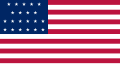 | 5–4–6–6 | Illinois | July 4, 1819 – July 3, 1820 | 1 year |
| 23 | 13 |  | 6–5–6–6 | Alabama, Maine | July 4, 1820 – July 3, 1822 | 2 years |
| 24 | 13 |  | 4 rows of 6 | Missouri | July 4, 1822 – July 3, 1836 1831 term "Old Glory" coined | 14 years |
| 25 | 13 |    | 6–5–7–7 or 5 rows of 5 | Arkansas | July 4, 1836 – July 3, 1837 | 1 year |
| 26 | 13 | 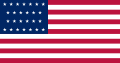 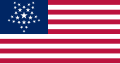 | 7–6–6–7 or Inverted pentagram with large star in center | Michigan | July 4, 1837 – July 3, 1845 | 8 years |
| 27 | 13 |  | 7–6–7–7 | Florida | July 4, 1845 – July 3, 1846 | 1 year |
| 28 | 13 | 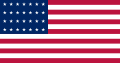 | 4 rows of 7 | Texas | July 4, 1846 – July 3, 1847 | 1 year |
| 29 | 13 |   | 8–7–6–8 or Diamond pattern | Iowa | July 4, 1847 – July 3, 1848 | 1 year |
| 30 | 13 |  | 5 rows of 6 | Wisconsin | July 4, 1848 – July 3, 1851 | 3 years |
| 31 | 13 | 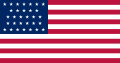 | 7–5–6–6–7 | California | July 4, 1851 – July 3, 1858 | 7 years |
| 32 | 13 | 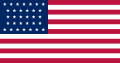 | 7–6–6–6–7 | Minnesota | July 4, 1858 – July 3, 1859 | 1 year |
| 33 | 13 | 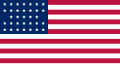    | 7–7–5–7–7 or Various patterns | Oregon | July 4, 1859 – July 3, 1861 | 2 years |
| 34 | 13 |   | 7–7–6–7–7 or Circle pattern | Kansas | July 4, 1861 – July 3, 1863 | 2 years |
| 35 | 13 |   | 5 rows of 7 or Circle pattern | West Virginia | July 4, 1863 – July 3, 1865 | 2 years |
| 36 | 13 |   | 8–6–8–6–8 or Wagon wheel pattern | Nevada | July 4, 1865 – July 3, 1867 | 2 years |
| 37 | 13 |    | 7–8–7–8–7 or 8–7–7–7–8 or Two concentric rings | Nebraska | July 4, 1867 – July 3, 1877 | 10 years |
| 38 | 13 |    | 7–8–8–8–7 or 8–7–8–7–8 or Circle pattern | Colorado | July 4, 1877 – July 3, 1890 | 13 years |
| 43 | 13 |  | 8–7–7–7–7–7 | North Dakota, South Dakota, Montana, Washington, Idaho | July 4, 1890 – July 3, 1891 | 1 year |
| 44 | 13 |  | 8–7–7–7–7–8 | Wyoming | July 4, 1891 – July 3, 1896 | 5 years |
| 45 | 13 |  | 8–7–8–7–8–7 | Utah | July 4, 1896 – July 3, 1908 | 12 years |
| 46 | 13 | 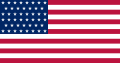 | 8–7–8–8–7–8 | Oklahoma | July 4, 1908 – July 3, 1912 | 4 years |
| 48 | 13 | 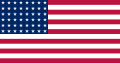 | 6 rows of 8 | New Mexico, Arizona | July 4, 1912 – July 3, 1959 | 47 years |
| 49 | 13 |  | 7 rows of 7 | Alaska | July 4, 1959 – July 3, 1960 | 1 year |
| 50 | 13 |  | 6–5–6–5–6–5–6–5–6 | Hawaii | July 4, 1960 – present | 65 years |
Symbolism
The flag of the United States is the nation's most well-known symbol. In the United States, flags are often seen on public buildings, homes, car windows, and clothing. Because the United States became a very important country in the 20th century, its flag is one of the most recognized symbols in the world and stands for the United States.
The flag is a symbol of Americanism and is shown on many special occasions. Big flags are sometimes used by stores to attract customers. People have deep respect for the flag. Even though some tried to stop it, damaging the flag is allowed as a way of free speech under the First Amendment to the United States Constitution. This shows how the United States values freedom, even the freedom to disagree or protest.
Color symbolism
When the flag was officially chosen in 1777, the colors red, white, and blue did not have an official meaning. But in 1782, Charles Thomson, who was in charge of the government at the time, explained the meaning of these colors when he showed a design for the U.S. seal:
The colours of the pales are those used in the flag of the United States of America; White signifies purity and innocence, Red, hardiness & valor, and Blue, the colour of the Chief signifies vigilance, perseverance & justice.
These ideas have been widely accepted, though others have shared their own thoughts as well:
-
Henry Ward Beecher spoke about the Fort Sumter Flag in 1865.
-
In 1986, President Ronald Reagan shared his view.
-
A meaning linked to George Washington claims that we took the stars from the sky, the red from our original country, separating it with white stripes.
Design
The U.S. flag has thirteen red and white stripes and a blue rectangle in the top left corner with fifty white stars. The stripes stand for the thirteen original colonies, and the stars stand for the fifty states.
The colors red, white, and blue come from the flag of the United Kingdom. Some government groups use special colors for making flags, like "Old Glory Red," "Old Glory Blue," and "White." The flag can sometimes have a golden fringe around the edges for special displays, like in parades.
| Pantone Identifier | RGB | CMYK | ||||||
|---|---|---|---|---|---|---|---|---|
| R | G | B | 8-bit hex | C | M | Y | K | |
| White | 255 | 255 | 255 | #FFFFFF | 0.00 | 0.00 | 0.00 | 0.00 |
| PMS 193C | 191 | 10 | 48 | #BF0A30 | 0.00 | 0.95 | 0.75 | 0.25 |
| PMS 281C | 0 | 32 | 91 | #00205B | 1.00 | 0.65 | 0.00 | 0.64 |
| Pantone Identifier | RGB | CMYK | ||||||
|---|---|---|---|---|---|---|---|---|
| R | G | B | 8-bit hex | C | M | Y | K | |
| White | 255 | 255 | 255 | #FFFFFF | 0.00 | 0.00 | 0.00 | 0.00 |
| PMS 186C | 187 | 19 | 62 | #C8102E | 0.00 | 0.90 | 0.67 | 0.27 |
| PMS 288C | 0 | 45 | 114 | #002D72 | 1.00 | 0.61 | 0.00 | 0.55 |
| Color | RGB | CMYK | ||||||
|---|---|---|---|---|---|---|---|---|
| R | G | B | 8-bit hex | C | M | Y | K | |
| White | 255 | 255 | 255 | #FFFFFF | 0.00 | 0.00 | 0.00 | 0.00 |
| Red | 187 | 19 | 62 | #BB133E | 0.00 | 0.90 | 0.67 | 0.27 |
| Blue | 0 | 33 | 71 | #002147 | 1.00 | 0.54 | 0.00 | 0.72 |
| Color | RGB | CMYK | ||||||
|---|---|---|---|---|---|---|---|---|
| R | G | B | 8-bit hex | C | M | Y | K | |
| White | 255 | 255 | 255 | #FFFFFF | 0.00 | 0.00 | 0.00 | 0.00 |
| Red | 179 | 25 | 66 | #B31942 | 0.00 | 1.00 | 0.66 | 0.13 |
| Blue | 10 | 49 | 97 | #0A3161 | 0.90 | 0.49 | 0.00 | 0.62 |
Display and use
The American flag is seen at public buildings and many homes all year. It is shown on important days such as Memorial Day, Veterans Day, Presidents' Day, Flag Day, and Independence Day. The flag is also flown at half-staff until noon on Memorial Day to honor those who died in U.S. wars.
The United States Flag Code gives rules on how to show the flag. The flag should never touch the ground and should be lit at night. If the flag becomes worn, it should be fixed or replaced. Old flags are retired in special ceremonies. The flag should never be used as clothing or for decoration on things meant to be thrown away. Though these rules are laws, people are mostly free to choose how they display the flag.
When placed on vehicles, the flag should have the blue field facing forward. The flag has been used on U.S. spacecraft and appears in museums. Flags are displayed at important places such as the White House, the Washington Monument, and war memorials. The flag is shown on special days like Martin Luther King Jr. Day, Presidents' Day, Mother's Day, Father's Day, Labor Day, Thanksgiving Day, and Christmas Day.
The flag is flown at half-staff as a sign of respect on certain days such as Memorial Day and Pearl Harbor Remembrance Day.
Folding for storage
When the flag is not being used, it is often folded into a neat triangle. Two people hold the flag so it lies flat. They fold the bottom half over the top, then fold it again. Next, they make a rectangle and then start making triangles by folding one corner over the other. This continues until the flag is a small triangle, with only the blue stars showing. Some groups have special words they say while folding the flag.
Use in funerals
The flag of the United States is sometimes used in special ceremonies for people who have served their country. During these ceremonies, the flag is placed on the coffin as a sign of respect. When the coffin is lowered, the flag is folded carefully and given to the family.
Surviving historical flags
This section lists flags that have survived from important moments in history.
Revolutionary War
- Forster Flag (1775) – This flag was carried by soldiers from Manchester during the battles of Lexington and Concord. It is the oldest known flag showing the 13 colonies. It might have been a British flag with its design changed.
- Westmoreland Flag (1775?) – Used by soldiers from Westmoreland County, Pennsylvania. It is in very good shape, suggesting it may not have been used in many battles.
- Brandywine flag (1777) – This flag was used at the Battle of Brandywine, one of the earliest battles after the first flag rules were made.
- Dansey Flag (1777) – Captured by a British soldier during a fight in Delaware, this flag was kept as a trophy in England before being returned to the United States.
- First Pennsylvania Rifles Flag (1776?) – This flag belonged to a group of soldiers formed in 1775. They fought in many important battles during the war.
- Third New York Regiment Flag (1779) – Given to soldiers from New York, this flag later inspired the state’s current flag design.
War of 1812
- Star Spangled Banner Flag (1814) – This huge flag flew over Fort McHenry during a British attack. It inspired the song that became the United States’ national anthem.
Antebellum Period
- Fillmore Flag – A flag similar to ones from the Battle of Bennington, kept in a museum. It was made sometime in the early 1800s.
- Old Glory Flag – The first flag called “Old Glory.” A sea captain named William Driver received it from his mother and took it on his voyages.
- Matthew Perry Expedition Flag (1853) – This flag was the first American flag to fly in Japan, raised in 1853 during a trip to open trade relations.
Civil War
- Fort Sumter Flag (1861) – This flag was raised above Fort Sumter in South Carolina when the fort was attacked, marking the start of the Civil War. It was taken down when the fort surrendered but raised again after the war ended.
- Abraham Lincoln Assassination Flag (1865) – This flag was placed near President Abraham Lincoln after he was fatally injured.
Reconstruction
- Little Big Horn Guidon – This flag was carried by soldiers during the Battle of Little Big Horn in 1876. All the soldiers in that battle were killed.
World War II
- Iwo Jima Flag (1945) – This flag was raised on Mount Suribachi during the Battle of Iwo Jima. A famous photograph of this moment became an iconic image of the war.
Cold War
- Freedom 7 Flag (1961) – This flag traveled on the Freedom 7 spacecraft, becoming the first American flag to go into space.
Modern day
- 9/11 Flag (2001) – This flag was found near the World Trade Center site after the 9/11 attacks. It was raised on a broken pole and became a symbol of hope and recovery. The real flag was found many years later and is now kept in a museum.
Related flags
Main article: List of flags of the United States
The U.S. flag has inspired many other flags for different places and groups. Some other countries with flags that look similar include Chile, Cuba, Greece, Togo, and Uruguay. Many flags of U.S. states and territories also use stars, stripes, and the colors red, white, and blue.
The Confederate States of America used flags that looked like the American flag. The flag of Liberia looks very similar to the U.S. flag and has 11 stripes to honor the people who started the country. Other flags inspired by the U.S. flag include those of Malaysia, the Philippines, El Salvador, and Brittany.
Unicode
The flag of the United States can be shown as an emoji using special symbols in Unicode. The symbols U+1F1FA 🇺 and U+1F1F8 🇸 make the "🇺🇸" flag. Some platforms use U+1F1FA 🇺 and U+1F1F2 🇲 for the United States Minor Outlying Islands, which looks like 🇺🇲.
Images
Related articles


.svg?width=330)
This article is a child-friendly adaptation of the Wikipedia article on Flag of the United States, available under CC BY-SA 4.0.
Images from Wikimedia Commons. Tap any image to view credits and license.