 Safekipedia
Niue
Adapted from Wikipedia · Adventurer experience
Niue is a self-governing island country in free association with New Zealand. It is located in the South Pacific Ocean and is part of Polynesia. Niue is known as "The Rock" because it is one of the world's largest coral islands.
The island is shaped like a triangle, sitting between Tonga, Samoa, and the Cook Islands. It is about 2,400 kilometres northeast of New Zealand and has a land area of roughly 261 square kilometres. In 2022, the population was 1,689 people.
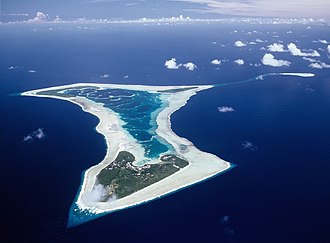
Niue has two main levels of terrain. The higher level is a limestone cliff along the coast, with a plateau in the centre reaching about 60 metres above sea level. The lower level is a coastal terrace about half a kilometre wide and 25 to 27 metres high. A coral reef surrounds the island, with the only major break near the capital, Alofi.
Niue is divided into 14 villages, each with its own council. These villages also serve as electoral districts, sending representatives to the Niue Assembly, or parliament. Niue is part of the Realm of New Zealand, so New Zealand handles most diplomatic relations for the country. Niueans are citizens of New Zealand, and Charles III serves as the head of state as King of New Zealand.
Most Niuean people live in New Zealand, and the country is bilingual, with many speaking both Niuean and English. Niue is a parliamentary democracy, holding legislative elections every three years. Though not a member of the United Nations, Niue works with some UN agencies and attends United Nations conferences as a freely associated state. It has been a member of the Pacific Community since 1980.
History
Main articles: History of Niue and British Western Pacific Territories
People from Samoa first settled on Niue around the year 900. Later, people from Tonga arrived in the 1500s. For many years, Niue did not have one leader for the whole island; instead, local chiefs and family leaders made decisions.
The first Europeans to see Niue were sailors led by Captain James Cook in 1774. He tried three times to land but was not allowed. He called the island “Savage Island” because he thought the people greeting him had red paint on their faces. The red substance was actually from a local banana.
In the 1800s, Christian missionaries arrived. One missionary, Nukai Peniamina, was trained in Samoa and returned to Niue to teach Christianity. He was allowed to stay in one village and slowly, Christianity spread across the island.
In 1900, Niue’s leaders asked Queen Victoria of Britain for protection. Britain later made Niue part of New Zealand in 1901. In 1974, Niue became self-governing, meaning it could make its own decisions but still had ties to New Zealand.
In 2004, a big storm named Cyclone Heta damaged much of the island. In 2020, Niue became the first whole country to be named an International Dark Sky Sanctuary for its very dark night skies. In 2022 and 2023, the United States officially recognized Niue as an independent nation.
Geography
Main article: Geography of Niue
See also: List of villages in Niue
Niue is a raised coral atoll in the southern Pacific Ocean, east of Tonga. It is one of the world's largest coral islands and is called "The Rock." The island has steep limestone cliffs along the coast and a flat middle area that rises to about 60 metres above sea level. A coral reef surrounds the island, with the only big break in the reef near the capital, Alofi.
Some Niue soils are special, with elements found deep in the ocean. These soils have lots of phosphate but are not good for plants. Niue has a tropical rainforest climate with warm temperatures and rain all year. Niue is trying to use more renewable energy and has put up solar panels to help. The island made its whole exclusive economic zone a marine park, but it will be hard to manage with few resources.
See also: Niue Nukutuluea Multiple-Use Marine Park
Government and politics
Main article: Politics of Niue
The Niue Constitution Act of 1974 gives power to His Majesty the King in Right of New Zealand and the Governor-General of New Zealand. The government works through a Cabinet led by the Prime Minister, who is currently Dalton Tagelagi. The Cabinet includes three other ministers, and they are all members of the Niue Assembly, which is the nation’s parliament.
The Assembly has 20 members. Fourteen are elected from village areas, and six are elected by all voters. Everyone born in Niue must be registered to vote. There are no political parties; all members act independently. The Assembly chooses a Speaker and then elects the Prime Minister. Elections happen every three years, with the most recent one on 29 April 2023.
The judiciary includes a High Court and a Court of Appeal, with higher appeals going to the Judicial Committee of the Privy Council in London.
Defence and foreign affairs
Main article: Foreign relations of Niue
See also: Political status of the Cook Islands and Niue
Niue has been a self-governing state in free association with New Zealand since 1974. Niue handles its own internal matters. For defence and some foreign affairs, New Zealand still has responsibility. Niue has its own representative office in Wellington, New Zealand.
At first, New Zealand managed Niue’s foreign relations and defence. Now, Niue has started to handle many of these areas on its own. Niue belongs to groups like the Pacific Islands Forum and has joined many international agreements. It is not a member of the United Nations but has signed important treaties.
Niue does not have its own army. New Zealand’s military protects Niue and its waters. This includes navy ships and air support. Niue’s waters cover a large area of about 317,500 square kilometres.
People from Niue have served with the New Zealand military. During World War I, Niueans joined the New Zealand forces.
Economy
Main article: Economy of Niue
Niue's economy is small. It uses the New Zealand dollar for money.
The government has a plan called the Niue Integrated Strategic Plan to help the country grow. A big storm named Cyclone Heta slowed these plans, so the country focused on fixing things after the storm. In 2004, New Zealand gave money to help rebuild.
Joint ventures
In 2003 and 2004, the government worked with a company from New Zealand to develop fishing and a farm for making juice from a fruit called noni. They also started a company to process fish, mainly tuna, for selling to other countries.
Mining
In 2005, a company from Australia thought Niue might have a lot of uranium, but later they found nothing useful and stopped their plans.
Debt
In 2016, Niue finished paying off all its debts. The government plans to use the money saved to help people. Niue still gets money from New Zealand each year and depends on it for support.
Revenue
In the past, money sent home by people living in New Zealand helped Niue a lot. Now, most families live in New Zealand, so this help has stopped. Foreign aid, mostly from New Zealand, is now a big part of Niue's money. Other money comes from taxes and selling things like phone lines.
Internet
In 1997, Niue started using the internet address .nu. The money from this helped build internet services on the island. In 2003, Niue became the first place to give free wireless internet to everyone. In 2026, Niue allowed a company called Starlink to provide internet services.
Agriculture
Farming is very important to Niue. Many families grow their own food, like taro, yams, and bananas. They also grow vanilla and noni for selling. Niue is famous for its pink taro, which is strong and does not get sick easily.
Tourism
Tourism, fishing, and farming are important for Niue's economy. The only airport is Niue International Airport, and Air New Zealand flies there twice a week. Niue became the first country to have very dark skies, which is good for stargazing. Tourists can join guided tours to see the stars.
Information technology
In 1986, Niue started using computers to count people. In 2003, Niue became the first country to give free wireless internet to everyone. In 2015, all villages got connected with a fibre optic cable.
Demographics
The 2022 census counted 1,681 people living in Niue. This is a small drop from the number in 2017. Most people live in villages such as Alofi South, Alofi North, Hakupu, and Tamakautoga.
Niue's official languages are English and Niuean. Many people practice Christianity, with the Ekalesia Niue Church being the biggest group. Children go to school from age five to 16. Some can earn scholarships to study in New Zealand or other places.
| Year | Pop. | ±% |
|---|---|---|
| 1900 | 4,015 | — |
| 1911 | 3,943 | −1.8% |
| 1921 | 3,750 | −4.9% |
| 1931 | 3,797 | +1.3% |
| 1945 | 4,253 | +12.0% |
| 1951 | 4,553 | +7.1% |
| 1961 | 4,864 | +6.8% |
| 1971 | 4,990 | +2.6% |
| 1981 | 3,281 | −34.2% |
| 1991 | 2,239 | −31.8% |
| 2001 | 1,788 | −20.1% |
| 2011 | 1,611 | −9.9% |
| 2022 | 1,681 | +4.3% |
| Source: | ||
Culture
See also: Music of Niue and Niuean mythology
Niue is where the artist and writer John Pule was born. He wrote a book and painted designs from a special material called tapa cloth.
The government of Niue has a department called Taoga Niue that helps protect the island's culture and traditions.
Media
Niue has two places for news: Television Niue and Radio Sunshine. These are run by the Broadcasting Corporation of Niue. There is also one newspaper called the Niue Star.
Arts and culture
Hiapo is a special art from Niue. It is made from tree bark and decorated with natural colors. Some famous Niuean hiapo artists are John Pule and Cora-Allan Wickliffe.
Takalo is a dance from Niue. It is done at special events.
Museums
See also: List of museums in Niue
In 2004, a big storm damaged a museum. In 2018, a new museum opened.
Cuisine
Because Niue is an island, many foods come from nature, like coconuts, fruits, and vegetables. The island’s most famous dish is Takihi. It is made from coconut cream and slices of taro and papaya, layered like a cake. It is cooked in a special oven.
Sport
See also: Rugby union in Niue
Even though Niue is small, many sports are enjoyed there. Rugby union is the most popular sport, and both men and women play it. Netball is played only by women. There is a small golf course and a place to play bowling. Association football is also popular.
Niue takes part in the Commonwealth Games, but it is not part of the International Olympic Committee, so it does not compete in the Olympic Games.
Images
Related articles


This article is a child-friendly adaptation of the Wikipedia article on Niue, available under CC BY-SA 4.0.
Images from Wikimedia Commons. Tap any image to view credits and license.