 Safekipedia
Orion Nebula
Adapted from Wikipedia · Adventurer experience
The Orion Nebula (also known as Messier 42, M42, or NGC 1976) is a diffuse nebula in the Milky Way. It is south of Orion's Belt in the constellation of Orion. It looks like the middle "star" in the "sword" of Orion.
It is one of the brightest nebulae and can be seen with the naked eye at night. It is about 1,267 light-years from Earth.
The Orion Nebula is about 25 light-years across. It has a mass of about 2,000 times that of the Sun.
Astronomers study the Orion Nebula a lot. It helps us learn how stars and planets are born from clouds of gas and dust. They have seen protoplanetary disks and brown dwarfs there.
Physical characteristics
The Orion Nebula can be seen without a telescope, even in places with bright city lights. It looks like the middle "star" in the "sword" of Orion, the three stars below Orion's Belt. To people with very good eyesight, this "star" looks fuzzy, and using binoculars or a small telescope makes the nebula, or cloudy area, very clear.
Inside the Orion Nebula is a group of very young stars called the Trapezium Cluster. This cluster has four main stars that form a shape like a trapezoid. The nebula is surrounded by a big cloud of gas and dust.
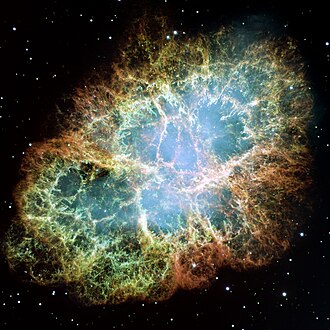
The nebula has a mix of colors. It often looks greenish, with areas of red and blue-violet. The red color comes from hot gas, while the blue-violet color is reflected light from hot stars in the center. The green color puzzled scientists until they learned it was caused by light from oxygen atoms in the nebula.
History
Some people think the ancient Mayans of Central America may have talked about the Orion Nebula in their stories. Many famous astronomers have observed it over the years. The first detailed drawing of the nebula was made in 1659 by Christiaan Huygens.
The nebula was added to a list of deep sky objects in 1774 by Charles Messier. In 1865, William Huggins showed that the nebula was made of glowing gas. Since then, many detailed images have been taken, showing stars and other objects that are too faint to see without a telescope.
John Herschel studied the nebula from Cape Town, South Africa between 1834 and 1838.
In 1993, the Hubble Space Telescope began observing the Orion Nebula. These images helped scientists understand the shape of the nebula and see how new stars are forming. In 2023, the James Webb Space Telescope found pairs of planet-like objects in the nebula. In 2025, it captured the first direct images of a planet forming around a young star in the nebula.
Structure
The Orion Nebula is a big area in the sky. It has clouds of gas and dust, groups of stars, glowing gas, and reflection nebulae.
It is part of a bigger nebula called the Orion molecular cloud complex. This complex fills the whole constellation of Orion. Many new stars are forming here, especially in tight groups that light up the Orion Nebula.
The nebula has a glowing center around a bright star. Cooler gas and dust surround it. People have given special names to different parts of the nebula, like "Sinus Magnus" and "The Wings".
Star formation
The Orion Nebula is a special place in the sky where new stars are being born. Scientists have found about 700 stars there.
Stars form when clouds of hydrogen and other gases come together. As the clouds squeeze tighter, they get very hot. When they get hot enough, they start a fire inside called nuclear fusion, and a star is born. After a star is born, there is often a leftover cloud of material around it. This is where planets might start to form. Recent observations show that these clouds have tiny bits of dust that are growing.
Once stars are born, they send out streams of particles. These streams push on the gas around them and shape the clouds. They also help move the gas in the nebula. The gas in the Orion Nebula moves in complex ways.
Evolution
Interstellar clouds like the Orion Nebula are found in galaxies such as the Milky Way. These clouds start as cold blobs of hydrogen with traces of other elements. Gravity pulls the cloud together, but the gas pressure inside balances this pull.
Events like collisions with a spiral arm or shock waves from supernovae can cause the atoms to form heavier molecules, leading to the birth of stars. This process usually takes many millions of years. As parts of the cloud collapse, they form disks that concentrate into stars, sometimes with disks of material around them. The Orion Nebula is currently in this stage, with new stars still forming.
The youngest and brightest stars in the Orion Nebula are less than 300,000 years old. These massive stars give off strong ultraviolet light, which pushes away the surrounding gas and dust. This creates the empty space in the center of the nebula, allowing us to see the stars within. Over time, most of the gas and dust will be blown away, leaving behind a group of young, bright stars.
Images
Related articles


This article is a child-friendly adaptation of the Wikipedia article on Orion Nebula, available under CC BY-SA 4.0.
Images from Wikimedia Commons. Tap any image to view credits and license.