Star
This article is about the astronomical object. For other uses, see Star (disambiguation) and Stars (disambiguation).
A star is a glowing ball of plasma held together by its own self-gravity. The nearest star to Earth is the Sun, which is a G-type main-sequence star. You can see many other stars with your eyes at night. They are so far away that they look like fixed points of light. People have grouped the brightest stars into constellations and asterisms. Many of the brightest stars have proper names. Astronomers make star catalogues that list known stars and give them standard stellar designations. The observable universe may contain a huge number of stars. Only about 4,000 of them can be seen without a telescope, and all of them are in the Milky Way galaxy.
A star begins when a cloud of gas called a nebula pulls itself together under its own gravitational collapse. This gas is mostly hydrogen and helium, with small amounts of heavier elements. A star's total mass mostly decides how it changes over time and how its life ends. For most of its active life, a star shines because thermonuclear fusion changes hydrogen into helium in its core. This makes energy that moves through the star and radiates into outer space. When a star nears the end of its life, fusion stops and its core becomes a stellar remnant. This can be a white dwarf, a neutron star, or, if the star is big enough, a black hole.
Stars and their remnants make almost all of the natural chemical elements heavier than lithium, through Stellar nucleosynthesis. Stellar mass loss and supernova explosions send this material back into the interstellar medium, where it is used to make new stars. Astronomers learn about a star's mass, age, metallicity (chemical makeup), variability, distance, and movement through space. They do this by studying its apparent brightness, its spectrum, and changes in its position in the sky over time.
Stars can form groups with other astronomical objects, such as planetary systems and star systems with two or more stars. When two stars orbit very closely, their gravity can strongly affect how they change. Stars also often belong to much larger groups held together by gravity, such as star clusters and galaxies.
Etymology
The English word star comes from a very old root word, Proto-Indo-European *h₂stḗr, which also meant 'star'. That root can be split into smaller parts. One part, *h₂eh₁s-, means 'to burn', and the English word ash comes from it. The other part, *-tēr, is a suffix that names the one doing an action.
Words in other languages that come from the same origin are called cognates. They include Latin stella, Greek aster, and German Stern. Other English words from the same origin include asterisk, asteroid, astral, constellation, and Esther.
See also: Stars in astrology
Stars have been important to civilizations around the world for a very long time. People used them in religious practices, divination rituals, and mythology. Stars also helped with celestial navigation, showed the passing of the seasons, and were used to set calendars. Early astronomers noticed that "fixed stars" stayed in the same place on the celestial sphere, while "wandering stars" (planets) moved over days or weeks. Many ancient astronomers thought the stars were fixed to a heavenly sphere and never changed. Astronomers grouped bright stars into asterisms and constellations to track the planets and the Sun. The Gregorian calendar, used almost everywhere today, is based on the Sun. The oldest accurately dated star chart came from Egyptian astronomy in 1534 BC. The earliest known star catalogues were made by Babylonian astronomers in Mesopotamia during the Kassite Period.
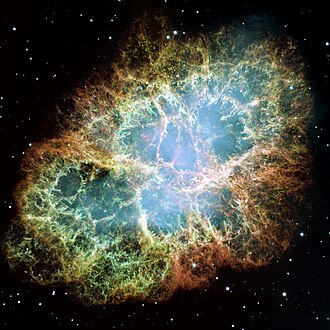
The first star catalogue in Greek astronomy was made by Aristillus with help from Timocharis. The catalogue of Hipparchus listed 1,020 stars and was used to create Ptolemy's star catalogue. Many of the constellations and star names we use today come from Greek astronomy. Even though the heavens seemed unchanging, Chinese astronomers recorded new stars appearing. In 185 AD, they were the first to write about a supernova, now known as SN 185. The brightest star event in recorded history was the SN 1006 supernova. The SN 1054 supernova created the Crab Nebula. Medieval Islamic astronomers gave Arabic names to many stars that are still used today, and they invented many astronomical instruments. Later, Tycho Brahe and Giordano Bruno helped change ideas about stars, and William Herschel studied how stars are spread across the sky. In the 1800s, Joseph von Fraunhofer and Angelo Secchi started stellar spectroscopy. Friedrich Bessel made the first direct measurement of a star's distance using parallax. In the early 1900s, Annie J. Cannon developed the modern star classification system. In 1913, the Hertzsprung–Russell diagram was developed, and Cecilia Payne-Gaposchkin proposed that stars were made mainly of hydrogen and helium. Today, individual stars have mostly been studied in the Local Group. One star called Icarus was seen far away with the help of gravitational lensing.
The idea of a constellation was known during the Babylonian period. Ancient sky watchers saw patterns in groups of stars and linked them to nature and their myths. Twelve of these patterns lay along the ecliptic and became the basis of astrology. Many of the brightest stars were given names, often in Arabic or Latin. The Sun and certain constellations also had their own myths. To the Ancient Greeks, some wandering lights called planets represented important gods. The names of Mercury, Venus, Mars, Jupiter and Saturn came from these gods. Uranus and Neptune were named later by astronomers, since they were not known in ancient times.
Around 1600, stars were named after the constellations they were in. The German astronomer Johann Bayer made star maps and used Greek letters as designations for the stars in each constellation. Later, a numbering system based on right ascension was added to John Flamsteed's star catalogue in his book "Historia coelestis Britannica" (the 1712 edition). This system became known as the Flamsteed designation. Today, the International Astronomical Union (IAU) is the recognized authority for naming stars. Its Working Group on Star Names (WGSN) lists and standardizes star names. Some private companies sell star names, but the IAU, professional astronomers, and amateur astronomers do not recognize these names. The British Library calls this an unregulated commercial enterprise. The New York City Department of Consumer and Worker Protection once issued a violation against one such company for an unfair or misleading business practice.
Units of measurement
Star sizes, masses, and brightness can be written in SI units or Gaussian units. It is often easiest to use solar units, which are based on the Sun. In 2015, the IAU set a group of standard solar values that scientists can use when describing stars:
The solar mass was not set by the IAU. The Newtonian constant of gravitation is known with much less certainty. The product of that constant and the solar mass has been measured much more precisely, so the IAU set a standard value for it:
Using this value and the 2014 CODATA estimate of the Newtonian constant, the solar mass is about 1.9885×1030 kg. Very large distances, such as the size of a giant star or the semi-major axis of a binary star system, are often measured in astronomical units. One astronomical unit is about the average distance between the Earth and the Sun, which is about 150 million km (93 million miles). In 2012, the IAU set the astronomical constant as an exact length of 149,597,870,700 m.
| nominal solar luminosity | L☉ = 3.828×1026 W |
| nominal solar radius | R☉ = 6.957×10⁸ m |
Formation and evolution
Main article: Stellar evolution
Stars form from huge clouds of gas and dust called molecular clouds. These clouds are mostly hydrogen, with some helium. Parts of a cloud can become denser and start to pull together under their own gravity. A protostar forms at the center. One place where stars are forming today is the Orion Nebula. Most stars are born in groups, and many are part of binary stars, which orbit each other.
Stars spend most of their lives as main-sequence stars. In their cores, they join hydrogen together to make helium. Stars of different sizes change in different ways as they grow old. Stars like the Sun become red giants and then leave behind a white dwarf. Very large stars become supergiants, and many end their lives in a huge explosion. After this, the core may become a neutron star. The biggest stars may become a black hole instead.
When stars die, they send materials back into space. These materials can be used to make new stars and rocky planets. Stars also slowly lose some of their mass through a flow of particles called a stellar wind. Very massive stars can lose a lot of mass even while they are still on the main sequence. Some red dwarfs live for trillions of years because they use their fuel very slowly. Scientists study binary stars closely, because many stars come in pairs or groups. This affects how stars grow and change.
Distribution
Stars are not spread evenly across space. They are usually grouped into galaxies, along with gas and dust. A large galaxy like the Milky Way has hundreds of billions of stars. Many stars are in pairs or small groups that orbit each other. Bigger groups include stellar associations, open clusters with dozens to thousands of stars, and globular clusters with hundreds of thousands. The stars in a cluster usually formed from the same giant molecular cloud, so they tend to be about the same age.
The nearest star to Earth, other than the Sun, is Proxima Centauri. It is about 4.2 light-years away. Stars rarely crash into each other because the distances are so large. In crowded places, such as the centres of some clusters, collisions happen more often and can make blue stragglers.
Characteristics
How bright a star is, how big it is, how it changes, how long it lives, and how it ends all depend mostly on how much mass it starts with. Most stars are between 1 billion and 10 billion years old, and some may be close to the age of the universe. The oldest star found so far, HD 140283, is nicknamed the Methuselah star and is estimated to be about 14.46 billion years old. Heavier stars live shorter lives because they use up their hydrogen fuel faster. The most massive stars last only a few million years, while the smallest stars, called red dwarfs, can last tens to hundreds of billions of years.
Because stars are so far away, most look like tiny points of light that twinkle because of Earth's air. The Sun looks like a disk instead. The supergiant Betelgeuse in the Orion constellation is about 640 times as wide as the Sun. Stars also have magnetic fields, which can create starspots, coronal loops, and stellar flares. Young stars spin quickly, while older stars like the Sun spin more slowly. The surface of the most massive stars can reach about 50,000 K, while the Sun's surface is a few thousand K.
| Initial mass (M☉) | Main sequence | Subgiant | First red giant | Core he burning |
|---|---|---|---|---|
| 1.0 | 9.33 | 2.57 | 0.76 | 0.13 |
| 1.6 | 2.28 | 0.03 | 0.12 | 0.13 |
| 2.0 | 1.20 | 0.01 | 0.02 | 0.28 |
| 5.0 | 0.10 | 0.0004 | 0.0003 | 0.02 |
Radiation
Stars send energy into space in two ways: as electromagnetic radiation and as particle radiation. The particle radiation is seen as the stellar wind, a stream of electrically charged protons, alpha and beta particles. Almost massless particles called neutrinos also flow out from the star's core. Energy is made in the core when atomic nuclei join together, giving off gamma ray photons. By the time this energy reaches the outer layers, it has become electromagnetic energy with a lower frequency, such as visible light.
A star's color depends on the temperature of its outer layers, including its photosphere. Stars also give off light that the human eye cannot see. This light covers the whole electromagnetic spectrum, from radio waves to X-rays and gamma rays. By studying the stellar spectrum, astronomers can learn a star's surface temperature, surface gravity, and rotational speed. A star's luminosity is the amount of light and other radiant energy it gives off in a given amount of time. It depends on the star's radius and surface temperature.
Main articles: Apparent magnitude and Absolute magnitude
| Apparent magnitude | Number of stars |
|---|---|
| 0 | 4 |
| 1 | 15 |
| 2 | 48 |
| 3 | 171 |
| 4 | 513 |
| 5 | 1,602 |
| 6 | 4,800 |
| 7 | 14,000 |
Classification
Main article: Stellar classification
Scientists began sorting stars into groups in the early 1900s. At first, stars were sorted by how strong their hydrogen line was. People thought this line only changed with temperature, but the pattern was more complicated. The line grew stronger as stars got hotter, then became weaker at the very highest temperatures. Later, the letters were put in order by temperature, and this is the system used today.
Stars are given a letter based on their light patterns, called spectra. The letters go from O for the hottest stars to M for the coolest. From hottest to coolest, the main letters are O, B, A, F, G, K, and M. Each letter has 10 smaller groups, numbered 0 to 9. Stars are also grouped by how bright they are. The groups run from 0 (hypergiants) through III (giants) to V (main-sequence dwarfs). The Sun is a main-sequence G2V yellow dwarf.
| Class | Temperature | Sample star |
|---|---|---|
| O | 33,000 K or more | Zeta Ophiuchi |
| B | 10,500–30,000 K | Rigel |
| A | 7,500–10,000 K | Altair |
| F | 6,000–7,200 K | Procyon A |
| G | 5,500–6,000 K | Sun |
| K | 4,000–5,250 K | Epsilon Indi |
| M | 2,600–3,850 K | Proxima Centauri |
Variable stars
Main article: Variable star
Variable stars get brighter and dimmer over time. This can happen because of things inside the star or things outside it. Most of the changes come from inside the star, and they fall into three main groups. Pulsating variable stars grow and shrink, so they get brighter and dimmer in cycles. These cycles can last from minutes to years, depending on the star's size. This group includes Cepheid and Cepheid-like stars and long-period variables such as Mira. Eruptive variables suddenly become brighter because of flares or material being thrown out. This group includes protostars, Wolf-Rayet stars, flare stars, and giant and supergiant stars.
Cataclysmic or explosive variable stars change in dramatic ways. This group includes novae and supernovae. In a double star system with a nearby white dwarf, the white dwarf pulls hydrogen from its companion star. When the hydrogen starts to fuse, it can cause explosions such as novae and Type Ia supernovae. Some novae repeat with outbursts of moderate strength. Stars can also change in brightness because of outside factors. For example, eclipsing binaries are stars that pass in front of each other, and rotating stars can have very large starspots. A well-known example of an eclipsing binary is Algol. It changes in brightness from 2.1 to 3.4 every 2.87 days.
Structure
Main article: Stellar structure
Inside a stable star, two forces stay in balance. This is called hydrostatic equilibrium. Gravity pulls inward, and a push from the pressure gradient pushes outward. The pressure gradient is created by differences in temperature. The core is much hotter than the outer parts, at least about 107 K in main-sequence and giant stars. This heat is enough for nuclear fusion to happen. The energy from fusion keeps the star from collapsing. Over time, a main-sequence star changes hydrogen into helium, and its core eventually becomes mostly helium. Energy also moves through the star. The amount leaving each layer matches the amount coming in from below. This is called thermal equilibrium. In some layers, energy moves as radiation, in the radiation zone. In other layers, hot material rises and cooler material sinks, which is called convection. Convection depends on the star's mass and can change as the star ages. How easily heat passes through a layer depends on its opacity.
The photosphere is the part of a star that we can see, because light can escape from this layer into space. Above it is the stellar atmosphere. In the Sun, this includes the thin chromosphere. Tiny jets called spicules appear here, and stellar flares can begin here. Above that is the very hot corona. It is easiest to see during a solar eclipse. A stream of particles called the solar wind flows outward from the Sun. It forms a bubble-shaped region called the heliosphere.
Nuclear fusion reaction pathways
Main article: Stellar nucleosynthesis
When atomic nuclei fuse, the new nucleus has less mass than the parts did. This lost mass turns into energy, following mass–energy equivalence. Different fusion reactions happen in the cores of stars, depending on their mass and what they are made of. In the Sun, hydrogen fuses into helium in the proton–proton chain reaction. Each reaction makes only a tiny amount of energy, but huge numbers of them happen all the time, and that makes all the energy the star gives off. In bigger stars, helium is made in a cycle catalyzed by carbon, called the carbon-nitrogen-oxygen cycle.
Hydrogen fusion is very sensitive to temperature. Because of this, the core temperature of main-sequence stars ranges from 4 million kelvin in a small M-class star to 40 million kelvin in a massive O-class star. In older stars, helium can become carbon through the triple-alpha process, which uses the element beryllium.
In massive stars, heavier elements burn through the neon-burning process and the oxygen-burning process. The final stage is the silicon-burning process, which produces the stable isotope iron-56. Further fusion would use up energy instead of making it, so any extra energy can only come from gravitational collapse.
| Fuel material | Temperature (million kelvins) | Density (kg/cm3) | Burn duration (τ in years) |
|---|---|---|---|
| H | 37 | 0.0045 | 8.1 million |
| He | 188 | 0.97 | 1.2 million |
| C | 870 | 170 | 976 |
| Ne | 1,570 | 3,100 | 0.6 |
| O | 1,980 | 5,550 | 1.25 |
| S/Si | 3,340 | 33,400 | 0.0315 (~11.5 days) |

Quiz time!
4 questions about Star
What is a star?
Pictures
Keep exploring


This article is a child-friendly adaptation of the Wikipedia article on Star, available under CC BY-SA 4.0.
Images from Wikimedia Commons. Tap any image to view credits and license.