Galaxy
A galaxy is a huge group of stars, planetary systems, leftover stellar material, and other objects. It also contains interstellar gas, dust, and dark matter. Gravity holds everything together. The word comes from the Greek galaxias, meaning "milky," which refers to the Milky Way galaxy that contains our Solar System. If you want to learn about Earth's galaxy, see Milky Way. For other meanings of the word, see Galaxy (disambiguation).
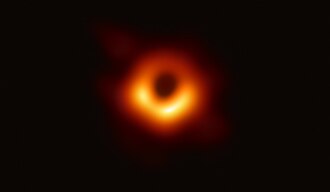
Galaxies come in many sizes. Some dwarfs have fewer than a thousand stars. The largest galaxies known, called supergiants, can have one hundred trillion stars. Each star moves around its galaxy's center of mass. Most of a typical galaxy's mass is dark matter. Only a small part of that mass is visible as stars and nebulae. Supermassive black holes are often found at the centers of galaxies.
Scientists sort galaxies by how they look. The groups include elliptical, spiral, and irregular. The Milky Way is a spiral galaxy. Some galaxies are special for other reasons. They may interact with another galaxy, make stars very quickly, or have an active galactic nucleus. Scientists estimate there are between 200 billion (2×10¹¹) and 2 trillion galaxies in the observable universe. The Milky Way is at least 26,800 parsecs (87,400 light years) across. Its nearest large neighbour, the Andromeda Galaxy, is just over 750,000 parsecs (2.4 million light years) away.
Most galaxies are held together by gravity in groups, clusters, and superclusters. The Milky Way is part of the Local Group, which it shares with the Andromeda Galaxy. That group belongs to the Virgo Supercluster. On the largest scale, these groups form sheets and filaments. Huge empty spaces called voids surround them.
Scientists understand the formation of stars quite well. They know that gravity pulls dense clouds of gas together to make stars. Galaxy formation, however, is less well understood. The process takes place over about a billion years. Galaxies sometimes collide during their lifetimes.
Etymology
The word galaxy came into English through French and Medieval Latin. It comes from the Greek name for the Milky Way, galaxías (kúklos), which means 'milky (circle)'. The name describes how the Milky Way looks like a milky band of light in the sky. In astronomy books, the capitalised word "Galaxy" often means the Milky Way galaxy. This helps tell it apart from the other galaxies in the universe.
Galaxies were first found with telescopes, and people called them spiral nebulae. Most astronomers in the 1700s and 1800s thought they were either star clusters or extragalactic nebulae. Their true nature was still a mystery. Larger telescopes showed a few nearby bright galaxies, like the Andromeda Galaxy, as large groups of stars. They looked very faint and held so many stars that they seemed to be far beyond the Milky Way. People often called them island universes. Harlow Shapley suggested the word "galaxy" instead of "universes" or "nebula," but the very influential Edwin Hubble kept using "nebulae." The name did not fully change until after Hubble died in 1953.
Nomenclature
Millions of galaxies have been counted and listed, but only a few have well-known names. Some examples are the Andromeda Galaxy, the Magellanic Clouds, the Whirlpool Galaxy, and the Sombrero Galaxy. Astronomers use numbers from several catalogues to name galaxies. These include the Messier catalogue, the NGC (New General Catalogue), the IC (Index Catalogue), the CGCG (Catalogue of Galaxies and of Clusters of Galaxies), the MCG (Morphological Catalogue of Galaxies), the UGC (Uppsala General Catalogue of Galaxies), and the PGC (Catalogue of Principal Galaxies, also called LEDA). Famous galaxies can appear in more than one of these lists, but each list gives them a different number.
For example, Messier 109 (or "M109") is a spiral galaxy. It has the number 109 in the Messier catalogue, and it has other names in other catalogues. Millions of fainter galaxies are known by codes from sky surveys, such as the Sloan Digital Sky Survey.
Observation history
Main article: Milky Way
See also: Observational astronomy
Long ago, Greek philosopher Democritus suggested that the bright band in the night sky, the Milky Way, might be made of many distant stars. Aristotle had a different idea. In 1610, Italian astronomer Galileo Galilei looked at the Milky Way through a telescope and saw that it was made of a huge number of faint stars. In 1785, William Herschel counted stars in different parts of the sky to draw a picture of the galaxy's shape.
Some galaxies outside the Milky Way, such as the Andromeda Galaxy, can be seen on a dark night without a telescope. In the 1920s, Edwin Hubble showed that some spiral clouds of light were much too far away to be part of the Milky Way. In the 1970s, Vera Rubin noticed something puzzling about how fast galaxies spin. Scientists think this may be explained by dark matter, which we cannot see. Beginning in the 1990s, the Hubble Space Telescope gave scientists clearer pictures of the universe.
Types and morphology
See also: Galactic bulge, Central massive object, Active galactic nucleus, and Galaxy morphological classification
Galaxies come in three main types: ellipticals, spirals, and irregulars. A more detailed way to sort them is the Hubble sequence. It only looks at shape, so it can miss things like how quickly star formation happens in starburst galaxies and what happens in the centers of active galaxies. Many galaxies are thought to have a huge black hole at their center. The Milky Way is one of them, and its core region is called the Galactic Center.
Main article: Elliptical galaxy
Elliptical galaxies are rated from E0, which is almost round, to E7, which is very stretched out. They look smooth and have little interstellar matter and few open clusters, so they make few new stars. Most of their stars are older evolved stars, which are a bit like the much smaller globular clusters. Their overall shape is ellipsoidal. The largest galaxies are the supergiant type-cD galaxies. They have a faint halo of stars. Scientists are still studying how they form. The main idea is that they grow by joining with smaller galaxies. Another idea involves cooling flow, which has been seen in clusters such as Perseus and the Phoenix Cluster.
Main article: Type-cD galaxy
Some elliptical galaxies have shells of stars, as in NGC 3923, which has over 20 shells.
Spiral galaxies look like spinning pinwheels. Most of their mass is in a roughly round halo of dark matter. They have a central bulge of older stars, with bright arms reaching outward. Some spiral arms are faint, called a flocculent spiral galaxy. Others are bold and clear, called a grand design spiral galaxy. Many spirals, including the Milky Way, have a bar of stars through the core that connects to the arms. The bar may form from a tidal interaction with another galaxy. The Milky Way is a large barred-spiral galaxy with about two hundred billion (2×11) stars.
Main articles: Spiral galaxy and Barred spiral galaxy
Other galaxies have unusual shapes. Peculiar galaxies are shaped by tidal interactions, such as a ring galaxy that may have formed when a small galaxy passed through a spiral galaxy like the Andromeda Galaxy, seen in infrared light. A lenticular galaxy mixes features of ellipticals and spirals, and barred lenticular galaxies also exist. Irregular galaxies, including the Magellanic Clouds, do not fit neatly into either group. Most galaxies are actually small dwarf galaxies, with only a few billion stars, which often include young, hot, massive stars. Many orbit larger galaxies. The Local Group holds many dwarfs, which are classed as irregular, dwarf elliptical, or dwarf spheroidal galaxies. Studies suggest that dwarf galaxies have a central mass of about 10 million solar masses. Dark matter may play a large role in them, possibly warm dark matter.
Main article: Dwarf galaxy
Main article: Interacting galaxy
Main article: Starburst galaxy
Main article: Radio galaxy
Main article: Active galactic nucleus
Main article: Seyfert galaxy
Main article: Quasar
Main article: Luminous infrared galaxy
Galaxies often meet and interact with each other. These meetings can be an important part of galactic evolution. When galaxies pass close by, tidal interactions can bend their shapes. When two galaxies pass straight through each other, their stars usually do not crash into one another. But the gas and dust inside them can mix, and sometimes new stars form. If one galaxy is much bigger, it can pull apart the smaller one. This is called cannibalism. The Milky Way is doing this now to the Sagittarius Dwarf Elliptical Galaxy and the Canis Major Dwarf Galaxy. Some galaxies make stars very quickly. This is called a starburst. Starbursts usually last only about ten million years. They are often linked to galaxies that join together or interact, such as M82, which came close to the larger M81.
Some galaxies have a bright center powered by a supermassive black hole. These are called active galaxies. Radio galaxies have huge areas of radio energy that reach far beyond their visible shapes. Jets from an active galactic nucleus power this energy. The most energetic and distant active galaxies are quasars, and the ones with lower energy are Seyfert galaxies. Luminous infrared galaxies are very bright in infrared light. They are believed to form when spiral galaxies strongly interact and merge.
Physical diameters
Galaxies do not have a clear edge. Their stars become less crowded the farther you go from the center, so it is hard to say how big they really are. Even so, astronomers have found several ways to measure galaxy sizes. As early as 1936, when Edwin Hubble worked, people tried to describe galaxy diameters. The first method used the angle a galaxy covers in the sky and its estimated distance. This gave the angular diameter, also called the "metric diameter." Later, the isophotal diameter became a standard way to measure size using brightness. Isophotes are curves that join points of equal brightness on a picture of a galaxy. A galaxy's brightness is measured in magnitudes per square arcsecond. A typical galaxy has a brightness of 18 mag/arcsec2 at its center. The isophotal diameter usually includes all the light down to 25 mag/arcsec2 in the blue B-band. This is called the D25 standard.
Another common measure is the half-light radius, also called the effective radius (Re). It is the distance from the center where half of the galaxy's total brightness is found. Gérard de Vaucouleurs first proposed it in 1948. Later, José Luis Sérsic used it in 1968 to describe the relationship between mass and radius in galaxies. Another method, the Petrosian magnitude, was first described by Vahe Petrosian in 1976. A changed version of it was used by the Sloan Digital Sky Survey. The Infrared Processing and Analysis Center criticized an earlier version of this method. The 2MASS survey used a method based on near-infrared light, which can show dimmer, cooler, and older stars. In that method, the standard area of the galaxy is set by an isophote of 20 mag/arcsec2 in the Ks band.
| galaxy | diameter |
|---|---|
| Large Magellanic Cloud | 9.96 kiloparsecs (32,500 light-years) |
| Milky Way | 26.8 kiloparsecs (87,400 light-years) |
| Messier 87 | 40.55 kiloparsecs (132,000 light-years) |
| Andromeda Galaxy | 46.58 kiloparsecs (152,000 light-years) |
Larger-scale structures
Seyfert's Sextet is an example of a small galaxy group. Galaxies are often found in groups and clusters. Only about 5% of galaxies that have been studied are isolated. This means they have not interacted much with other galaxies of similar size in the past few billion years. Most galaxies are pulled by gravity toward other galaxies, forming a fractal-like pattern. The smallest of these groupings are called groups. They contain most galaxies and most of the baryonic matter in the universe. To stay together in a group, each galaxy must move slowly enough not to escape (see Virial theorem). Clusters hold hundreds to thousands of galaxies. They are often led by one giant galaxy, the brightest cluster galaxy. This giant galaxy tidally pulls apart its smaller neighbours over time and adds their material to its own. On the largest scale, the universe keeps expanding, so the distances between galaxies generally grow (see Hubble's law).
Superclusters contain tens of thousands of galaxies. At the supercluster scale, galaxies are arranged into sheets and long threads, with vast empty spaces between them. Beyond this scale, the universe looks the same in every direction (isotropic), though recent discoveries of very large structures have challenged this idea. The Hercules–Corona Borealis Great Wall is the largest structure found so far. It is 10 billion light-years long. The Milky Way is a member of the Local Group, a small group about one megaparsec across. The Andromeda Galaxy is the other brightest galaxy in this group. The Local Group is part of a cloud-like structure within the Virgo Supercluster, which is centred on the Virgo Cluster. The Virgo Supercluster is, in turn, part of the Laniakea Supercluster.
Magnetic fields
Galaxies have magnetic fields of their own. These fields affect how galaxies change in several ways. They help shape spiral arms and move spin energy through gas clouds. This matters because it helps gas clouds collapse under gravity, which is needed for stars to form.
For spiral galaxies, the typical average equipartition strength is about 10 μG (microgauss), or 1 nT (nanotesla). For comparison, Earth's magnetic field averages about 0.3 G (Gauss), or 30 μT (microtesla). Galaxies that give off little radio energy, like M31 and M33, are neighbors of the Milky Way. They have weaker fields of about 5 μG. Gas-rich galaxies that form stars quickly, like M51, M83 and NGC 6946, average 15 μG. In bright spiral arms, where cold gas and dust also gather, the field can reach 25 μG. The strongest fields, 50–100 μG, were found in starburst galaxies, such as M82 and the Antennae. They were also found in the central starburst areas of NGC 1097 and other barred galaxies.
Formation and evolution
Scientists' current ideas about how early galaxies formed are based on the ΛCDM model. About 300,000 years after the Big Bang, hydrogen and helium atoms began to form. This event is called recombination. No stars had formed yet, so this time is called the "dark ages". Small differences in density let larger structures begin to appear. Gas gathered in cold dark matter halos to form protogalaxies. These were large clouds of gas that came before the first galaxies. As the gas gathered, it grew hotter and denser, and some parts formed stars.
The first stars, called Population III stars, were made almost entirely of hydrogen and helium. The biggest of them ended in supernova explosions. These spread heavy elements into the interstellar medium. Within about a billion years, groups of stars called globular clusters appeared, along with a supermassive black hole at the center and a galactic bulge. Over the next two billion years, the matter settled into a galactic disc. Galaxies keep taking in material from high-velocity clouds and dwarf galaxies. Over time, the formation of planets became possible. Galaxies can also change when they meet others. The Milky Way and the Andromeda galaxy are moving toward each other. They might join together in about five to six billion years.
Main article: Future of an expanding universe
Spiral galaxies, like the Milky Way, keep making new stars as long as they have dense molecular clouds of hydrogen in their arms. Elliptical galaxies have little of this gas, so they make few new stars. In the very far future, the "stellar age" will end, after about 1013–1014 years, as the smallest, longest-lived red dwarfs fade. Galaxies will then be made mostly of compact objects, such as brown dwarfs, white dwarfs, neutron stars, and black holes.

Quiz time!
4 questions about Galaxy
Where does the word "galaxy" come from?
Pictures
Keep exploring




This article is a child-friendly adaptation of the Wikipedia article on Galaxy, available under CC BY-SA 4.0.
Images from Wikimedia Commons. Tap any image to view credits and license.