 Safekipedia
Spiral galaxy
Adapted from Wikipedia · Adventurer experience
Spiral galaxies are a special type of galaxy. They were first described by Edwin Hubble in his book The Realm of the Nebulae. They are part of what is called the Hubble sequence.
Most spiral galaxies have a flat, spinning disk. This disk is filled with stars, gas, dust, and a bright bunch of stars in the middle called the bulge. Around this, there is usually a faint area called the halo. The halo contains many stars grouped in special clusters.
These galaxies are called "spiral" because they have spiral shapes that stretch out from the center. These spiral arms are places where new stars are born. They glow brightly because of the young, hot stars there. Many spiral galaxies also have a bar-like shape coming from the center. The spiral arms start at the ends of this bar.
The Milky Way, the galaxy we live in, is a barred spiral. Spiral galaxies make up a big part of all galaxies we see. They are usually found in areas where there are not many other galaxies.
Structure
Spiral galaxies have several parts. They usually have a flat, spinning disk with stars, gas, and dust. This disk often shows spiral patterns, which is why these galaxies are called "spiral" galaxies.
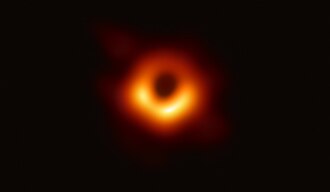
In the middle of the disk, there is a big group of older stars called the bulge. Around the galaxy, there is a faint area filled with stars, some of which are in round clusters. At the very center of the bulge, there is a supermassive black hole. The way these parts look can change a lot from one galaxy to another.
Spiral arms are the long, thin areas of stars that stretch out from the center of spiral galaxies. They look like spirals and give these galaxies their name. These arms are bright because they have many young, blue stars.
A bulge is a large, tight group of stars in the middle of most spiral galaxies. The stars in the bulge of some galaxies are older, while in others they are younger.
Many spiral galaxies also have a bar-shaped group of stars. This bar can be strong or weak and is seen in many spiral galaxies.
Most of the stars in a spiral galaxy are either close to a single flat plane, moving in circles around the center, or in a round bulge around the core. Some stars are in a spherical halo around the galaxy. These halo stars are older and have fewer heavy elements than stars in the disk.
The oldest known spiral galaxy is BRI 1335-0417. Its light took 12.4 billion years to reach Earth. Another very old spiral galaxy is BX442, which is about eleven billion years old.
Main article: Spiral arm
Main article: Galactic bulge
Origin of the spiral structure
The study of how spiral galaxies form their spiral shapes began with Bertil Lindblad in 1925. He noticed that stars could not stay in a perfect spiral shape forever because the galaxy rotates. This causes any fixed spiral arm to twist and wind tighter over time. This is called the winding problem.
There are two main ideas about why spiral arms look the way they do. One idea is that spiral arms are areas with more stuff, called density waves. This causes new stars to form. The other idea is that the arms form because of shock waves from exploding stars and stellar winds. These trigger new star formation.
Bertil Lindblad suggested that spiral arms are areas where there is more material. When gas enters these areas, it gets squeezed and forms new stars.
Frank Shu and C. C. Lin later explained that these arms are like waves moving through the galaxy. Stars and gas move through these waves. When they do, the extra material can cause new stars to form. The arms look brighter because they contain many young, bright stars.
Distribution of stars in spirals
The stars in spiral galaxies are arranged in thin, flat disks. The brightness of these stars gets dimmer as you move away from the center of the galaxy. Scientists use special formulas to describe how the stars are spread out. These formulas help us learn about the size and total brightness of the galaxy’s star disk. The way the light is spread out in these disks is the same, no matter how bright the galaxy is overall.
Spiral nebula
Before we knew that spiral galaxies were separate from our own Milky Way, they were called spiral nebulae. This was because Lord Rosse used his big telescope to see the spiral shape of galaxies for the first time. In 1845, he found the spiral shape of a galaxy later called the "Whirlpool Galaxy".
Later, scientists wondered if these spiral shapes were their own galaxies or just parts of our Milky Way. In 1923, Edwin Hubble showed that these spiral shapes were whole galaxies outside our own. After that, the term spiral nebula was no longer used.
Milky Way
The Milky Way looks like a normal spiral galaxy. In the 1960s, scientists thought it might be a barred spiral galaxy. This was proven true in 2005. The Spitzer Space Telescope showed that the central bar in the Milky Way is bigger than people thought.
Famous examples
Further information: List of spiral galaxies
Here are some well-known spiral galaxies:
- Alaknanda Galaxy – A newly found spiral galaxy
- Andromeda Galaxy – A barred spiral galaxy near us
- Black Eye Galaxy – A spiral galaxy in the sky pattern called Coma Berenices
- Malin 1 – A spiral galaxy in Coma Berenices
- Milky Way – The galaxy where our Solar System lives
- Pinwheel Galaxy – A galaxy in the Ursa Major pattern
- Sunflower Galaxy – A spiral galaxy in Canes Venatici
- Triangulum Galaxy – A spiral galaxy in the Triangulum pattern
- Whirlpool Galaxy – A galaxy in Canes Venatici
Images
Related articles




This article is a child-friendly adaptation of the Wikipedia article on Spiral galaxy, available under CC BY-SA 4.0.
Images from Wikimedia Commons. Tap any image to view credits and license.