 Safekipedia
Supermassive black hole
Adapted from Wikipedia · Adventurer experience
A supermassive black hole (SMBH or sometimes SBH) is the biggest kind of black hole. It can be hundreds of thousands to billions of times the mass of the Sun.
Black holes are special places in space where gravity is so strong that nothing, not even light, can escape.
Almost every big galaxy has a supermassive black hole in the middle. For example, our galaxy, the Milky Way, has a supermassive black hole at its center. This is linked to the radio source Sagittarius A*. When interstellar gas moves toward these black holes, it can create very bright objects called active galactic nuclei (AGNs) and quasars.
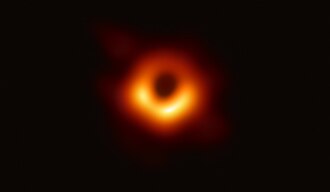
Two supermassive black holes have been pictured by the Event Horizon Telescope. These are Sagittarius A* in the center of the Milky Way, and the black hole in the center of Messier 87, a large elliptical galaxy. Studying these helps scientists learn about the universe and how galaxies grow.
Description
Supermassive black holes are the largest type of black hole. They can be hundreds of thousands to billions of times the mass of the Sun solar masses (M☉). Unlike smaller black holes, supermassive black holes have weaker tidal forces near their event horizon. This means a person near the edge of such a black hole might feel forces similar to standing on Earth.
Interestingly, the density of a supermassive black hole can be less than that of water. This is because the space they occupy grows quickly with their mass, making them less dense overall. Some of the biggest known supermassive black holes are found in galaxies like TON 618, NGC 6166, ESO 444-46, and NGC 4889. Recent studies even suggest the existence of extremely large black holes, called stupendously large black holes, with masses over 100 billion times that of the Sun, possibly including the black hole in Phoenix A.
History of research
The search for supermassive black holes began in 1963 when Maarten Schmidt studied a bright radio source called 3C 273. At first, people thought it was a star, but they learned it was very far away and giving off huge amounts of energy. This made scientists think it might be a special kind of object called a quasar.
As scientists learned more, they began to think these powerful objects might be explained by supermassive black holes. In the 1970s, observations of stars moving quickly around the centers of galaxies showed there must be something very heavy there. Later, telescopes like the Hubble Space Telescope helped scientists find strong evidence for these black holes. In 2019, the Event Horizon Telescope Collaboration took the first picture of a black hole’s edge, confirming these giant objects really exist at the centers of many galaxies.
Formation
Scientists are still learning about how supermassive black holes began. Black holes can grow by taking in matter and by joining with other black holes. There are a few ideas about how the first black holes, called "seeds," formed. If these seeds had enough material around them, they could grow bigger by taking in more matter.
Some very old supermassive black holes are hard to explain because they appeared quickly after the Big Bang. One idea is that they might have formed from dark matter collapsing directly. Another idea suggests they could be evidence that the Universe resulted from a Big Bounce instead of a Big Bang. These black holes might have formed before the Big Bang.
The first stars might have left behind smaller black holes. These could grow by taking in more matter. Another idea is that large clouds of gas could collapse directly into black holes without becoming stars first.
Supermassive black holes can also form from very dense clouds of gas collapsing directly into a black hole.
There is a natural limit to how large supermassive black holes can grow. Theories suggest this limit is around 50 billion times the mass of the Sun. Beyond this limit, growth slows down a lot.
In the very far future, some of these black holes might continue to grow during the collapse of groups of galaxies.
Main articles: Population III star, Quasi-star, and Dark star (dark matter)
Activity and galactic evolution
Main articles: Active galactic nucleus and Galaxy formation and evolution
The gravity of supermassive black holes at the centers of galaxies helps create bright objects like Seyfert galaxies and quasars. There is a special link between the size of these black holes and the amount of matter in the galaxy they are in. Scientists call this link the M–sigma relation.
When galaxies crash into each other and join together, their supermassive black holes can also come close to each other. Over time, these black holes might move closer and join into one black hole. This can create strong waves called gravitational waves, which might push the new black hole away from the center of the galaxy. Scientists look for special signs in space to find these moving black holes.
Evidence
We learn about black holes by watching how stars and gas move around them. When material moves toward a black hole, its light changes color. This happens because of the Doppler effect. The light appears redder when moving away and bluer when moving closer. This helps scientists learn how fast things are moving near a black hole.
We believe our Milky Way galaxy has a supermassive black hole at its center, called Sagittarius A*. One star, S2, moves very quickly around this black hole. This helps scientists figure out the black hole’s mass. It is about 4 million times the mass of our Sun. Other galaxies also show signs of having supermassive black holes, even if we can’t always see them directly.
Individual studies
The Andromeda Galaxy, which is 2.5 million light-years away, has a central black hole. This black hole is about 140 million times the mass of the Sun.
One of the largest known supermassive black holes is in Messier 87. It weighs about 6.5 billion times the Sun's mass and is 48.92 million light-years away.
Other huge black holes are found in distant objects called quasars. For example, TON 618 has a black hole estimated to be 40.7 billion times the mass of the Sun. Some galaxies even have two supermassive black holes close together. These might eventually merge and create strong gravitational waves.
Images
Related articles



This article is a child-friendly adaptation of the Wikipedia article on Supermassive black hole, available under CC BY-SA 4.0.
Images from Wikimedia Commons. Tap any image to view credits and license.