 Safekipedia
Holy See
Adapted from Wikipedia · Discoverer experience
The Holy See is the central governing body of the Catholic Church and Vatican City. It is also known as the See of Rome, the Petrine See, or the Apostolic See. The Holy See includes the office of the pope, who serves as the spiritual and administrative leader of the Catholic Church and Vatican City.
According to Catholic tradition, the Holy See was founded in the first century by Saint Peter and Saint Paul. It is based in Rome, where the pope lives in Vatican City, an independent city-state. The Holy See is run by the Roman Curia, a group of offices that help the pope manage the Church’s affairs.
The Holy See is more than just a religious group; it is also recognized as a sovereign entity under international law. It has its own diplomats, known as papal nuncios, who represent the Holy See to other countries and international groups. The Holy See plays an important role in global issues, working with organizations like the United Nations. It also provides education and health care to people around the world.
Terminology
The word "see" comes from the Latin word sedes, meaning 'seat'. It refers to the special chair, called a cathedra, used by a bishop. In the Catholic Church, the term "Apostolic See" can mean any important church started by one of the Twelve Apostles. But when people talk about "the Apostolic See", they usually mean the special church led by the Bishop of Rome, who is thought to be the successor of Saint Peter.
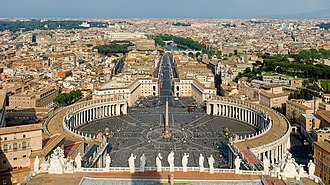
While many people think of St. Peter's Basilica in Vatican City when they hear about the Pope, the main cathedral of the Holy See is actually the Archbasilica of Saint John Lateran in Rome. In the Roman Catholic Church, only the Pope's see is called "holy". There was one special case: during the time of the Holy Roman Empire, the church led by the Archbishopric of Mainz was also allowed to call itself "the Holy See of Mainz".
History
Further information: History of the papacy, Papal primacy, and Temporal power (papal)
According to Catholic tradition, the main church in Rome was set up in the first century by Saint Peter and Saint Paul.
In the year 313, the Catholic Church gained legal recognition through the Edict of Milan, issued by Roman emperor Constantine the Great. Later, in the year 380, it became the official church of the Roman Empire under Emperor Theodosius I. Over the centuries, the Holy See gained more land and authority. In the year 756, it received sovereignty through the Donation of Pepin.
From 756 until 1870, the Papal States controlled a large area with their own army. In the year 800, Pope Leo III crowned Charlemagne as Roman Emperor. The Holy See faced challenges over time, including conflicts with nearby kingdoms and periods when it was far from Rome. In the year 1929, the Lateran Treaty recognized Vatican City as an independent city-state, separate but fully owned and controlled by the Holy See.
Organization
Main article: Roman Curia
The Holy See is one of the last remaining absolute monarchies in the world. The Pope leads the Catholic Church through a group of offices called the Roman Curia. This group helps manage church affairs, including important tasks like guiding church teachings and handling international relationships.
The Curia includes many offices, such as the Secretariat of State, which helps organize and coordinate the work of the Curia. The person in charge of this group acts like a prime minister for the Holy See. There are also special offices that focus on different areas, like teaching church beliefs, helping with worldwide church activities, and dealing with important social issues. The Holy See continues to operate even when there is no Pope, with a group of leaders managing church affairs during that time.
Status in international law
Main article: Legal status of the Holy See
The Holy See is recognized in international law as having rights and duties similar to those of countries. Even though it does not have a permanent population, defined territory, stable government, or the ability to enter into relations with other states in the traditional sense, it has full legal personality in international law. This is shown by its ability to maintain diplomatic relations with 180 states, be a member of various international organizations, and be respected by the international community as a subject of international law capable of engaging in diplomatic relations and entering into binding agreements aimed at establishing and preserving peace in the world.
Main article: Foreign relations of the Holy See
Since medieval times, the episcopal see of Rome has been recognized as a sovereign entity. The Holy See maintains formal diplomatic relations with 183 sovereign states, the European Union, and the Sovereign Military Order of Malta. It also has special relations with the Palestine Liberation Organization. Of the diplomatic missions accredited to the Holy See, 69 are located in Rome. The Holy See has 180 permanent diplomatic missions abroad, with many accredited to multiple countries or international organizations. The diplomatic activities of the Holy See are directed by the Secretariat of State, specifically through the Section for Relations with States. The Holy See is the only European entity in international law that maintains diplomatic relations with the Republic of China (Taiwan) as representing China, rather than the People's Republic of China.
The Holy See is a member of various international organizations, including the International Atomic Energy Agency (IAEA), International Telecommunication Union (ITU), Organization for Security and Co-operation in Europe (OSCE), Organisation for the Prohibition of Chemical Weapons (OPCW), and the United Nations High Commissioner for Refugees (UNHCR). It is also a permanent observer in organizations such as the United Nations General Assembly, Council of Europe, UNESCO, World Trade Organization (WTO), and the Food and Agriculture Organization (FAO).
The Holy See participates as an observer in organizations like the African Union, Arab League, Council of Europe, Non-Aligned Movement, and Organization of American States. It also engages with United Nations agencies such as FAO, ILO, UNCTAD, UNEP, UNESCO, UN-HABITAT, UNHCR, UNIDO, UNWTO, WFP, WHO, and WIPO. As a full member, it participates in IAEA, OPCW, and the Organization for Security and Co-operation in Europe (OSCE).
Although closely associated with Vatican City, the Holy See and Vatican City are separate and distinct entities. After Italy seized the Papal States in 1870, the Holy See had no territorial sovereignty. Despite this, it continued to send and receive diplomatic representatives and maintain relations with states, including major powers like Russia, Prussia, and Austria-Hungary. The number of states with diplomatic relations with the Holy See grew from 16 to 29 during this period.
The State of Vatican City was created by the Lateran Treaty in 1929 to ensure the Holy See's absolute and visible independence and guarantee its sovereignty in international affairs. Vatican City serves as a small support-state that guarantees the spiritual freedom of the Pope with minimal territory. The Holy See, not Vatican City, maintains diplomatic relations with states. Foreign embassies are accredited to the Holy See, and it is the Holy See that establishes treaties and concordats with other sovereign entities. When necessary, the Holy See enters into treaties on behalf of Vatican City.
Under the Lateran Treaty, the Holy See has extraterritorial authority over various sites in Rome and two Italian sites outside Rome, including the Pontifical Palace at Castel Gandolfo. This authority is also extended under international law over the Apostolic Nunciature of the Holy See in foreign countries.
Military
See also: Military in Vatican City
In the past, popes had soldiers called Swiss mercenaries to protect them. The Pontifical Swiss Guard was started by Pope Julius II in 1506 to guard the Pope. Even today, they serve this role and are listed under the Holy See, not Vatican City.
As of 2026, the Guard has 135 members. They must be Catholic, Swiss citizens, and meet certain age and height requirements. They carry small weapons and a special tool called a halberd for protection.
Vatican City has its own police force, which is separate from the Holy See. The Holy See has also agreed to work toward removing nuclear weapons worldwide by signing a special treaty.
Coat of arms
Main articles: Coat of arms of the Holy See and Coat of arms of Vatican City
The Holy See uses special symbols called coats of arms. These symbols include two keys, one gold and one silver, crossed in a special way. This design is also used when there is no pope, called "sede vacante."
Vatican City, which was created in 1929, uses the same keys but arranged differently. The Holy See’s coat of arms does not have a shield behind it, which you can see on its official website and on its special travel documents called passports.
Images
Related articles


This article is a child-friendly adaptation of the Wikipedia article on Holy See, available under CC BY-SA 4.0.
Images from Wikimedia Commons. Tap any image to view credits and license.