 Safekipedia
Mandarin Chinese
Adapted from Wikipedia · Discoverer experience
Mandarin is the largest group of Chinese languages. It is spoken by 70 percent of all Chinese speakers. It stretches from Yunnan in the southwest to Xinjiang in the northwest and Heilongjiang in the northeast. Many Mandarin varieties, such as those of the Southwest and the Lower Yangtze, are not mutually intelligible with the Beijing dialect. Mandarin as a group is often placed first in lists of languages by number of native speakers (with nearly one billion).
Most Mandarin varieties have four tones. The historical capitals of China have been within the Mandarin-speaking area for most of the last two millennia, making these dialects very prestigious. Some form of Mandarin has served as a lingua franca for government officials and the courts since at least the 14th century.
In the early 20th century, a standard language based on the Beijing dialect, with elements from other Mandarin varieties, was adopted as the national language. Today, Standard Chinese is the official language of China and Taiwan, one of four official languages of Singapore, and one of six official languages of the United Nations. It is also the most commonly taught form of Chinese as a foreign language.
Name
The word "mandarin" comes from Portuguese. Long ago, officials in China used a special language to talk to each other, even though they spoke different dialects at home. When European explorers learned about this language, they called it "Mandarin" because it was used by officials.
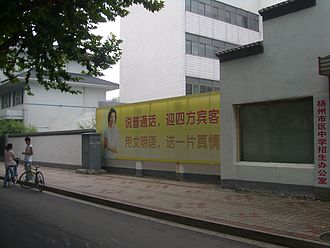
Today, when people say "Mandarin," they usually mean Standard Chinese. This is based on the dialect spoken in Beijing. It is the main language in China, Taiwan, and one of the official languages in Singapore. It is also used to teach students in schools in China and Taiwan and is one of the official languages of the United Nations. People in different places may call this language by different names, like "common speech" in China or "national language" in Taiwan.
History
Further information: History of the Chinese language
Many modern local varieties of Chinese grew from older regional forms of Old Chinese and Middle Chinese. Traditionally, seven major groups of dialects have been recognized. Besides Mandarin, the other six are Wu, Gan, and Xiang in central China and Min, Hakka, and Yue on the southeast coast. The Language Atlas of China (1987) lists three more groups: Jin, which split from Mandarin, and Huizhou in the Huizhou region of Anhui and Zhejiang, and Pinghua in Guangxi and Yunnan.
Old Mandarin
Main article: Old Mandarin
After the fall of the Northern Song and during the Jin and Yuan dynasties in northern China, a common way of speaking developed from the dialects of the North China Plain around the capital. This language was called Old Mandarin. New types of everyday literature were based on this language, including verses, plays, and stories, such as qu and sanqu poetry.
The rules for rhyming in these new verses were written down in a rime dictionary called the Zhongyuan Yinyun (1324). This book showed many features of modern Mandarin dialects, such as changes in sounds and tones. Other sources include the 'Phags-pa script, based on Tibetan writing, used in the Mongol empire.
Vernacular literature
Until the early 1900s, formal writing, poetry, and stories were done in Literary Chinese, based on old classics from the Warring States period and the Han dynasty. Over time, spoken ways of talking changed a lot from this formal writing. The formal way of writing was not good for performing or telling stories, like plays or tales. From the Yuan dynasty to the Qing dynasty, a new kind of writing called written vernacular Chinese (白话; 白話; báihuà) developed. This writing often showed Mandarin ways of speaking and helped unite Mandarin-speaking areas.
Hu Shih wrote an important study about this new writing style.
Late imperial koiné
Main article: Mandarin (late imperial lingua franca)
Until the mid-1900s, many people in South China only spoke their local way of talking. To help with government work, leaders of the Ming and Qing dynasties used a common way of speaking based on Mandarin varieties, called Guānhuà. Knowing this language was important for government jobs, but it was never clearly defined.
Leaders noticed that people from different places spoke very differently. In 1728, the Yongzheng Emperor asked leaders from Guangdong and Fujian to teach proper speaking. This led to books that showed the ideal way to speak. Common features included changes in sounds and tones.
Standard Chinese
Main article: Standard Chinese
The form of Mandarin spoken by educated people in Beijing became the official language of China in the early 1900s. Leaders wanted to replace the old formal writing with a new way based on northern ways of speaking. After discussions, they chose the Beijing dialect in 1932. The People’s Republic, starting in 1949, kept this standard and called it pǔtōnghuà.
This standard language is used in schools, news, and formal events in mainland China and Taiwan, and among Chinese community of Singapore. In Hong Kong and Macau, the local Cantonese is still used. Since the 2000s, China has worked to teach Standard Mandarin widely to reduce regional differences.
Geographic distribution
Mandarin is spoken across northern and southwestern China, with some pockets in neighbouring countries. Unlike their compatriots on the southeast coast, few Mandarin speakers engaged in overseas emigration until the late 20th century, but there are now significant communities of them in cities across the world.
Most Han Chinese living in northern and southwestern China are native speakers of a dialect of Mandarin. The North China Plain provided few barriers to migration, leading to relative linguistic homogeneity over a wide area in northern China. In contrast, the mountains and rivers of southern China have spawned the other six major groups of Chinese varieties, with great internal diversity, particularly in Fujian.
However, the varieties of Mandarin cover a huge area containing nearly a billion people. As a result, there are pronounced regional variations in pronunciation, vocabulary, and grammar, and many Mandarin varieties are not mutually intelligible.
Standard Mandarin is one of the official languages of Taiwan. The Taiwanese standard of Mandarin differs very little from that of mainland China, with differences largely in some technical vocabulary developed from the 1950s onwards.
Mandarin is one of the four official languages of Singapore along with English, Malay, and Tamil. Historically, it was seldom used by the Chinese Singaporean community, which primarily spoke the Southern Chinese languages of Hokkien, Teochew, Cantonese, or Hakka. The launch of the Speak Mandarin Campaign in 1979 by the government prioritized the language over traditional vernaculars in an attempt to create a common ethnic language and foster closer connections to China. This has led to a significant increase and presence of Mandarin usage in the country, coupled with a strong decline in usage of other Chinese variants.
In Malaysia, Mandarin has been adopted by local Chinese-language schools as the medium of instruction with the standard based on that of Singapore. However, it is not as widespread in daily life among the Malaysian Chinese community, as Hokkien speakers continue to form a plurality among the ethnic Chinese population and Cantonese serves as the common language (especially in commerce and local media). An exception is in the state of Johor, where Mandarin is increasingly used alongside Cantonese as a lingua franca in part due to Singaporean influence.
In northern Myanmar, a Southwestern Mandarin variant close to the Yunnanese dialect is spoken by local Chinese and other ethnic groups. In some rebel group-controlled regions, Mandarin also serves as the lingua franca.
The Dungan people of Kyrgyzstan, Kazakhstan and Uzbekistan are descendants of Hui people who fled to the Russian Empire from Dzungaria in 1877 after the fall of Kashgaria to Qing forces and from the Ili valley after it was ceded to China in the Treaty of Saint Petersburg in 1881. About 500 speakers live in a compact area in Rovensky District, Saratov Oblast in Russia. The Dungan speak two dialects, descended from Central Plains Mandarin dialects of southeast Gansu and southwest Shaanxi, and write their language in the Cyrillic script.
Classification
Further information: List of varieties of Chinese
The way people group Chinese dialects has changed a lot over time. In 1936, a scientist named Wang Li made the first grouping based on sounds. He included dialects from northern and southwestern China, as well as Hunan and northern Jiangxi in his Mandarin group.
Later, other scientists made new groupings. By 1960, Yuan Jiahua had a popular way to group them into seven types. He kept some groups separate and split Mandarin into four parts: Northern, Northwestern, Southwestern, and Jiang–Huai.
Mandarin Chinese has many different types, or subgroups. One big group is called Northeastern Mandarin, spoken in northeast China. It is very close to the standard form of Chinese. Beijing Mandarin is spoken in and around Beijing and is the basis for standard Chinese. Jilu Mandarin is spoken in Hebei and Shandong provinces. Jiaoliao Mandarin is found in parts of Shandong and Liaodong Peninsulas.
Other groups include Central Plains Mandarin, spoken in Henan and parts of Shaanxi, and Lanyin Mandarin in Gansu and Ningxia. Jianghuai Mandarin is spoken along the north side of the Yangtze River. Southwestern Mandarin is the most widely spoken, covering Hubei, Sichuan, Guizhou, Yunnan, and parts of other provinces.
Phonology
See also: Standard Chinese phonology
A syllable in Mandarin can have up to five parts: a starting consonant, a glide, a vowel, an ending sound, and a tone. In simple terms, the glide, vowel, and ending are grouped together as a "final." Not all possible combinations are used. For example, Standard Chinese, based on the Beijing dialect, has about 1,200 different syllables.
Mandarin dialects share some key features:
-
The palatalization of velar consonants and alveolar sibilants when they come before palatal glides;
-
One syllable can hold at most four sound units (up to three vowels and no cluster of consonants)
-
The loss of final stop consonants and /-m/ (though in some Jianghuai Mandarin and Jin Chinese dialects, a hint of the final stops remains as a glottal stop);
-
The use of retroflex consonants (though these are missing in many Southwestern and Northeastern Mandarin dialects);
-
The historical devoicing of stops and sibilants (also common in most non-Mandarin varieties).
-
Most Mandarin areas tell apart the retroflex sounds /ʈʂ ʈʂʰ ʂ/ from the similar sounds /ts tsʰ s/, though they often use different sounds than in standard language. In many southeast and southwest dialects, retroflex sounds merge with alveolar sounds, so zhi becomes zi, chi becomes ci, and shi becomes si.
-
The sounds /tɕ tɕʰ ɕ/ come from mixing old palatalized velar sounds and palatalized alveolar sounds. In about 20% of dialects, the alveolar sounds did not change and stay separate from the alveolo-palatal sounds. In some eastern Shandong dialects, the velar sounds did not change either.
-
Many southwestern Mandarin dialects mix /f/ and /xw/, using one for the other in some cases. For example, fei /fei/ 'to fly' and hui /xwei/ 'grey' may sound the same in these areas.
-
In some dialects, the sounds /l/ and /n/ are not told apart. In Southwestern Mandarin, these usually become /n/; in Jianghuai Mandarin, they usually become /l/.
-
In many Mandarin areas, people may use different starting sounds where Beijing uses r- /ɻ/. Common replacements include /j/, /l/, /n/ and /w/.
-
Some dialects use /ŋ/ where the standard language has no starting sound. This comes from mixing old sounds with /ŋ/ and /ʔ/.
-
Many Northwestern and Central Plains Mandarin dialects have /pf pfʰ f v/ where Beijing has /tʂw tʂʰw ʂw ɻw/. Examples include /pfu/ 'pig' for standard zhū 豬 /tʂu/, /fei/ 'water' for standard shuǐ 水 /ʂwei/, /vã/ 'soft' for standard ruǎn 軟 /ɻwan/.
Most Mandarin dialects have three glide sounds, /j/, /w/ and /ɥ/ (written as i, u and ü in pinyin), though how often they appear varies. The glide /w/ is lost after certain starting sounds in several areas. So Southwestern Mandarin says /tei/ 'correct' where standard language says dui /twei/. Southwestern Mandarin also uses /kai kʰai xai/ in some words where standard language uses jie qie xie /tɕjɛ tɕʰjɛ ɕjɛ/. This is a well-known feature of southwestern Mandarin, since it is very noticeable. For example, hai 'shoe' for standard xie, gai 'street' for standard jie.
Mandarin dialects usually have few vowel sounds. Syllabic fricatives, like in standard zi and zhi, are common in Mandarin dialects, though they also appear elsewhere. The old ending sounds /j/ and /w/ are mostly kept in Mandarin dialects, creating several diphthongs and triphthongs instead of the larger sets of single vowel sounds common in other dialect groups and some scattered Mandarin dialects.
The old ending /m/ was still present in Old Mandarin, but it has merged with /n/ in modern dialects. In some areas (especially the southwest) the ending /ŋ/ has also merged with /n/. This is especially common in the pairs -en/-eng /ən əŋ/ and -in/-ing /in iŋ/. As a result, jīn 'gold' and jīng 'capital' sound the same in those dialects.
The old ending sounds have changed in different ways across Mandarin dialects (see Tones below). In Jianghuai dialects and some north-western dialects they have become a final glottal stop. In other dialects they have been lost, affecting the vowel sound. As a result, Beijing Mandarin and Northeastern Mandarin have more vowel changes than many other Mandarin varieties. For example:
R-coloring, a feature of Mandarin, works differently in the southwest. While Beijing usually removes only a final /j/ or /n/ when adding the ending -r /ɻ/, in the southwest the -r replaces almost the whole vowel part.
.svg)
.svg)
.svg)
.svg)
The word ma with each of the main tones in Standard Chinese
In general, no two Mandarin-speaking areas have exactly the same set of tone sounds, but most have very similar tone patterns. For example, the dialects of Jinan, Chengdu, Xi'an and so on all have four tones that match quite well with the Beijing dialect tones of [˥] (55), [˧˥] (35), [˨˩˦] (214), and [˥˩] (51). The exception is in how syllables that used to end in a stopping sound are treated, which varies across Mandarin dialects.
Middle Chinese stopping and affricate sounds had a three-way difference between plain, aspirated, and voiced (or breathy voiced) consonants. In Mandarin dialects the voicing is usually lost, leaving aspirated sounds in syllables with an old high pitch and non-aspirated sounds in other syllables. Of the four tones of Middle Chinese, the high, rising and leaving tones have developed into four modern tones in a uniform way across Mandarin dialects; the high tone split into two levels, depending on the voicing of the old starting sound, while rising tone syllables with voiced beginning sounds moved to the leaving tone. The following examples from standard language show the common pattern shared by Mandarin dialects (note that pinyin d marks a non-aspirated /t/, while t marks an aspirated /tʰ/):
In old Chinese sound study, syllables that ended in a stop in Middle Chinese (i.e. /p/, /t/ or /k/) were considered a special group called the "entering tone". These stopping endings have mostly disappeared in most Mandarin dialects, with the syllables spreading across the other four modern tones in different ways in the various Mandarin groups.
In the Beijing dialect that forms the basis of standard language, entering-tone syllables starting with old voiceless consonants spread across the four tones. For example, the three words 積脊跡, all tsjek in Middle Chinese (William H. Baxter's transcription), are now said as jī, jǐ and jì respectively. Older dictionaries such as Mathews' Chinese-English Dictionary mark words whose pronunciation once ended with a stop with a superscript 5; however, this number is more commonly used for words that always have a light tone (see below).
In Jianghuai dialects, some Southwestern dialects (e.g. Minjiang) and Jin Chinese (sometimes seen as non-Mandarin), old stopping endings were not fully lost, but changed into a glottal stop /ʔ/. (This includes the dialect of Nanjing on which the Postal Romanization was based; it writes the glottal stop as a trailing h.) This change is shared with Wu Chinese and is thought to show the pronunciation of Old Mandarin. In line with old Chinese sound study, dialects such as Jianghuai and Minjiang are thus said to have five tones instead of four. However, modern language study considers these syllables as having no phonemic tone at all.
Though the tone system is common across Mandarin dialects, how the tones are actually said tone contours varies widely:
Mandarin dialects often use light tones in the second parts of words, creating syllables whose tone sound is so short and light that it is hard or impossible to tell the tone. These light-tone syllables also appear in non-Mandarin dialects, but in many southern dialects the tones of all syllables are clearly heard.
| Character | Meaning | Standard (Beijing) | Beijing, Harbin Colloquial | Jinan (Ji–Lu) | Xi'an (Central Plains) | Chengdu (Southwestern) | Yangzhou (Jianghuai) | Middle Chinese Reconstructed | |
|---|---|---|---|---|---|---|---|---|---|
| Pinyin | IPA | ||||||||
| 课 | 'lesson' | kè | kʰɤ | kʰɤ | kʰə | kʰwo | kʰo | kʰo | kʰɑ |
| 客 | 'guest' | tɕʰie | kʰei | kʰei | kʰe | kʰəʔ | kʰɰak | ||
| 果 | 'fruit' | guǒ | kwo | kwo | kwə | kwo | ko | ko | kwɑ |
| 国 | 'country' | guó | kwei | kwe | kɔʔ | kwək | |||
| Middle Chinese tone | "level tone" (píng 平) | "rising tone" (shǎng 上) | "departing tone" (qù 去) | |||||||||
|---|---|---|---|---|---|---|---|---|---|---|---|---|
| Example | 丹 | 灘 | 蘭 | 彈 | 亶 | 坦 | 懶 | 但 | 旦 | 炭 | 爛 | 彈 |
| Middle Chinese | tan | tʰan | lan | dan | tan | tʰan | lan | dan | tan | tʰan | lan | dan |
| Standard Chinese | dān | tān | lán | tán | dǎn | tǎn | lǎn | dàn | tàn | làn | dàn | |
| Modern Mandarin tone | 1 (yīnpíng) | 2 (yángpíng) | 3 (shǎng) | 4 (qù) | ||||||||
| subgroup | Middle Chinese initial | ||
|---|---|---|---|
| voiceless | voiced sonorant | voiced obstruent | |
| Beijing | 1,3,4 | 4 | 2 |
| Northeastern | |||
| Jiao–Liao | 3 | ||
| Ji–Lu | 1 | ||
| Central Plains | 1 | ||
| Lan–Yin | 4 | ||
| Southwestern | 2 | ||
| Jianghuai | marked with final glottal stop (rù) | ||
| Tone name | 1 (yīnpíng) | 2 (yángpíng) | 3 (shǎng) | 4 (qù) | marked with glottal stop (rù) | |
| Beijing | Beijing | ˥ (55) | ˧˥ (35) | ˨˩˦ (214) | ˥˩ (51) | |
| Northeastern | Harbin | ˦ (44) | ˨˦ (24) | ˨˩˧ (213) | ˥˨ (52) | |
| Jiao–Liao | Yantai | ˧˩ (31) | (˥ (55)) | ˨˩˦ (214) | ˥ (55) | |
| Ji–Lu | Tianjin | ˨˩ (21) | ˧˥ (35) | ˩˩˧ (113) | ˥˧ (53) | |
| Shijiazhuang | ˨˧ (23) | ˥˧ (53) | ˥ (55) | ˧˩ (31) | ||
| Central Plains | Zhengzhou | ˨˦ (24) | ˦˨ (42) | ˥˧ (53) | ˧˩˨ (312) | |
| Luoyang | ˧˦ (34) | ˦˨ (42) | ˥˦ (54) | ˧˩ (31) | ||
| Xi'an | ˨˩ (21) | ˨˦ (24) | ˥˧ (53) | ˦ (44) | ||
| Tianshui | ˩˧ (13) | ˥˧ (53) | ˦ (44) | |||
| Lan–Yin | Lanzhou | ˧˩ (31) | ˥˧ (53) | ˧ (33) | ˨˦ (24) | |
| Yinchuan | ˦ (44) | ˥˧ (53) | ˩˧ (13) | |||
| Southwestern | Chengdu | ˦ (44) | ˨˩ (21) | ˥˧ (53) | ˨˩˧ (213) | |
| Xichang | ˧ (33) | ˥˨ (52) | ˦˥ (45) | ˨˩˧ (213) | ˧˩ʔ (31) | |
| Kunming | ˦ (44) | ˧˩ (31) | ˥˧ (53) | ˨˩˨ (212) | ||
| Wuhan | ˥ (55) | ˨˩˧ (213) | ˦˨ (42) | ˧˥ (35) | ||
| Liuzhou | ˦ (44) | ˧˩ (31) | ˥˧ (53) | ˨˦ (24) | ||
| Jianghuai | Yangzhou | ˧˩ (31) | ˧˥ (35) | ˦˨ (42) | ˥ (55) | ˥ʔ (5) |
| Nantong | ˨˩ (21) | ˧˥ (35) | ˥ (55) | ˦˨ (42), ˨˩˧ (213) | ˦ʔ (4), ˥ʔ (5) | |
Vocabulary
Mandarin has many words made from more than one sound, especially compared to other Chinese languages like Shanghainese. This happened because Mandarin changed sounds more over time, leading to many words that sound alike. To solve this, new words were created by adding small parts like lao- 老 or -zi 子, or by joining two words together, like cōngmáng 匆忙, which means both "hurried" and "busy".
One special feature in southwest Mandarin is repeating nouns, like saying bāobāo 包包 for "handbag" instead of just bāor. Mandarin also has special words for "I", "you", and "he/she/it", and can change these to talk about groups of people. Most dialects of Mandarin share these pronoun words.
Because of history with Mongolian and Manchurian peoples, Mandarin includes some words from these languages, like hútòng 胡同 for "alley". Mandarin also borrows words from other languages, such as gāo'ěrfū 高尔夫 for "golf" and bǐjīní 比基尼 for "bikini".
The biggest differences between Mandarin dialects are in everyday words and slang, while more formal words, like those used in science or government, stay mostly the same.
Grammar
Further information: Chinese grammar
Chinese languages, including Mandarin, are known for being simple in structure. They rely on the order of words and small words called particles instead of changing words with endings or adding extra letters at the start or end.
In Mandarin, sentences usually follow the order of "subject–verb–object," like "I give you a book." However, in some other Chinese dialects, the order of the two things being given can be different.
Mandarin uses special small words, called particles, after the main verb to show when something happened or is happening. For example, "le" (了) shows something is finished, and "zhe" (着; 著) shows something is ongoing.
Mandarin also has a special particle "de" (的) that connects ideas in a sentence. Other dialects may not use this particle in the same way.
In everyday speech, Chinese speakers often add small words at the end of sentences to change the meaning slightly. These can differ depending on where people live.
Some Mandarin words are made by combining characters together, similar to adding prefixes and suffixes in English. For example, the character 師 combines with 教 (to teach) to make the word for "teacher."
| Affix | Pronunciation | Gloss | Example | Example gloss |
|---|---|---|---|---|
| 们; 們 | men | plural for human nouns, same as -s, -es | 学生们; 學生們, 朋友们; 朋友們 | 'students', 'friends' |
| 可 | kě | same as -able | 可信, 可笑, 可靠 | 'trusty', 'laughable', 'reliable' |
| 重 | chóng | same as re- (again) | 重做, 重建, 重新 | 'redo', 'rebuild', 'renew' |
| 第 | dì | same as -th, -st, -nd | 第二, 第一 | 'second', 'first' |
| 老 | lǎo | old, or show respect to a certain type of person | 老头; 老頭, 老板; 老闆, 老师; 老師 | 'old man', 'boss', 'teacher' |
| 化 | huà | same as -ize, -en | 公式化、制度化、強化 | 'officialize', 'systemize', 'strengthen' |
| 家 | jiā | same as -er or expert | 作家、科學家 [科学家]、藝術家 [艺术家] | 'writer', 'scientist', 'artist' |
| 性 | xìng | same as -ness, -ability | 可靠性、實用性 [实用性]、可理解性 | 'reliability', 'usability', 'understand-ability' |
| 鬼 | guǐ | usually used in a disparaging way, similar to -aholic | 煙鬼、酒鬼、膽小鬼 [胆小鬼] | 'smoker', 'alcoholic', 'coward' |
| 匠 | jiàng | a technician in a certain field | 花匠, 油漆匠, 木匠 | 'gardener', 'painter', 'carpenter |
| 迷 | mí | an enthusiast | 戏迷; 戲迷, 球迷, 歌迷 | 'theater fan', 'sports fan', 'groupie (of a musician)' |
| 师; 師 | shī | suffix for occupations | 教师; 教師, 厨师; 廚師, 律师]; 律師 | 'teacher', 'chef', 'lawyer' |
Example text
From Article 1 of the Universal Declaration of Human Rights in Chinese (Mandarin):
人人
Rénrén
生
shēng
而
ér
自由,
zìyóu,
在
zài
尊嚴
zūnyán
和
hé
權利
quánlì
上
shàng
一律
yīlù
平等。
píngděng.
他們
Tāmen
賦有
fùyǒu
理性
lǐxìng
和
hé
良心,
liángxīn,
並
bìng
應
yīng
以
yǐ
兄弟
xiōngdì
關係
guānxì
的
de
精神
jīngshén
互相
hùxiāng
對待。
duìdài.
人人 生 而 自由, 在 尊嚴 和 權利 上 一律 平等。 他們 賦有 理性 和 良心, 並 應 以 兄弟 關係 的 精神 互相 對待。
Rénrén shēng ér zìyóu, zài zūnyán hé quánlì shàng yīlù píngděng. Tāmen fùyǒu lǐxìng hé liángxīn, bìng yīng yǐ xiōngdì guānxì de jīngshén hùxiāng duìdài.
All human beings are born free and equal in dignity and rights. They are endowed with reason and conscience and should act towards one another in a spirit of brotherhood.
Related articles




This article is a child-friendly adaptation of the Wikipedia article on Mandarin Chinese, available under CC BY-SA 4.0.
Images from Wikimedia Commons. Tap any image to view credits and license.