
Natural satellite
A natural satellite is an astronomical body that orbits a planet, dwarf planet, or small Solar System body. These objects are often called moons, just like Earth's moon, which is also known as Selene or Luna. The word Moon with a capital M refers to Earth's moon, while moon with a lowercase m is used for any natural satellite.
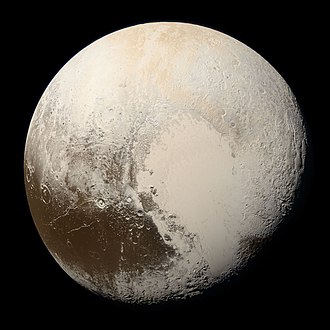
In our Solar System, there are six planets that have moons, making up a total of 455 natural satellites that we know about. Even some dwarf planets, like Pluto and Haumea, have their own moons. As of February 2026, scientists have found that 613 smaller planets also have natural satellites orbiting them. These moons come in many shapes and sizes, and they help us learn more about the space around us.
Terminology
The first known natural satellite was the Moon. Long ago, people thought the Moon was a planet until Copernicus changed that idea in 1543. Later, in 1610, Galileo discovered four objects orbiting Jupiter, which we now call the Galilean satellites.
The word "satellite" was first used by the astronomer Johannes Kepler in 1610. He took the word from the Latin language, where it means "guard" or "companion," because these objects travel with their planet through space.
Over time, the word "satellite" came to mean any object that orbits a planet. But when the first human-made object, Sputnik, was launched in 1957, people needed a new way to talk about these objects. Today, we use the word "moon" to talk about natural satellites, and we capitalize "Moon" when we mean Earth’s special satellite.
Origin and orbital characteristics
Further information: Circumplanetary disk
Natural satellites that orbit close to their planet in steady, circular paths are believed to have formed from the same cloud of material that created the planet itself. Others, especially those with distant, tilted, or backward orbits, are thought to be captured asteroids, possibly broken apart by collisions. Most big natural satellites have steady orbits, but some smaller ones have more unusual paths. The Moon and the Moons of Pluto are special cases; they may have formed from a big crash early in the Solar System's history. Another example is Triton, which orbits backward despite being close to its planet, suggesting it was captured from space.
Trojan satellites
Two natural satellites have small companions at special points in their orbits, sixty degrees ahead and behind them. These companions are called trojan moons, similar to certain asteroids that share Jupiter's path. The trojan moons are Telesto and Calypso, which accompany the moon Tethys, and Helene and Polydeuces, which accompany the moon Dione.
Temporary satellites
Main article: Temporary satellite
Sometimes, an asteroid can temporarily orbit a planet before moving away. As of 2023[update], a few small objects have shown this behavior with Earth, including 1991 VG, 2006 RH120, 2020 CD3, and 2022 NX1.
2006 RH120 was a temporary satellite of Earth for nine months in 2006 and 2007.
Tidal locking
Main article: Tidal locking
Most moons in our Solar System always show the same face to the planet they orbit. This happens because the planet's gravity slows the moon's rotation until it stops. One exception is Saturn's moon Hyperion, which spins unpredictably because of the pull from Titan. Pluto's small moons also spin chaotically due to the influence of Charon.
Farther-out moons, like Jupiter's Himalia, Saturn's Phoebe, and Neptune's Nereid, do not always face the same way because they are too far from their planets to be slowed down.
Satellites of satellites
Main article: Subsatellite
We do not know of any natural satellites that orbit another natural satellite, which we call "moons of moons" or subsatellites. This is because the pull of the planet would usually make such a system unstable. However, some large moons far from their planets, like Titan, Iapetus, Callisto, and Earth's Moon, might be exceptions. But other forces could still prevent submoons from staying in orbit.
After finding a possible ring system around Saturn's moon Rhea in 2008, scientists thought satellites might orbit Rhea safely. They also thought the rings might be kept narrow by small moons called shepherd moons. But later pictures from the Cassini spacecraft did not show any rings around Rhea.
Some ideas suggest that Iapetus, another moon of Saturn, might have had a satellite in the past. This is one idea to explain a strange ridge along its middle. Studies also suggest that Saturn's irregular moon Kiviuq has a very stretched shape, and it might even be made of two pieces orbiting each other.
Shape
See also: Satellite planet
Some moons, like Proteus around Neptune, have unusual shapes. As moons get bigger, their gravity can make them more round over time. But this process might take longer than the age of our Solar System, so some big moons still look odd.
Big moons that always face their planet the same way often look like eggs — squashed at the poles and stretched a bit at the sides. For example, Saturn's moon Mimas is a little wider along one direction than another. Tiny moons like Saturn's Methone show this effect clearly because they are small.
Geological activity
Some of the bigger natural satellites in our Solar System are still geologically active today. Io is the most active volcano in the Solar System. Europa, Enceladus, and Triton show signs of movement and cold volcanoes. This activity is often caused by the pull of gravity from the planets they orbit.
Many other natural satellites, like Earth's Moon, Ganymede, Titan, Tethys, and Miranda, had geological activity in the past. This was powered by things like the breaking down of special materials inside them or changes in their orbits. Enceladus and Triton have features like geysers. Titan and Triton have atmospheres, and Titan even has lakes made of special liquids. Europa, Ganymede, Callisto, Titan, and Enceladus are believed to have oceans of water deep underneath their surfaces.
Occurrence in the Solar System
Of the inner planets, Mercury and Venus have no natural satellites. Earth has one large natural satellite, called the Moon. Mars has two tiny natural satellites, Phobos and Deimos. The giant planets have many natural satellites, including several that are about the size of Earth's Moon. These include the four Galilean moons, Saturn's Titan, and Neptune's Triton. Saturn has six more mid-sized natural satellites, and Uranus has five.
Some smaller objects in space, like Ceres and Sedna, have no known natural satellites. Pluto has a large natural satellite named Charon and four smaller ones. Haumea has two natural satellites. Other small objects like Orcus, Quaoar, Makemake, Gonggong, and Eris each have one natural satellite. The Pluto–Charon system is special because the center of mass is between them, like a double-planet system.
Pictures
Keep exploring



This article is a child-friendly adaptation of the Wikipedia article on Natural satellite, available under CC BY-SA 4.0.
Images from Wikimedia Commons. Tap any image to view credits and license.