 Safekipedia
Pyrenees
Adapted from Wikipedia · Discoverer experience
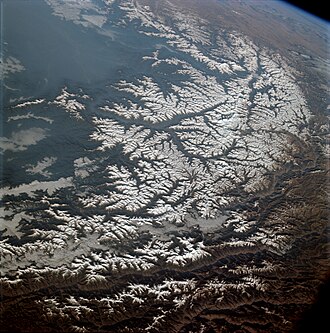
The Pyrenees are a mountain range in southwestern Europe, forming a natural border between France and Spain. These majestic mountains stretch nearly 500 kilometres (310 miles) from where they meet the Cantabrian Mountains to the tip called Cap de Creus on the Mediterranean coast. The highest point in the Pyrenees is the peak of Aneto, which rises to 3,404 metres (11,168 feet) above sea level, located in the area of Huesca in Spain.
This mountain range not only divides two countries but also creates a unique landscape filled with beautiful valleys, rivers, and forests. A small country called Andorra lies nestled within the Pyrenees, making it one of the most mountainous nations in the world. For hundreds of years, the Pyrenees have been an important part of history, with ancient kingdoms like the Crown of Aragon and the Kingdom of Navarre developing on both sides of the mountains.
Today, the Pyrenees are a popular place for people to explore through hiking, skiing, and enjoying the peaceful natural beauty. The mountains provide a special home for many plants and animals, some found nowhere else on Earth. Whether you’re interested in adventure, history, or nature, the Pyrenees offer something wonderful for everyone to discover.
Etymology
In Greek mythology, Pyrene is a princess who gave her name to the Pyrenees. The Greek historian Herodotus says Pyrene was also the name of a town in Celtic Europe.
Some other stories say the name comes from a Greek word for fire. One tale tells of herdsmen who left a fire that burned across the mountains, leading people to name them after the fire.
Geography
The Pyrenees are a mountain range in southwestern Europe that form a natural border between Spain and France. The mountains stretch nearly 500 kilometres (310 mi) from where they meet the Cantabrian Mountains to Cap de Creus on the Mediterranean coast. The highest peak is Pico de Aneto, which reaches 3,404 metres (11,168 ft) above sea level.
The Pyrenees can be divided into three main parts: the Western, Central, and Eastern Pyrenees. The Central Pyrenees hold the tallest mountains, including Pico de Aneto, Pico Posets, and Monte Perdido. Many smaller hills and lower mountains, called foothills, are found mainly on the Spanish side, while the French side has steeper slopes with fewer foothills.
Geology
See also: Geology of the Pyrenees
The Pyrenees are older than the Alps. Their sediments were first formed in ancient coastal basins during the Paleozoic and Mesozoic eras. About 100 to 150 million years ago, during the Early Cretaceous Period, the land pushed together, creating strong pressure on layers of sedimentary rock. This pressure lifted the Earth's surface, forming the mountains we see today.
The eastern part of the Pyrenees has lots of granite and gneissose rocks, while the western part has limestone alongside granite peaks. The mountains look big and strong because granite does not wear away easily, and there has been only a little glacial shaping over time.
Landscape
The Pyrenees mountains have some very special sights. You won’t find big lakes like in other mountain areas, but there are many fast-flowing streams called gaves that create tall waterfalls. Some of the biggest waterfalls in Europe are here, like the one at Gavarnie.
There aren’t many easy paths over the mountains for cars and trains, so most roads are at the lower ends near the sea. However, there are some important mountain paths, or passes, such as Col de Puymorens and Pas de la Casa, which connect France and Spain. Because the paths are high up, tunnels have been built to help people travel through the mountains more easily. One famous spot is La Brèche de Roland, a gap in the mountains said to have been made by a hero in old stories.
Natural resources
The Pyrenees have many useful materials. Long ago, people found metals like iron in places such as Andorra and Vicdessos. Today, there are important coal deposits on the Spanish side and some lignite on the French side. One big open mine near Luzenac provides a lot of talc, a mineral used in many products.
The mountains also have many marble quarries, opened by people thousands of years ago. These marbles, including special kinds like Grand Antique, have been used to decorate famous buildings such as the Louvre and Versailles in France, and the Royal Palace of Madrid in Spain. There are also many mineral springs, especially warm ones, in places like Les Escaldes, Panticosa, and Ax-les-Thermes. These springs are known for their natural warmth and unique qualities.
Climate
The Pyrenees get more rain and snow in the west than in the east. This is because moist air comes from the Atlantic Ocean over the Bay of Biscay. By the time the air reaches the eastern Pyrenees, it has lost most of its moisture.
Some parts of the Pyrenees have glaciers, especially in the west and central areas, but there are no glaciers in the east because it doesn’t snow enough there. These glaciers are small and stay near the highest peaks. In the past, during very cold times, there was much more ice in the mountains. The snow usually stays on the ground above about 1,600 metres (5,200 ft) from December to April.
Flora and fauna
Flora
Main category: Flora of the Pyrenees
See also: Forests of the Iberian Peninsula - Eurosiberian region
The Pyrenees mountains have many different plants growing on them. In the western part, there are more forests, but as you move east, the land becomes wilder and less filled with trees. The plants in the west of the Pyrenees look more like those in central Europe, while the plants in the east have a style more like the lands around the Mediterranean Sea. Some plants grow only in the Pyrenees and nowhere else in the world. These special plants include types of Xatardia, Arenaria montana, Bulbocodium vernum, and Ranunculus glacialis. There are also many kinds of saxifrages here, and some of these grow only in the Pyrenees.
Fauna
The Pyrenees are home to animals that live only in this mountain range. One such animal is the Pyrenean desman, a small water creature found in some streams on the northern side of the mountains. Another special animal is the Pyrenean brook salamander, which lives in cold, high-altitude streams and lakes. There are also blind insects living deep inside caves in the area.
The Pyrenean ibex, a type of wild goat, was lost in the year 2000, but another similar type of ibex from western Spain was brought in, and today there are over 400 of them. Brown bears were almost gone from the Pyrenees by the 1990s, but a small group was brought from Slovenia in 1996. These bears have had healthy families, and today there are thought to be about 15 brown bears living in the central part of the Pyrenees.
Protected areas
The Pyrenees mountains have several important natural areas where animals and plants are protected. These include Ordesa y Monte Perdido National Park and Aigüestortes i Estany de Sant Maurici National Park in Spain, and Pyrénées National Park in France. In 1997, parts of these parks were named a special place on the UNESCO World Heritage List because of their beautiful shapes and old farming ways.
Demographics and culture
The Pyrenees have a rich mix of traditions, stories, and history. Many different places call this area home, such as Andorra, Ariège, the Basque Country, Béarn, Catalonia, Navarre, and Roussillon. The main languages spoken here are Spanish and French, along with others like Aragonese, Catalan, and Basque. Some people also speak Occitan language, which includes dialects like Gascon and Languedocien in France, and Aranese in the Aran Valley.
One special tradition in the Pyrenees is called "transhumance." This is when farmers move their animals, like cows and sheep, from the valleys up to the mountain pastures in the summer. Families would also move to small stone cabins in the mountains for the warmer months, taking along animals such as pigs, horses, and chickens. Though fewer people practice this today because of changes in farming, it is still celebrated in festivals.
Scientific facilities
The Pic du Midi Observatory is an astronomical observatory located high in the French Pyrenees. It was built in the late 1800s and early 1900s and has helped scientists learn more about space. It was used to study the Moon before astronauts landed there and to examine the atmospheres of planets like Mars and Venus.
The Odeillo solar furnace is the world's largest solar furnace, located in southern France. It uses mirrors to focus sunlight and create very high temperatures. Scientists use it to study how materials behave under extreme heat.
Urban areas
The Pyrenees mountains do not have large cities within them, but there are important roads on both sides that help people travel. Near the Pyrenees on the French side, the biggest city is Toulouse, with many people living there. On the Spanish side, Pamplona is the largest nearby city. Inside the mountains, smaller towns such as Andorra la Vella in Andorra and Lourdes in France are popular places to visit.
Highest summits
Main article: List of Pyrenean three-thousanders
The Pyrenees have many tall mountains, with several reaching above 3,000 metres. Some famous peaks below this height include Pic du Midi d'Ossau, reflected in Lac Gentau, and Aiguilles d'Ansabère along with Mesa de los Tres Reyes, seen in the Lake of Ansabère. Other notable spots are Gavarnie and Mont Valier.
Sports and leisure
Both sides of the Pyrenees are favorite places for winter activities like alpine skiing and mountaineering. In the warmer months, athletes enjoy training here by bicycling and running.
During summer and autumn, the Pyrenees host important cycling races such as the Tour de France and the Vuelta a España. These races attract many fans to the area.
There are three long walking paths through the mountains: the GR 10 on the northern side, the GR 11 on the southern side, and the HRP along the highest peaks. Many other paths are also marked for hikers.
Pirena is a fun dog-mushing event held in the Pyrenees.
Ski resorts
Ski resorts in the Pyrenees include:
Images
Related articles



This article is a child-friendly adaptation of the Wikipedia article on Pyrenees, available under CC BY-SA 4.0.
Images from Wikimedia Commons. Tap any image to view credits and license.