 Safekipedia
Thomas Jefferson
Adapted from Wikipedia · Discoverer experience
Thomas Jefferson (April 13 O.S. April 2, 1743 – July 4, 1826) was an American Founding Father who served as the second vice president of the United States from 1797 to 1801 and as the third president of the United States from 1801 to 1809. He was the main writer of the Declaration of Independence, a document that helped start the United States.
Jefferson was born into a family of farmers in Virginia. During the American Revolution, he helped create the Declaration of Independence, which told the world why the American colonies wanted to be free from Britain. He believed strongly in democracy, republicanism, and natural rights, which means he thought everyone should have fair treatment and a say in how their country is run.
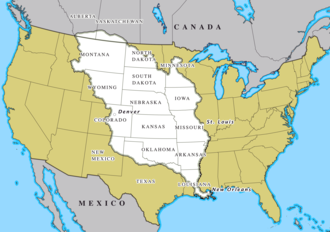
As president, Jefferson did many important things. He helped protect American ships from attacks by Barbary pirates and made a big deal happen called the Louisiana Purchase, which added a huge amount of land to the United States. He also sent explorers, Lewis and Clark, to learn more about this new land. Jefferson is remembered for supporting freedom of thought, speech, and religion, even though he also owned many slaves, which was a sad and complicated part of his life.
Early life and education
Main article: Early life and career of Thomas Jefferson
Thomas Jefferson was born on April 13, 1743, at Shadwell Plantation in Virginia, which was part of British America at the time. He was one of ten children. His father was a planter and surveyor, and his mother came from a well-known family. When Thomas was young, his family moved to another plantation, but they returned to Shadwell a few years later.
Jefferson started his education with tutors and later went to school, learning languages like Latin, Greek, and French. He also studied subjects such as history, science, and riding horses. After his father passed away, Thomas inherited some land where he would later build his home, Monticello. At age eighteen, Jefferson went to the College of William & Mary, where he studied many subjects and met teachers who encouraged his love for learning. He spent a lot of time reading and discussing important ideas with his teachers and friends. After finishing his studies, Jefferson began learning law and worked as a law clerk. He also kept books filled with notes and quotations throughout his life. Sadly, his sister Jane passed away when he was young, which made him very sad for many months. Jefferson loved books so much that he built three large libraries in his lifetime, even selling one to help rebuild the Library of Congress after it was destroyed by fire.
Career
Main article: Early life and career of Thomas Jefferson
Thomas Jefferson started his career as a lawyer in 1767. He worked in Virginia’s government, called the House of Burgesses, from 1769 to 1775. During this time, he tried to help enslaved people gain freedom. He believed everyone should have the right to be free, a idea he later used in the Declaration of Independence.
Jefferson also built his home, Monticello, near Charlottesville, Virginia. He designed it himself and worked on it for many years. In 1772, he married Martha Wayles Skelton. They had six children, but only two lived to adulthood. Sadly, Martha passed away in 1782, and Jefferson was very sad.
Revolutionary War
Declaration of Independence
Main article: United States Declaration of Independence
Thomas Jefferson was the main writer of the Declaration of Independence. When he was 33, he was one of the youngest people in the Second Continental Congress, which met in Philadelphia after the Battles of Lexington and Concord started the American Revolutionary War in 1775. The Congress wanted to declare their independence from Britain. Jefferson was inspired by ideas about individual rights and the writings of Locke and Montesquieu.
Jefferson worked with John Adams, Benjamin Franklin, Robert R. Livingston, and Roger Sherman to write the Declaration. Jefferson mostly wrote it alone from June 11 to June 28, 1776. The Congress made some changes before voting to approve it on July 4, 1776. The Declaration was shared with the public and read in places like Trenton, New Jersey, Easton, Pennsylvania, and Philadelphia.
Virginia state legislator and governor
At the start of the American Revolution, Jefferson became a leader in the Virginia House of Delegates. He helped write laws for Virginia, including ideas about education and freedom of religion. In 1779 and 1780, he served as governor of Virginia. He moved the state capital to Richmond and worked on laws to help people and improve schools.
Notes on the State of Virginia
Main article: Notes on the State of Virginia
In 1780, Jefferson answered questions about Virginia for a French diplomat. He wrote a book called Notes on the State of Virginia in 1785. The book talked about Virginia’s land, history, and people, including his thoughts on important social issues. The book was first published in French and later in English.
Member of Congress
Further information: Congress of the Confederation
Thomas Jefferson joined the Congress of the Confederation after peace was made with Great Britain in 1783. He helped set up money systems and suggested using a decimal system for American money, which was later used. Jefferson also helped create a plan for governing when Congress was not in session.
Jefferson wrote important papers to help set up rules for the new United States. He was the main writer of a plan that said Virginia would give up a big area of land northwest of the Ohio River to the country. He wanted this land to be divided so new states could form there, not just be controlled by the original thirteen states. He also tried to make a rule that would stop slavery in these new lands, but this idea was changed later.
Minister to France
In 1784, Thomas Jefferson was chosen to join Benjamin Franklin and John Adams in Paris to help make important agreements with other countries. He traveled there with his young daughter and two servants, arriving the next month. During his time in Paris, Jefferson became the main American representative in France after Franklin.
Jefferson made many friends in France, including the Marquis de Lafayette, a hero from the American Revolution. He helped arrange trade deals between the United States and France. When the French Revolution began, Jefferson allowed his home in Paris to be used for meetings by leaders of the revolution, including Lafayette.
Jefferson left Paris and returned to America in 1789. He supported the ideas of the French Revolution but was against the violent parts of it.
Secretary of State
See also: First Party System and Relationship of Alexander Hamilton and Thomas Jefferson
After coming back from France, Thomas Jefferson agreed to become the Secretary of State under President Washington. At that time, important issues like the national debt and deciding where to place the new national capital after moving it from Philadelphia in 1800 caused disagreements. Jefferson and President Washington wanted the capital to be further south, while Alexander Hamilton, the Secretary of the Treasury, preferred it to be closer to big business centers in the Northeast. They finally agreed to put the capital on the Potomac River, and the federal government took on the war debts of all the original 13 states.
Jefferson did not agree with having a national debt; he thought each state should handle its own debt. This was different from Hamilton's plan for the federal government to collect state debts and create a national bank. Because of these differences, Jefferson almost lost his job and eventually chose to leave the government team on his own.
Jefferson wanted to reduce America's reliance on British trade and increase trade with France. He also aimed to weaken control by Spain in areas west of the Appalachian Mountains and British influence in the northern areas, hoping this would help peaceful relations with Native Americans. Along with James Madison and Philip Freneau, Jefferson started a newspaper in Philadelphia called the National Gazette in 1791. The newspaper opposed the policies of the Federalist Party, which Hamilton supported through another newspaper.
In 1792, Jefferson asked President Washington to run for another term to help unite the country and protect democracy from the influence of banks and financial interests that the Federalists supported. Jefferson, Madison, and others believed in states' rights and local control rather than strong federal power.
When France and Britain went to war in 1793, Jefferson supported France. However, a French representative did not respect President Washington, weakening Jefferson's arguments. Jefferson also tried to get Britain to leave their posts in the northwest and to compensate the U.S. for people enslaved who had been freed by the British after the Revolutionary War. He stepped down as Secretary of State in December 1793, partly to have more influence in politics from outside the government.
After Washington’s administration made a treaty with Britain in 1794, Jefferson used it to bring together opposition for the Democratic-Republican Party. The treaty, created by Hamilton, was meant to lower tensions and boost trade. Jefferson argued it would give too much power to Britain and harm democratic values, but the treaty was approved. It ended in 1805 during Jefferson’s presidency, and he chose not to renew it. Jefferson kept supporting France, even during a tough time in their revolution, believing that leaving France would hurt democratic values in America.
Election of 1796 and vice presidency
Main article: Vice presidency of Thomas Jefferson
Further information: 1796 United States presidential election and Democratic-Republican Party
In the presidential campaign of 1796, Thomas Jefferson lost to John Adams but received the second-highest number of votes. At that time, the person with the second-most votes became vice president, so Jefferson became vice president of the United States. As vice president, Jefferson worked in the United States Senate, overseeing discussions and handling only important procedural matters. He had studied rules for many years, so he was well-prepared for this job.
Election of 1800
Main article: 1800 United States presidential election
Jefferson ran for president again in 1800 against John Adams. The election was very heated, with both sides saying bad things about each other. Jefferson’s party, the Democratic-Republicans, won more votes in the electoral college. However, Jefferson and his running mate, Aaron Burr, tied in votes. This meant the U.S. House of Representatives had to choose the president. After many votes, they chose Jefferson. This was important because it showed that even when political parties disagree strongly, the country can still change leaders peacefully.
Presidency (1801–1809)
Main article: Presidency of Thomas Jefferson
Jefferson became president on March 4, 1801, after being chosen by voters. Unlike earlier leaders, he preferred simple ways and walked to his ceremony instead of using a fancy carriage. In his speech, he talked about unity and important ideas like freedom of speech and religion.
Jefferson made several key choices for his team, including James Madison as the person in charge of foreign affairs. He also asked Dolley Madison, the wife of his friend James, to help manage events at the White House.
Jefferson faced many challenges during his time as president. One big goal was to reduce the country’s debt. He worked with his team to cut costs and taxes. He also believed in a strong military but thought the navy didn’t need to be very large during peaceful times.
Jefferson supported creating schools for training military leaders and showed great interest in building up the country’s library. He also worked to protect the rights of people who were not from Europe, though his actions on this were mixed and sometimes caused disagreement.
In foreign matters, Jefferson dealt with issues like pirates who attacked American ships and worked to expand the country’s land through the Louisiana Purchase, which doubled the size of the United States. He also organized trips to explore the new lands.
During his second term, Jefferson faced tough times with other countries, especially Britain and France, which led to difficult laws that affected trade. He also dealt with personal conflicts, including one involving his vice president, Aaron Burr.
Post-presidency (1809–1826)
After leaving the presidency, Jefferson stayed active and kept writing to many leaders in the country. One of his friends, Monroe, became president after him and used ideas Jefferson shared in 1823 for important decisions.
University of Virginia
Main article: University of Virginia
Jefferson wanted to create a university without church control. Students could choose new subjects not offered elsewhere. He believed education helped build a stable society and should be available to everyone based on ability, not wealth. In 1819, he started the University of Virginia. He helped plan the buildings and the courses. The university opened in 1825, and Jefferson served as its first leader.
Jefferson loved the architecture of ancient Greece and Rome and thought it best represented American democracy. The university's buildings, called pavilions, had designs inspired by these styles. The center of the university had a library instead of a church, showing its focus on learning rather than religion.
Reconciliation with Adams
Jefferson and John Adams were friends early in their careers but later disagreed due to political differences. After many years without speaking, they began writing to each other again in 1812. Over the next 14 years, they exchanged many letters, sharing their thoughts and discussing important events.
Autobiography
In 1821, Jefferson began writing about his life, focusing on important events up to 1790. He talked about his family, his education, and his role in the American Revolution. He believed in a society led by people of virtue and talent rather than just wealthy landowners.
Greek War of Independence
Thomas Jefferson supported the Greek War of Independence and shared his ideas with a Greek scholar, Adamantios Korais. He advised on building a government similar to the United States and suggested a classical education for Greece.
Lafayette's visit
Main article: Visit of the Marquis de Lafayette to the United States
In 1824, the Marquis de Lafayette visited the United States. Jefferson and Lafayette met again after many years. They shared memories and celebrated together at the University of Virginia.
Final days, death, and burial
See also: Death of John Adams
Jefferson worried about his debts in his final months. His health declined, and he stayed in bed by June 1826. He died on July 4, 1826, the 50th anniversary of the Declaration of Independence. Jefferson was buried at Monticello, with a simple marker he wrote himself.
Political, social, and religious views
Thomas Jefferson was inspired by thinkers like John Locke, Francis Bacon, and Isaac Newton. He believed in simple, rural living and distrusted big cities and wealthy bankers. He wanted government to be closer to the people and supported separating church and state.
Jefferson valued personal freedom and thought citizens should have the right to make their own choices. He believed in a strong jury system to protect people’s rights. As president, he tried to balance power between state and federal governments. He supported public education and a free press as important for a healthy democracy.
Jefferson had his own ideas about religion. He didn’t follow traditional Christian teachings and instead focused on the teachings of Jesus that he felt were important. He believed in a creator but didn’t agree with all traditional Christian beliefs. He supported the right for people to practice their own religion freely.
Interests and activities
Thomas Jefferson loved learning about many things. He was a farmer who tried new ways to grow crops like tobacco, wheat, and vegetables. He also tried to grow grapes to make wine but had trouble with it. Jefferson taught himself about buildings and helped make famous places look beautiful.
Jefferson was also interested in digging up old places to learn about the past. He studied birds, natural wonders, and talked with other smart people about science. He joined a group called the American Philosophical Society to share ideas and help others learn.
Jefferson could speak many languages, including French, Greek, and German. He liked studying old languages to understand how words change over time. He also invented useful things like a special chair and a clock that used gravity to keep time. His ideas helped improve tools and made life easier for many people.
Legacy
Historical reputation
Main article: Historical reputation of Thomas Jefferson
Thomas Jefferson is remembered as a big champion of freedom and democracy. He wrote the Declaration of Independence, which helped start the United States. Many people think he was one of the best presidents because he believed in giving people more say in their government.
Memorials and honors
Further information: List of places named for Thomas Jefferson
Jefferson has many memorials to honor him. His face is carved on Mount Rushmore along with three other important presidents. There is also a special building called the Jefferson Memorial in Washington, D.C., with a big statue of him inside. He has appeared on money, like the two-dollar bill and the nickel coin, as well as many stamps.
Several plants and animals have been named after Jefferson too. For example, a special flower is called Jeffersonia, and there is a fossil named after him as well.
Writings
Thomas Jefferson wrote many important documents that helped shape the United States. Some of his well-known works include A Summary View of the Rights of British America from 1774 and the Declaration of the Causes and Necessity of Taking Up Arms from 1775. Most famously, he was the main author of the Declaration of Independence in 1776, which announced the colonies' separation from Britain. He also wrote about many topics, including a journey through France and Italy in 1787 and thoughts on the state of Virginia in 1781. Later in life, he created a special Bible focusing on the life and teachings of Jesus, called the Jefferson Bible.
Images
Related articles




This article is a child-friendly adaptation of the Wikipedia article on Thomas Jefferson, available under CC BY-SA 4.0.
Images from Wikimedia Commons. Tap any image to view credits and license.