 Safekipedia
Pyrenees
Adapted from Wikipedia · Explorer experience
The Pyrenees
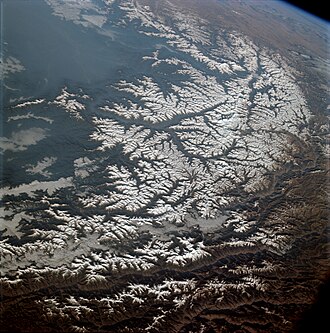
The Pyrenees are a beautiful mountain range in southwestern Europe. They form a natural border between France and Spain. These tall mountains stretch nearly 500 kilometres (310 miles) from where they meet the Cantabrian Mountains to the tip called Cap de Creus on the Mediterranean coast. The highest point is Aneto, which rises to 3,404 metres (11,168 feet) above sea level, located in Huesca in Spain.
The Pyrenees divide two countries and create a lovely landscape with valleys, rivers, and forests. A small country called Andorra lies within the Pyrenees, making it one of the most mountainous nations in the world. For hundreds of years, the Pyrenees have been important in history, with ancient kingdoms like the Crown of Aragon and the Kingdom of Navarre developing on both sides of the mountains.
Today, the Pyrenees are a popular place for people to explore through hiking, skiing, and enjoying the peaceful natural beauty. The mountains provide a special home for many plants and animals, some found nowhere else on Earth. Whether you’re interested in adventure, history, or nature, the Pyrenees offer something wonderful for everyone to discover.
In Greek mythology, Pyrene was a princess, and the name of the Pyrenees comes from her. Some stories say the name comes from a Greek word for fire. One story tells of herdsmen who left a fire that burned across the mountains. People named the mountains after the fire.
The Pyrenees have three main parts: the Western, Central, and Eastern Pyrenees. The Central Pyrenees have the tallest mountains, including Pico de Aneto, Pico Posets, and Monte Perdido. Smaller hills and lower mountains, called foothills, are mostly on the Spanish side. The French side has steeper slopes with fewer foothills.
The Pyrenees have many special sights. You won’t find big lakes, but there are many fast-flowing streams called gaves that create tall waterfalls. Some of the biggest waterfalls in Europe are here, like the one at Gavarnie. Because the paths are high up, tunnels have been built to help people travel through the mountains more easily. One famous spot is La Brèche de Roland, a gap in the mountains said to have been made by a hero in old stories.
The Pyrenees are home to animals that live only in this mountain range. One such animal is the Pyrenean desman, a small water creature found in some streams on the northern side of the mountains. Another special animal is the Pyrenean brook salamander, which lives in cold, high-altitude streams and lakes. The Pyrenean ibex, a type of wild goat, was lost in the year 2000, but another similar type of ibex from western Spain was brought in, and today there are over 400 of them. Brown bears were almost gone from the Pyrenees by the 1990s, but a small group was brought from Slovenia in 1996. These bears have had healthy families, and today there are thought to be about 15 brown bears living in the central part of the Pyrenees.
The Pyrenees mountains have special natural areas where animals and plants are protected. These include Ordesa y Monte Perdido National Park and Aigüestortes i Estany de Sant Maurici National Park in Spain, and Pyrénées National Park in France. In 1997, parts of these parks were named a special place on the UNESCO World Heritage List for their beautiful shapes and old farming ways.
The Pyrenees have many traditions and stories. Many places are home to people here, such as Ariège, the Basque Country, Béarn, Catalonia, Navarre, and Roussillon. The main languages are Spanish and French, along with others like Aragonese, Catalan, and Basque. Some people also speak Occitan language, which includes dialects like Gascon and Languedocien in France, and Aranese in the Aran Valley.
Both sides of the Pyrenees are popular for winter activities like alpine skiing and mountaineering. In warmer months, people enjoy training here by bicycling and running. During summer and autumn, the Pyrenees host important cycling races such as the Tour de France and the Vuelta a España. These races bring many fans to the area.
There are three long walking paths through the mountains: the GR 10 on the northern side, the GR 11 on the southern side, and the HRP along the highest peaks. Many other paths are marked for hikers.
Images
Related articles


This article is a child-friendly adaptation of the Wikipedia article on Pyrenees, available under CC BY-SA 4.0.
Images from Wikimedia Commons. Tap any image to view credits and license.