 Safekipedia
Discovery and exploration of the Solar System
Adapted from Wikipedia · Discoverer experience
Discovery and exploration of the Solar System is the study and visit to our cosmic neighborhood. This includes the Sun, Earth and the Moon, the major planets Mercury, Venus, Mars, Jupiter, Saturn, Uranus, and Neptune, their satellites, as well as smaller bodies like comets, asteroids, and dust.
In ancient times, people could only see the Sun, the Moon, the five classical planets, and comets with their eyes. They also saw things in Earth's sky like meteors and aurorae. The invention of the telescope helped scientists discover moons and rings around planets, new planets, and asteroids.
Robotic space probes, human landings on the Moon through the Apollo program, and space telescopes have helped us learn much more about other planets. Today, we know the Solar System is just one of many planetary systems in our galaxy. The word "solar" comes from the Latin word for Sun, Sol. Anything from or related to the Sun is called "solar", like the solar wind.
Pre-telescope
See also: Planet § History, History of astronomy, Timeline of Solar System astronomy, and Historical models of the Solar System
The first humans could only see a few objects in the sky, like the Sun, the Moon, and a few bright stars they called planets. They noticed the Sun helped create day and night, and the Moon helped them measure time and seasons.
Ancient people around the world had different ideas about how the universe worked. Many thought Earth was the center of everything, with the sky moving around it. Some thought Earth was round, while others had other shapes in mind. They often linked planets to gods because these objects moved differently across the sky.
One important discovery was realizing that the bright object seen at sunrise and the bright object seen at sunset were actually the same planet, Venus.
Later, some thinkers suggested that Earth and the planets all move around the Sun instead. One famous idea came from Nicolaus Copernicus, who said Earth and the planets orbit the Sun. Another scientist, Johannes Kepler, discovered that planets move in oval shapes called ellipses, not perfect circles.
It took time for these new ideas to spread around the world. Even during explorations, some places still used the older ideas about the sky.
Telescopic observations
See also: Timeline of discovery of Solar System planets and their moons
Early telescopic discoveries
See also: Scientific Revolution
The invention of the telescope changed astronomy forever. It let people see details about the Sun, Moon, and planets that were invisible to the naked eye. The telescope was invented around 1608 in the Netherlands and quickly became a tool for astronomers.
Italian scientist Galileo Galilei was one of the first to use a telescope. He made many important discoveries. He saw that the Moon had craters, that the Sun had sunspots, and that Jupiter had four moons orbiting it. Christiaan Huygens later found Titan, a moon of Saturn, and saw the shape of Saturn’s rings. Giovanni Domenico Cassini discovered more moons of Saturn and a gap in its rings called the Cassini division.
Around 1677, Edmond Halley watched Mercury pass in front of the Sun. This helped him understand how to measure distances in space. In 1705, Halley noticed that a comet returned every 75–76 years. This was the first proof that something besides planets orbited the Sun. Around 1704, the term “Solar System” was used for the first time.
Newtonian physics
The English scientist Isaac Newton explained how planets move. He thought a force called gravity pulled all objects in the Solar System toward each other. Newton’s ideas, published in 1687, helped explain both space and Earth’s physics.
Discovery of additional planets and moons
Telescopes allowed scientists to find objects too faint to see without them. In 1781, William Herschel discovered Uranus, a new planet. In 1801, Giuseppe Piazzi found Ceres, a small world between Mars and Jupiter. More small worlds were found there, and they were called asteroids.
By 1846, the orbit of Uranus didn’t quite match what scientists expected. This led to the discovery of Neptune. Later, moons were found around Uranus, Neptune, and Mars.
In 1930, Pluto was discovered. It was once thought to be a planet but was later reclassified.
More technical improvements
In 1668, Isaac Newton built a new kind of telescope that helped scientists see better. In 1840, the first picture of the Moon was taken. New tools like spectroscopy let scientists study what objects in space are made of.
By the mid-20th century, new technologies like radar and radio astronomy changed how we study space.
Discovery of the solar system as one among many
In the past, people thought the stars were fixed on a giant sphere around Earth. But with telescopes, scientists saw that the stars were very far away. The Sun was just one star among many.
In the 1800s, scientists measured distances to nearby stars and studied their light. This showed that the Sun was a star like others, and that other stars might have planets too.
Extrasolar planets and the Kuiper belt
In 1992, the first planets around a star other than the Sun were found. By 2022, over 5,000 such planets were known.
Also in 1992, scientists found the first object in the Kuiper belt, a group of icy worlds beyond Neptune. Later, many more objects were found there, including Pluto.
Observations by radar
Main article: Radar astronomy
Radar astronomy is a way to study objects in space by sending out radio waves or microwaves and looking at the signals that bounce back. This helps us learn about the shapes and surfaces of objects that we can’t see clearly in other ways. Radar can also tell us exactly where these objects are and how they move, especially when they are small, like comets and asteroids. In some cases, radar can even create images as detailed as 7.5 meters across.
The Moon was one of the first objects studied with radar, beginning in 1946. Scientists used it to measure how far the Moon is from Earth and to study its surface. Other objects studied with radar include:
- Mercury – Helped measure its distance from Earth and study its rotation and surface.
- Venus – First seen with radar in 1961. It helped measure the distance between Earth and the Sun. The Magellan mission mapped the whole planet using radar because Venus’s thick clouds block regular images.
- Earth – Radars from airplanes and spacecraft have mapped large areas of our planet, like the Shuttle Radar Topography Mission.
- Mars – Scientists have mapped its surface roughness and used special radar tools on the Mars Express mission.
- Jupiter system – Studied its moon Europa.
- Saturn system – Looked at its rings and the moon Titan. The Cassini spacecraft mapped Titan’s surface, just like on Venus.
By 2018, radar had observed many asteroids and comets, helping us learn more about these objects in our solar system.
Observations by spacecraft
See also: Space technology and Space exploration
Since the beginning of the Space Age, many robots have been sent to explore our Solar System. These spacecraft have visited all the planets, their big moons, and some asteroids and comets. They have taken pictures and done tests on the surfaces and atmospheres of some planets and moons.
The first object made by humans to go into space was the Soviet satellite _Sputnik 1, launched in 1957. The first satellite to take a picture of Earth from space was the American probe _Explorer 6, launched in 1959.
In 1966, the Moon was the first object beyond Earth to be circled by a satellite (Luna 10). Later, satellites orbited Mars, Venus, Jupiter, and many smaller worlds. The first spacecraft to land on another world was the Soviet Luna 2 probe, which hit the Moon in 1959. Since then, landers have reached Venus, Mars, an asteroid, Saturn’s moon Titan, and comets.
As of 2022, rovers have driven on the Moon, Mars, and the asteroid Ryugu. The first rover on another world was the Soviet _Lunokhod 1, which drove on the Moon in 1970. The first rover on a planet was _Sojourner, which explored Mars in 1997. In 2020, Ingenuity made the first powered flight on another world.
Sometimes, spacecraft bring back pieces of other worlds to Earth. We have samples from the Moon, asteroids, comet dust, and even solar wind.
See also the categories for missions to comets, asteroids, the Moon, and the Sun.
| # | Spacecraft | Launch year | Mercury | Venus | Mars | Ceres | Jupiter | Saturn | Uranus | Neptune | Pluto | End year |
|---|---|---|---|---|---|---|---|---|---|---|---|---|
| 1 | Venera 3 | 1965 | Crash landing | 1966 | ||||||||
| 2 | Pioneer 10 | 1972 | Flyby | 2003 | ||||||||
| 3 | Pioneer 11 | 1973 | Flyby | Flyby | 1995 | |||||||
| 4 | Mariner 10 | 1973 | Flyby | Flyby | 1975 | |||||||
| 5 | Voyager 1 | 1977 | Flyby | Flyby | — | |||||||
| 6 | Voyager 2 | 1977 | Flyby | Flyby | Flyby | Flyby | — | |||||
| 7 | Galileo | 1989 | Flyby | Orbiter | 2003 | |||||||
| 8 | Ulysses | 1990 | Flyby | 2009 | ||||||||
| 9 | Cassini | 1997 | Flyby | Flyby | Orbiter | 2017 | ||||||
| 10 | Mars Odyssey | 2001 | Orbiter | — | ||||||||
| 11 | MER-A / B | 2003 | Rovers | 2010 / 2018 | ||||||||
| 12 | Mars Express | 2003 | Orbiter | — | ||||||||
| 13 | MESSENGER | 2004 | Orbiter | Flyby | 2015 | |||||||
| 14 | MRO | 2005 | Orbiter | — | ||||||||
| 15 | Venus Express | 2005 | Orbiter | 2014 | ||||||||
| 16 | New Horizons | 2006 | Flyby | Flyby | — | |||||||
| 17 | Dawn | 2007 | Orbiter | 2018 | ||||||||
| 18 | Juno | 2011 | Orbiter | — | ||||||||
| 19 | Curiosity (MSL) | 2011 | Rover | — | ||||||||
| 20 | Tianwen-1 | 2020 | Orbiter | — | ||||||||
| 20 | Zhurong | 2020 | Rover | — | ||||||||
| 21 | Perseverance (Mars 2020) | 2020 | Rover | — | ||||||||
| 21 | Ingenuity (Mars 2020) | 2020 | Flying probe | — |
Crewed exploration
The first person to travel into space and orbit Earth was Yuri Gagarin, a Soviet cosmonaut, who flew in Vostok 1 on April 12, 1961. The first person to walk on another world in our Solar System was Neil Armstrong, who stepped onto the Moon on July 21, 1969, during the Apollo 11 mission. After that, there were five more landings on the Moon before 1972. The United States developed a reusable Space Shuttle that flew many missions from 1981 to 2011.
The first space station to host more than one crew was NASA’s Skylab, which had three crews from 1973 to 1974. Later, the Soviet space station Mir was lived in continuously for almost ten years, from 1989 to 1999. Today, the International Space Station has had people living and working there since 2001. In 2004, the President of the United States shared plans for new space missions, including going back to the Moon and eventually sending people to Mars.
Further information: Human spaceflight and Space exploration
Exploration by country
See also: Timeline of first orbital launches by country
Legend
☄ – orbit or flyby
❏ - Space observatory
Ѫ – successful landing on an object
⚗ – sample return
⚘ – crewed mission
ↂ – permanent inhabited space station
| Country or organisation | LEO | Moon | Mars | Mars moons | SSSBs | Venus | Mercury | Outer Solar System |
|---|---|---|---|---|---|---|---|---|
 United States United States | ☄❏⚘ↂ | ☄❏Ѫ⚗⚘ | ☄Ѫ | ☄ | ☄Ѫ⚗ | ☄Ѫ | ☄ | ☄ |
 Soviet Union Soviet Union | ☄❏⚘ↂ | ☄Ѫ⚗ | ☄Ѫ | ☄ | ☄ | ☄Ѫ | ||
 China China | ☄❏⚘ↂ | ☄❏Ѫ⚗ | ☄Ѫ | ☄ | ||||
 Russia (since 1992) Russia (since 1992) | ☄❏⚘ↂ | |||||||
 Japan Japan | ☄❏ↂ | ☄Ѫ | ☄Ѫ⚗ | ☄ | ||||
 ESA ESA | ☄❏ↂ | ☄ | ☄ | ☄ | ☄Ѫ | ☄ | ☄Ѫ | |
 India India | ☄❏ | ☄Ѫ | ☄ | |||||
 Israel Israel | ☄ | ☄ | ||||||
 South Korea South Korea | ☄ | ☄ | ||||||
 United Arab Emirates United Arab Emirates | ☄ | |||||||
 Iran Iran | ☄ | |||||||
 Ukraine (since 1992) Ukraine (since 1992) | ☄ | |||||||
 North Korea North Korea | ☄ | |||||||
 New Zealand New Zealand | ☄ | |||||||
| Commercial | ☄⚘ | ☄Ѫ |
Exploration survey
Many objects in our Solar System have been seen up close by spacecraft. Some of the biggest include the Sun, Jupiter, Saturn, Uranus, Neptune, Earth, Venus, Mars, and their moons like Ganymede, Titan, Mercury, and Moon. We have also seen smaller objects like asteroids and comets from closer looks.
Some objects have only been seen from far away. You can find more information about these at "Near-Earth object".
| Satellites | |||||||
|---|---|---|---|---|---|---|---|
| Jupiter | Saturn | Uranus | Neptune | Pluto | |||
 Metis Metis |  Polydeuces Polydeuces |  Puck Puck |  Nereid Nereid |  Despina Despina |  Larissa Larissa |  Kerberos Kerberos |  Styx Styx |
| Selected asteroids, by number | Selected comets | ||||||
 3 Juno 3 Juno |  6 Hebe 6 Hebe |  13 Egeria 13 Egeria | 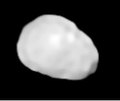 15 Eunomia 15 Eunomia |  16 Psyche 16 Psyche |  29 Amphitrite 29 Amphitrite |  Halley's Halley's |  Hyakutake Hyakutake |
 41 Daphne 41 Daphne | 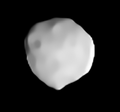 324 Bamberga 324 Bamberga | 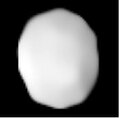 511 Davida 511 Davida |  704 Interamnia 704 Interamnia |  5535 Annefrank 5535 Annefrank |  9969 Braille 9969 Braille |  Holmes Holmes |  Giacobini–Zinner Giacobini–Zinner |
 94 Aurora 94 Aurora |  107 Camilla 107 Camilla |  423 Diotima 423 Diotima |  121 hermione 121 hermione | 423 Diotima |  532 Herculina 532 Herculina | 419 Aurelia |  52 Europa 52 Europa |
 409 Aspasia 409 Aspasia |  387 Aquitania 387 Aquitania | 386 Siegena |  360 Carlova 360 Carlova |  22 Kalliope 22 Kalliope |  283 Emma 283 Emma |  250 Bettin 250 Bettin | 233 Asterope |
 165 Loreley 165 Loreley |  146 Lucina 146 Lucina |  144 Vibilia 144 Vibilia |  129 Antigone 129 Antigone | 146 Lucina | 144 Vibilia |  135 Hertha 135 Hertha |  121 hermione 121 hermione |
| Trans-Neptunian objects (TNO), named and/or with radius above 200 km, ordered by size | |||||||
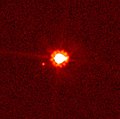 Eris Eris |  Haumea Haumea |  Makemake Makemake |  Gonggong Gonggong |  Quaoar Quaoar |  Sedna Sedna |  Orcus Orcus |  Salacia Salacia |
 Varda Varda |  Ixion Ixion |  Varuna Varuna |  Gǃkúnǁʼhòmdímà Gǃkúnǁʼhòmdímà |  Dziewanna Dziewanna |  Huya Huya | ||
Images
Related articles



This article is a child-friendly adaptation of the Wikipedia article on Discovery and exploration of the Solar System, available under CC BY-SA 4.0.
Images from Wikimedia Commons. Tap any image to view credits and license.